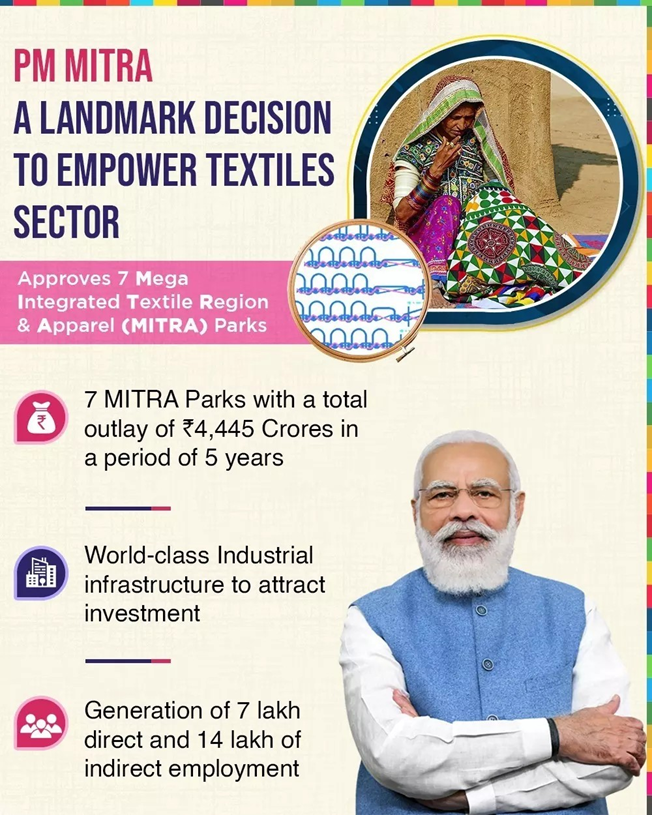
Core Vision and Mandate :-
- Launch & Nodal Ministry: Notified by the Ministry of Textiles (2021); operational period from 2021-22 to 2027-28.
- The ‘5F’ Vision: Inspired by the Prime Minister’s vision of Farm to Fibre to Factory to Fashion to Foreign.
- Objective: To develop integrated, large-scale, and modern industrial infrastructure for the entire textile value chain (spinning, weaving, processing, garmenting) at a single location.
- Site Type: Parks can be developed as either Greenfield or Brownfield projects.
How will the Scheme be Implemented?
- Execution Model: Developed by a Special Purpose Vehicle (SPV) owned by the Central and State Governments in Public Private Partnership (PPP) mode.
- Infrastructure: Each park will house an incubation centre, common processing house, Common Effluent Treatment Plant (CETP), and design/testing centres.
- Selection Criteria: Requires a contiguous, encumbrance-free land parcel of at least 1000 acres, supported by a conducive State Textile/Industrial Policy.
What is the Financial Support Framework?
- Development Capital Support (DCS): The Ministry of Textiles provides up to Rs 500 crore per park to the SPV for infrastructure development.
- Competitive Incentive Support (CIS): Up to Rs 300 crore per park is provided to manufacturing units to incentivize speedy implementation.
- Convergence: Facilitates integration with other Government of India schemes to offer additional incentives to Master Developers and investors.
Why is this Scheme Strategically Crucial?
- Logistics Optimization: By clustering the value chain, it significantly reduces logistics costs (a major hurdle for exports) and minimizes wastage.
- FDI Magnet: Aims to reverse the low trend of Foreign Direct Investment in textiles (only 0.69% of total FDI inflows from 2000-2020).
- Employment Generation: An investment of Rs 70,000 crore is projected to create approx. 20 lakh jobs (1 lakh direct and 2 lakh indirect jobs per park).
- Global Competitiveness: Aligns with SDG 9 (Resilient Infrastructure) and enhances the global standing of Indian textiles.
Where does India’s Textile Sector Stand Today?
- Economic Contribution: Accounts for >2% of total GDP and >12% of manufacturing GDP.
- Employment Hub: The 2nd largest employer after agriculture, supporting 45 million (direct) and 60 million (indirect) workers.
- Export Prowess: India is the 6th largest exporter globally (4% share); FY22 exports stood at USD 44.4 billion (41% YoY growth).
Complementary Initiatives :-
- PLI Scheme for Textiles.
- National Technical Textiles Mission.
- SAMARTH: Scheme for Capacity Building in the Textile Sector.
- ATUFS: Amended Technology Up-gradation Fund Scheme (for capital investment subsidy).
Q. Which of the following descriptions accurately represents the operational and financial structure of the PM MITRA Parks Scheme?
(a) It is a Central Sector Scheme where the entire funding is borne by the Union Government to establish parks exclusively on Greenfield sites.
(b) The scheme utilizes a Special Purpose Vehicle (SPV) with the State Government holding a majority stake, providing Development Capital Support for core infrastructure creation.
(c) It mandates the selection of sites solely through a nomination method by the Central Government, bypassing the need for State Government participation.
(d) The financial incentives are limited to Competitive Incentive Support (CIS) which is provided exclusively to the Master Developer for land acquisition.

Answer: (b)

Explanation:
Option (b) is correct: The PM MITRA parks are developed by a Special Purpose Vehicle (SPV) owned by the Central and State Governments (State holding 51%, Centre 49%). The Ministry of Textiles provides Development Capital Support (DCS) to the SPV (up to ₹500 Cr for Greenfield) for the creation of core infrastructure like incubation centres and effluent treatment plants.
Option (a) is incorrect: The scheme covers both Greenfield and Brownfield sites and operates in a Public Private Partnership (PPP) mode, not as a purely Central Sector scheme.
Option (c) is incorrect: Sites are selected through a transparent ‘Challenge Method’ based on criteria like land availability and state industrial ecosystem, not by direct central nomination.
Option (d) is incorrect: The scheme includes both DCS (for infrastructure) and Competitive Incentive Support (CIS). CIS is provided to the manufacturing units (up to ₹300 Cr) for speedy implementation, not for land acquisition.