Context
Recently, the Supreme Court of India highlighted concerns over the misuse of the Protection of Children from Sexual Offences (POCSO) Act in consensual adolescent relationships and urged the Centre to consider introducing a “Romeo–Juliet clause” to balance child protection with personal liberty.
Introducing a “Romeo–Juliet clause” aims to exempt genuine consensual adolescent relationships- where the age difference between the parties is minimal-from the strict application of the POCSO law.
Historical Background
- Rising child sexual abuse cases in the 1990s–2000s exposed gaps in IPC provisions and the lack of child-friendly procedures. India’s ratification of the UN Convention on the Rights of the Child in 1992 created obligations to strengthen protection laws, leading to the enactment of the POCSO Act, 2012.
- United Nations Convention on the Rights of the Child (UNCRC)The UN Convention on the Rights of the Child (UNCRC), adopted in 1989 (came into force in 1990), is a legally binding international treaty outlining the civil, political, economic, social, and health rights of everyone under 18. India ratified the convention in 1992.
About POCSO Act
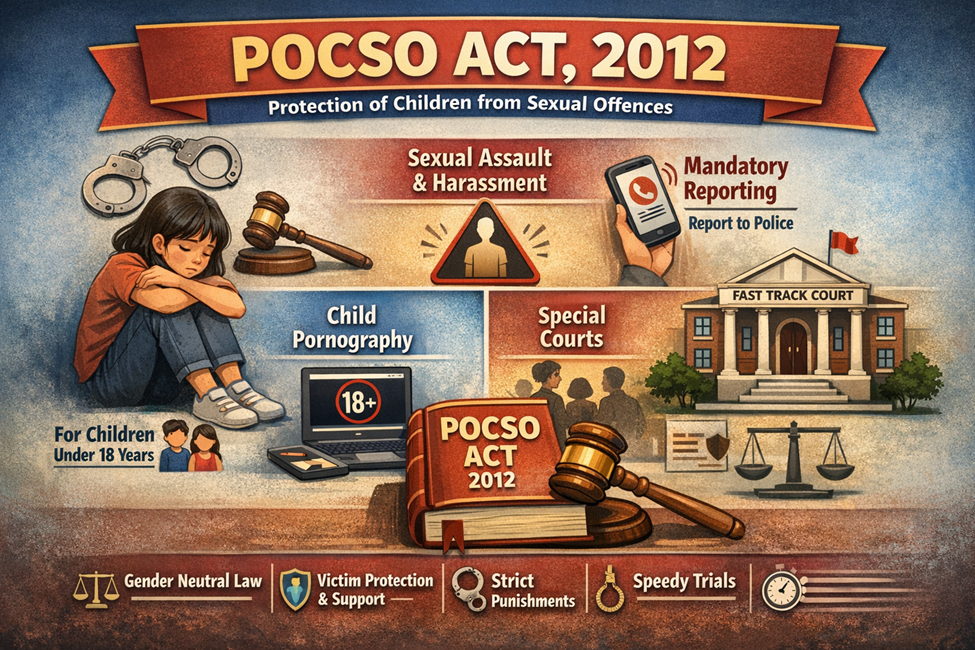
1. Enactment: The POCSO Act was passed in 2012 to provide a comprehensive legal framework for protecting children (below 18 years) from sexual offences.
2. Objective: To safeguard children from sexual assault, harassment, pornography, and ensure child-friendly justice procedures.
3. Gender-neutral law: Defines a child as any person below 18 years and applies irrespective of the gender of the child or offender.
4. Types of offences covered:
- Penetrative sexual assault
- Aggravated assault
- Sexual harassment
- Use of children in pornography
5. Not reporting abuse is an offence: A key and widely debated feature of the POCSO Act is mandatory reporting under Section 19, which requires anyone who suspects or knows of a sexual offence against a child to report it to the local police or the Special Juvenile Police Unit.
6. No time limit for reporting abuse: A victim can report an offence at any time, even a number of years after the abuse has been committed.
7. Maintaining confidentiality of the victim’s identity: Section 23 of the POCSO Act prohibits disclosure of the victim’s identity in any form of media, except when permitted by the special courts established under the act.
8. Special Courts: They ensure speedy, in-camera trials-ideally within one year-protect children from exposure to the accused or hostile questioning, and provide for compensation and rehabilitation of child victims.
9. The POCSO Amendment Act, 2019:
- It was enacted to strengthen the Protection of Children from Sexual Offences Act, 2012, introduced stricter punishments, including the death penalty, for aggravated sexual assault against children.
- The Act defines child pornography as an offence and penalises storing such material for commercial purposes with up to three years’ imprisonment, a fine, or both.
POCSO E-Courts and Fast-track Special Courts (FTSCs):
1. The Fast Track Special Courts (FTSCs) Scheme has been formulated exclusively for the expeditious trial of cases related to rape and offences under the POCSO Act and is funded through the Nirbhaya Fund, which is dedicated to initiatives aimed at enhancing the safety and security of women and children.
2. Structure: These courts are established under a Centrally Sponsored Scheme (initiated in 2019, extended to 2026) in districts with high pending cases.
3. Time-Bound Trial Mandate under POCSO Act: Investigation to be completed in 1 month and trial ideally within 1 year.
Consider the following statements regarding the provisions of the Protection of Children from Sexual Offences (POCSO) Act:

I. The Act defines a child as any person below eighteen years of age.

II. It is a gender neutral law.

III. Section 23 of the POCSO Act prohibits disclosure of the victim’s identity in any form of media.

Which of the statements given above is/are correct?

(a) I only
(b) II and III only
(c) I  and II only
(d) I, II and III

Answer: D

Explanation:
•  Statement I is Correct: Section 2(1)(d) of the POCSO Act explicitly defines a "child" as any person below the age of 18 years.
•  Statement II is Correct: The POCSO Act is a gender-neutral law, meaning it provides equal protection to both boy and girl children from sexual offences, unlike previous laws that were often gender-specific.
•  Statement III is Correct: Section 23 of the Act strictly prohibits the disclosure of a victim's identity (including name, address, or photograph) in any form of media to protect the child's privacy and prevent further trauma.