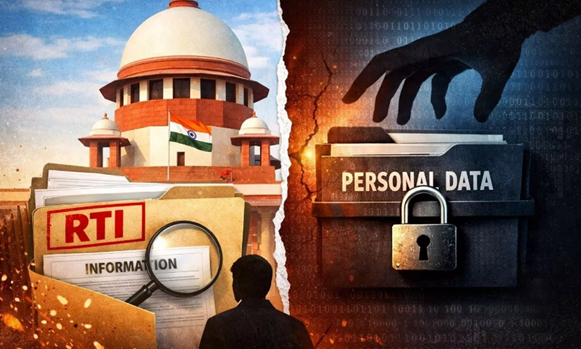
After Reading This Article You Can Solve This UPSC Mains Model Question:
The ‘Legitimate Uses’ framework of the DPDP Act, 2023, coupled with the dilution of the RTI Act, creates a ‘one-way mirror’ that undermines democratic accountability. Critically analyze this statement in the light of the emerging constitutional conflict between the Right to Know and the Right to Privacy. 250 Words, 15 Marks (GS-2, Polity and Governance)
CONTEXT
- Recently, the Supreme Court of India referred a series of petitions to a Constitution Bench to resolve the “constitutional sensitivity” arising from the Digital Personal Data Protection (DPDP) Act, 2023.
- These petitions challenge the amendment to Section 8(1)(j) of the Right to Information (RTI) Act, 2005, which critics label a “body blow” to democratic transparency.
- Chief Justice of India Surya Kant remarked that the Court must now legally define the boundaries of “personal information” to ensure that the fundamental right to know is not unfairly silenced by the right to privacy.
Background: Evolution of the Legal Framework
The current legal conflict represents a fundamental clash between two sets of rights, both of which are central to India’s constitutional fabric.
1. The RTI Act, 2005: The “Sunlight” Law
The RTI Act was not a mere administrative gift; it was the formal codification of a right already existing in the Constitution.
- Constitutional Basis: The “Right to Know” (Article 19)
- Clarity from State of UP v. Raj Narain (1975): In this landmark election case involving Prime Minister Indira Gandhi, the Supreme Court delivered a historic ruling. Justice Mathew famously observed:
“In a government of responsibility like ours… the people of this country have a right to know every public act, everything that is done in a public way, by their public functionaries.”
- The Logic: The Court held that Freedom of Speech and Expression (Article 19(1)(a)) is meaningless if citizens do not have the facts to speak about. You cannot express an opinion or hold a government accountable if you are kept in the dark. Thus, RTI is an inherent part of Article 19.
- The Philosophy: It moved the needle from “Official Secrecy” to “Public Trust,” establishing that information belongs to the people, and the State is merely its custodian.
- Later,in 1990s, the NGO Mazdoor Kisan Shakti Sangathan (MKSS), led by activists like Aruna Roy, started a massive movement in Rajasthan. They coined the famous slogan: “Hamara Paisa, Hamara Hisab” (Our Money, Our Accounts), demanding transparency in minimum wage payments and ration distribution.
- The Original Section 8(1)(j): A Balanced Exemption
- This was a calibrated safety valve. It didn’t ban the release of all personal data. It only protected information that:
- Had no relationship to any public activity or interest.
- Would cause an unwarranted invasion of an individual’s privacy.
- This was a calibrated safety valve. It didn’t ban the release of all personal data. It only protected information that:
- The “Public Interest” Override:
- Even if information was “personal,” it could still be disclosed if the Public Information Officer (PIO) found that the “larger public interest” outweighed the harm to the individual or justified the disclosure.
- The Golden Rule (Legislative Parity): The Act explicitly mandated that information which cannot be denied to Parliament or a State Legislature shall not be denied to any citizen.
2. The DPDP Act, 2023: The Privacy Shield
The 2023 Act introduces a new layer of protection for “Informational Privacy” in the digital age, following a redefined constitutional interpretation.
- Constitutional Basis: The “Right to Privacy” (Article 21)
- The Puttaswamy Landmark (2017): A 9-judge bench declared Privacy as a fundamental right under Article 21 (Right to Life and Personal Liberty).
- The Three-fold Test for State Interference: The Court ruled that the government can only restrict privacy if it satisfies three strict criteria:
- Legality: The restriction must be backed by a clear written law.
- Legitimate Aim: The State must have a valid reason (e.g., national security or social welfare).
- Proportionality: The restriction must be necessary and the least intrusive way to achieve the goal.
- The Amendment (Section 44(3)): The “Blanket Ban”
- The DPDP Act used Section 44(3) to delete the balanced “public interest” criteria from the RTI Act.
- It replaced it with a restrictive mandate: any “information which relates to personal information” is now exempted from disclosure.
- The Problem: By removing the “public interest override,” the amendment ignores the Proportionality Doctrine requirement. It makes privacy an absolute shield, even when disclosing the information is necessary to expose corruption or ensure government accountability.
Key Judicial Landmark: CPIO v. Subhash Chandra Agarwal (2019)
- The Supreme Court previously held that transparency and privacy are co-equal rights. It ruled that details like judicial assets or appointment files could be disclosed if it served a legitimate public purpose.
- The 2023 amendment bypasses this judicial precedent by removing the “public interest” gateway entirely, making the RTI Act potentially “defunct” in matters involving public officials.
Significance of the RTI Act in a Robust Democracy
- Upholding Participatory Democracy: Transparency acts as the bedrock of a “responsive government.” The RTI Act ensures that the “sovereign” (the people) can effectively check the “agent” (the State), moving beyond mere voting to active daily oversight.
- Empowering Social Audits and Welfare Delivery: The RTI is a vital tool for the marginalized to verify PDS (ration) distribution, MGNREGA wages, and pension lists. Since these lists often contain names and personal data to prevent leakages and “ghost beneficiaries,” the act ensures that welfare reaches the intended recipient.
- Institutionalizing an Anti-Corruption Mechanism: It facilitates the scrutiny of assets, educational qualifications, and disciplinary records of public officials. This transparency is essential to ensure integrity in public office and to discourage the abuse of power.
- Successes of RTI & E-Governance in Ensuring Probity: Since 2005, RTI has successfully unearthed major corruption scandals. Let me give you a few big examples:
- The Adarsh Housing Society Scam (Mumbai): RTI applications revealed how a high-rise building meant for Kargil war widows was illegally usurped by politicians and top bureaucrats.
- The 2G Spectrum Scam: RTI was instrumental in uncovering the arbitrary allocation of telecom spectrums, which caused massive losses to the public exchequer.
- Commonwealth game scam
- Vyapam Scam (Madhya Pradesh): Persistent RTI queries helped expose this massive, systemic medical admission and recruitment scam.
- E-Governance as a supplement to RTI: While RTI is a “demand-side” tool (citizens asking for information), E-governance is a “supply-side” tool. E-governance ensures probity by reducing human interface, minimizing discretion, and proactively placing data in the public domain.
- Examples: Bhoomi (Karnataka’s digitized land records), GeM (Government e-Marketplace, which ensures transparent public procurement), and DBT (Direct Benefit Transfers, which track welfare money directly to the beneficiary’s bank account).
Challenges Associated with the RTI–DPDP Conflict
- The “Legitimate Uses” Paradox: While the State can process citizen data without consent for welfare (Section 7 of DPDP), the RTI amendment prevents citizens from accessing State data. This creates a one-way mirror where the State monitors the citizen, but the citizen cannot scrutinize the State.
- Chilling Effect on Press Freedom: Journalists collecting data for investigative reports could be labeled “Data Fiduciaries.” Non-compliance with strict DPDP rules can lead to fines up to ₹250 crore, threatening to reduce journalism to mere government press releases.
- Failure of the Proportionality Test:
- The Supreme Court requires that any restriction on a fundamental right must be the “least restrictive means” to achieve a goal.
- Petitioners argue that removing the “public interest override” is manifestly arbitrary, as it creates a category of absolute secrecy that fails to balance the Right to Know (Art. 19) with the Right to Privacy (Art. 21).
Way Forward: Restore the Transparency–Privacy Balance
- Harmonizing Article 19 and Article 21: We need a balance between the Right to Know and the Right to Privacy. Both are important and both must not be subjugated.
- The Constitution Bench should uphold the spirit of the 2019 Central Public Information Officer judgment, which held that judicial independence and privacy do not stand in contradiction with the need for transparency. On similar lines, they can decide what is ‘personal information’.
- Protecting the Information Seekers: The government must operationalize the Whistleblowers Protection Act, 2014, to ensure the physical safety of activists.
- Journalistic Safeguards: India should adopt provisions similar to the EU’s General Data Protection Regulation (GDPR) model, offering explicit exemptions for journalistic purposes to ensure the media can perform its watchdog role without financial ruin.
- Implementing ARC Reforms: It is high time we replace the colonial Oath of Secrecy with an Oath of Transparency, as suggested by 2nd ARC to change the bureaucratic mindset from within.
Conclusion
The tension between the Right to Know (Article 19) and the Right to Privacy (Article 21) is not a zero-sum game. While protecting personal data is essential in the digital age, it must not become a tool for administrative opacity. As the Supreme Court reviews the amendment, the priority must be to ensure that the “informed citizenry” envisioned in 2005 remains empowered to hold the State accountable.