After reading this article you can solve this UPSC Mains model question:
Micrometeoroids and Orbital Debris (MMOD) pose a growing threat to space assets and long-term sustainability of outer space. Discuss the sources, risks and mitigation strategies for MMOD, with special reference to India’s space programme. (GS-3 Science & Technology)
What is Micrometeoroids and Orbital Debris(MMOD):
The Two Components of MMOD
1. Micrometeoroids (Natural)
- Origin: These are naturally occurring fragments of dust and rock from space, often shed by comets or asteroids.
- Characteristics: They have been a threat since the beginning of spaceflight. They travel at extremely high speeds, often much faster than man-made debris.
2. Orbital Debris (Man-made)
- Origin: Often called “space junk,” these are objects created by humans.
- Examples: Flecks of dried paint, frozen coolant, nuts, bolts, or fragments from satellite collisions and anti-satellite (ASAT) tests.
- The “Kessler Syndrome” Concern: A major issue discussed in today’s editorials is the risk of a chain reaction where one collision creates thousands of new debris pieces, eventually making certain orbits unusable.
The Nature of the Threat:
Space debris is primarily concentrated in the Low Earth Orbit (LEO), between 200 km and 2,000 km altitude.
- Micrometeoroids and Orbital Debris (MMOD): These range from tiny flecks of paint to large defunct satellites. Because they travel at hyper-velocities (about 11 to 72 km/s), even a 1 cm fragment carries the kinetic energy equivalent of a heavy moving object on Earth.
- Recent Incident: The article notes a minor crack in the window of the Chinese crewed vehicle Shenzhou-20 caused by a debris strike, which rendered the return capsule unusable for crew travel.
Defence Mechanism:
A. Physical Defense: Whipple Shields
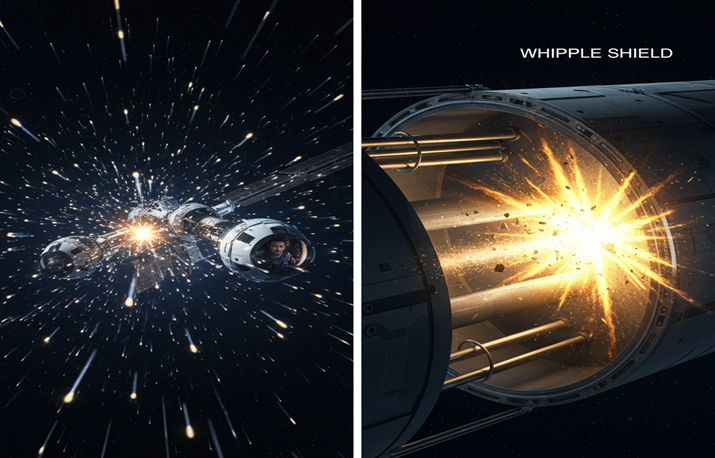
For debris that is too small to track, spacecraft rely on passive defense systems known as Whipple shields.
- How they work: Analogous to sea waves breaking against tetrapods, these shields consist of an outer “bumper” and an inner “rear wall” with a standoff gap between them.
- Energy Dissipation: The bumper shatters the high-velocity debris into a cloud of smaller fragments. As this cloud expands across the gap, its momentum is distributed over a wide area, allowing the rear wall to absorb the impact without failing.
B. Operational Defense: Avoidance Maneuvers
For larger, trackable debris (typically objects >10 cm), space agencies use active maneuvers.
- Tracking Catalogs: Agencies maintain detailed catalogs of these objects.
- Collision Avoidance: When a potential collision is projected, the spacecraft fires its thrusters to slightly alter its orbit and move out of the projected impact zone.
C. ISRO’s Gaganyaan Protection Scheme
As India prepares for the Gaganyaan mission, ISRO is employing stringent safety standards:
- Passive Shields: The MMOD protection for Gaganyaan utilizes Whipple shields validated at DRDO’s Terminal Ballistics Research Laboratory (TBRL) in Chandigarh.
- Validation: ISRO uses a “gas gun” facility to fire 7 mm spherical projectiles at velocities up to 5 km/s to test shield durability.
- Vulnerability Analysis: Specialized software tools perform “MMOD flux” analysis to determine the probability of failure for critical components over the mission’s duration.
International Standards and “Soft Law”:
Inter-Agency Space Debris Coordination Committee (IADC): This is the primary technical body (including ISRO, NASA, and ESA) that generates the foundational standards for debris mitigation.
UNCOPUOS Guidelines: The United Nations Committee on the Peaceful Uses of Outer Space adopted the IADC’s standards in 2007. These guidelines focus on:
- Limiting debris released during normal operations.
- Minimizing the potential for on-orbit break-ups (explosions).
- Post-Mission Disposal (PMD): Ensuring satellites are removed from useful orbits at the end of their life.
Challenges of MMOD:
1. The “Invisibility” Problem (Tracking Gaps)
- The Size Threshold: Earth-based radars can generally track objects larger than 10 cm. However, most MMOD particles are between 1 mm and 1 cm.
- The Issue: Because they are too small to be tracked, astronauts cannot “maneuver” away from them. Collision Avoidance Maneuvers (CAM) are useless against MMOD; the only defense is passive shielding.
2. Hyper-velocity Impact Physics
- Kinetic Energy: MMOD particles travel at average relative speeds of 10 km/s to 15 km/s.
- The Issue: At these speeds, a tiny fleck of paint possesses the kinetic energy of a bullet, and a 1 cm aluminum sphere can hit with the force of a hand grenade. This causes “hyper-velocity cratering,” which can breach pressurized modules or shatter solar panels.
3. The “Kessler Syndrome” Trigger
- Chain Reaction: Each collision between MMOD and a satellite doesn’t just damage the satellite; it creates thousands of new MMOD fragments.
- The Issue: We are reaching a “critical density” in Low Earth Orbit (LEO). This leads to a self-sustaining cascade of collisions that could eventually render specific orbital altitudes (like the 400-800 km band) unusable for centuries.
4. Vulnerability of Critical External Components
- Solar Arrays and Radiators: These cannot be heavily shielded because they need to be lightweight and exposed to work.
- The Issue: Constant MMOD bombardment causes “pitting” and erosion, which degrades power output over time. For long-duration missions like the Bharatiya Antariksha Station, this significantly shortens the operational lifespan of the hardware.
5. The “Soft Law” Enforcement Gap
- Policy Failure: International standards for debris mitigation are currently non-binding.
- The Issue: While agencies like ISRO follow strict “passivation” (venting leftover fuel to prevent explosions), many commercial actors in the “New Space” era do not. This lack of a “Global Space Traffic Management” system means the MMOD population continues to grow unchecked.
Way Forward:
1. Implementing the “Zero-Junk” Policy
- The DFSM 2030 Mandate: India has declared a goal to achieve Debris-Free Space Missions (DFSM) by 2030. The way forward involves ensuring that every satellite—whether governmental or private—is designed for Post-Mission Disposal (PMD).
- Tightening the De-orbiting Window: While international standards historically allowed a 25-year window for satellites to burn up in the atmosphere, ISRO is now advocating for a 5-year limit. This reduces the time a “dead” satellite remains a “sitting duck” for collisions.
- Passivation: To prevent “on-orbit break-ups” (explosions), all future upper stages of rockets (like PSLV and GSLV) must be passivated—meaning all excess fuel and stored energy are vented out after the mission.
2. Active Debris Removal (ADR)
- Robotic “Garbage Collectors”: Technologies like harpoons, magnets, and lasers are being explored to capture and pull defunct satellites into a “graveyard orbit” or back into the atmosphere.
- SPADEX Mission: ISRO’s upcoming Space Docking Experiment (SPADEX) is a critical step toward developing the robotic capability to dock with and move non-functional objects.
3. Enhanced Space Situational Awareness (SSA)
- Project NETRA: India is expanding its Network for Space Object Tracking and Analysis (NETRA). The way forward involves building more high-precision radars and telescopes to track objects as small as 10 cm up to a range of 3,400 km.
- Global Data Sharing: As space traffic becomes congested, agencies must move toward “automated collision avoidance” where satellites can “talk” to each other and coordinate movements without human intervention.
4. From “Soft Law” to “Hard Regulation”
The Inter-Agency Space Debris Coordination Committee (IADC) guidelines must be integrated into national laws.
- National Space Legislation: India is in the process of drafting a comprehensive Space Act that would make debris mitigation a mandatory condition for receiving a launch license.
- Inclusive Zoning: Protecting the 400 km orbital shell specifically for human spaceflight (Gaganyaan, ISS, and the future Bharatiya Antariksha Station) to ensure a safe “orbital highway.”
Conclusion:
The era of expanding human presence beyond the Moon can only be secured if the global community collectively addresses the risks of debris and adopts stringent zero-junk practices to ensure a safe, sustainable orbital highway for all.