WHY IN NEWS
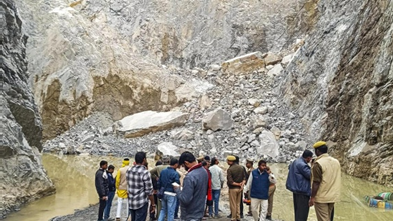
- Recently, stone quarry in Obra (Sonbhadra district, Uttar Pradesh) collapsed, burying nearly a dozen workers; death toll reported as mounting while hopes remain that some survivors may be rescued.
- Three-tier probe has been ordered by state government (district administration, police, mining department). FIR has been filed against quarry owner alleging negligence of safety protocols.
Background and Context
- Sonbhadra is recognized for mineral wealth, part of a region crossing Uttar Pradesh, Chhattisgarh, Bihar, Jharkhand, Madhya Pradesh.
- Importance as India’s energy capital is noted, with around 6,000 MW coal plant capacity (nearly half of Tamil Nadu’s).
- Region hosts numerous stone quarries and coal mines along the Vindhyas-Kaimur hill range.
- Despite mineral prosperity, human development indices remain low.
Incident Details
- Stone quarry collapse occurred recently in Obra; nearly a dozen workers were trapped; rescue operations ongoing; death toll rising.
- State disaster response workers reached site from Mirzapur, raising issue of local stationing of disaster response teams in area with multiple quarries/mines.
Investigations & Legal Action
- Three-tier probe mandated: district administration, police, mining department.
- FIR lodged against quarry owner for alleged safety protocol violations.
- Investigations to determine compliance with basic mining safety measures across region.
Safety Concerns Highlighted
- Questions raised about worker training and availability of safety gear.
- Stone quarries characterised as lowest end of mining and often least safety conscious.
- Contractors for stone quarries often described as small-time operators.
Structural Causes Identified
- Micro geological studies rarely carried out by contractors after leasing; macro geological studies by government may be done before leasing but are insufficient for site-level safety planning.
- Blasting design described as science that determines explosive size and throw and appropriate detonation distances; in practice, rule-of-thumb decisions often used.
- Open mines require benching (small horizontal plateaus along slope) to ensure stability; absence of proper benching increases risk of wholesale quarry collapse as witnessed in Obra.
- Many accidents are averted only by sheer luck, as noted by geologists.
Institutional resources & governance issue
- IIT (ISM) Dhanbad identified as provider of expertise and technology that could be leveraged for micro geological studies and safer mining practices.
- Political will to fully leverage available technical expertise questioned.
Broader Implications
- Human cost and safety failures in extractive sector pose policy challenge for occupational safety and labour welfare.
- Resource-rich regions can remain underdeveloped in human development if mining governance is weak.
- Regulatory gaps and implementation failures undermine technical safeguards even where macro studies exist.
- Local disaster preparedness and rapid response capacity must be strengthened in mining belts.
Way Forward
To prevent recurrence of such tragedies and address the systemic deficiencies in India’s mining and quarrying sector, the following measures must be prioritized:
- Conduct mandatory micro-level geological studies (at square-kilometre scale) by all leaseholders before commencing operations to identify weak joints, fracture lines, and unsafe hill slopes.
- Enforce scientific blasting design based on accurate assessment of explosive size, throw distance, and safe detonation parameters instead of rule-of-thumb practices.
- Make benching (creation of small horizontal plateaus along hill slopes) compulsory in all open-cast quarries and mines to reduce the risk of large-scale collapses.
- Ensure strict adherence to safety protocols, including regular safety training for workers and mandatory provision of adequate safety gear.
- Establish locally stationed disaster response teams in high-risk mining districts like Sonbhadra, equipped for rapid deployment.
- Strengthen post-leasing regulatory oversight and monitoring to curb illegal quarrying and negligence by contractors.
- Fully leverage institutional expertise and advanced technologies available at premier institutes such as IIT (ISM) Dhanbad for training, safety audits, and technology transfer.
- Promote greater political will and governance focus to transform mineral-rich but human-development-deficient regions through safe and sustainable mining practices.
Conclusion
- Sonbhadra quarry collapse has exposed deep structural problems in quarrying and mining operations: technical deficiencies (absence of micro geological studies, improper blasting design, lack of benching), governance failures (weak enforcement, possible illegal quarrying), and institutional gaps (limited local disaster response, underutilised technical expertise from IIT (ISM) Dhanbad).
- Immediate legal and investigative actions (three-tier probe, FIR) have been initiated; however, systemic reforms and political will will be required to prevent recurrence and to safeguard worker lives in mining belts.
SUSTAINABLE MINING PRACTICES
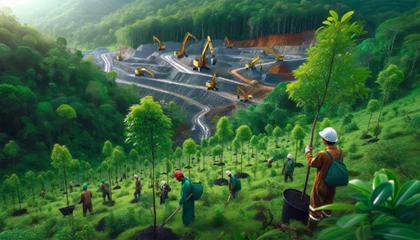
Sustainable mining practices refer to a holistic approach to mineral extraction that seeks to meet present resource needs without compromising the ability of future generations to meet their own. It integrates Environmental, Social, and Governance (ESG) principles across the entire mining lifecycle, from exploration and operation to closure and post-closure land use.
Core Principles of Sustainable Mining
Sustainable mining operates on a Triple Bottom Line framework, requiring performance across three interconnected pillars:
| Pillar | Focus Area | Key Objectives |
| 1. Environmental Stewardship (E) | Minimizing ecological footprint and resource use. | Zero harm to ecosystems, responsible water management, greenhouse gas (GHG) reduction, and effective land reclamation. |
| 2. Social Responsibility (S) | Securing a Social License to Operate (SLO) and creating shared value. | Prioritizing worker safety and health, respecting human rights and local cultures, and contributing to community development. |
| 3. Economic Viability and Governance (G) | Ensuring long-term profitability and transparent operations. | Resource efficiency, ethical business conduct, transparency, strong regulatory compliance, and anti-corruption measures. |
Environmental Best Practices
Environmental stewardship moves beyond mere compliance to regenerative practices.
Land Use and Biodiversity Conservation
- Progressive Reclamation: Restoration of mined land initiated concurrently with extraction, rather than waiting until mine closure. This minimizes the total disturbed area at any given time.
- Biodiversity Net Gain (BNG): Aiming for an overall positive impact on biodiversity through habitat creation, species translocation, and long-term conservation initiatives, moving beyond a “do no harm” approach.
- Scientific Closure: Preparation of a detailed Mine Closure Plan that is an integral part of the initial mining plan, ensuring the land is restored to its natural state or repurposed for sustainable post-mining use (e.g., eco-parks, agriculture, solar farms).
Water and Waste Management
- Closed-Loop Water Systems: Implementation of systems that recycle and reuse water internally, significantly minimizing fresh water consumption and preventing discharge into local water bodies.
- Advanced Tailings Management: Shifting from conventional liquid tailings ponds to safer alternatives like dry stacking or paste backfill, which reduces the risk of dam failure, conserves water, and allows for faster land rehabilitation.
- Circular Economy: Reprocessing mine tailings and waste rock to extract residual minerals or utilizing them as raw materials for construction (e.g., using waste rock for road building) to achieve zero waste mining.
Climate and Energy
- Decarbonisation: Transitioning mining operations (especially vehicle fleets and heavy machinery) to renewable energy sources (solar, wind, hydro) and using electric or hybrid equipment to significantly reduce scope 1 and 2 GHG emissions.
- Low-Impact Extraction: Using precise methods like surface miners, continuous miners, or precision drilling to reduce the overall disturbed area, minimize dust/vibration, and improve resource recovery.
Social and Safety Responsibility
A strong Social License to Operate (SLO) is crucial for the long-term success and stability of any mining project.
- Community Engagement and Development: Actively involving local and Indigenous communities in decision-making processes and ensuring that mining activities result in shared value through local employment, skill development, and investment in social infrastructure (health, education).
- Worker Health and Safety: Going beyond legal compliance by deploying advanced technologies (e.g., proximity sensors, virtual reality training, remote operation centers) to minimize human exposure to hazardous tasks and striving for a zero-harm safety culture.
- Ethical Sourcing and Human Rights: Strict adherence to international labor standards, fair compensation, and transparent due diligence across the supply chain to prevent child labor and human rights abuses.
Governance and Technology Integration
Effective governance ensures accountability and leverages technology for maximum efficiency and compliance.
Technology for Sustainability
- Digital Transformation: Use of IoT sensors and Artificial Intelligence (AI) for real-time monitoring of air/water quality, slope stability, and energy consumption, enabling predictive maintenance and early risk mitigation.
- Traceability: Implementing Blockchain-based platforms to ensure end-to-end transparency of the extracted material’s origin and ethical sourcing, catering to investor and consumer demand for responsible minerals.
- Autonomous Systems: Deploying autonomous haul trucks and remote-controlled equipment to improve operational efficiency, reduce fuel consumption, and enhance worker safety in dangerous areas.
Regulatory and Governance Frameworks
- ESG Integration: Making Environmental, Social, and Governance (ESG) factors central to all strategic and investment decisions, driven by investor demand and global reporting standards (e.g., TCFD, SASB).
- Transparency and Reporting: Transparent reporting on environmental performance, social impact, and financial contributions (e.g., adherence to the Extractive Industries Transparency Initiative – EITI), which builds trust with stakeholders and investors.
- Compliance: Ensuring strict adherence to national frameworks like the National Mineral Policy (2019) and rules like the Mineral Conservation and Development Rules (MCDR, 2017) in India, emphasizing scientific mining and progressive environmental protection.
Conclusion
- Sustainable mining is an integrated approach that balances economic viability with deep Environmental, Social, and Governance (ESG) responsibility.
- It mandates proactive measures like progressive reclamation and advanced tailings management while prioritizing worker safety and securing a Social License to Operate (SLO).
- Ultimately, sustainability is crucial for the mining sector to ensure long-term business continuity and ethically supply the resources needed for global development.
UPSC MAINS PYQs
- Mineral resources are fundamental to the country’s economy and these are exploited by mining. Why is mining considered an environmental hazard? Explain the remedial measures required to reduce the environmental hazard due to mining. (2025)