Context
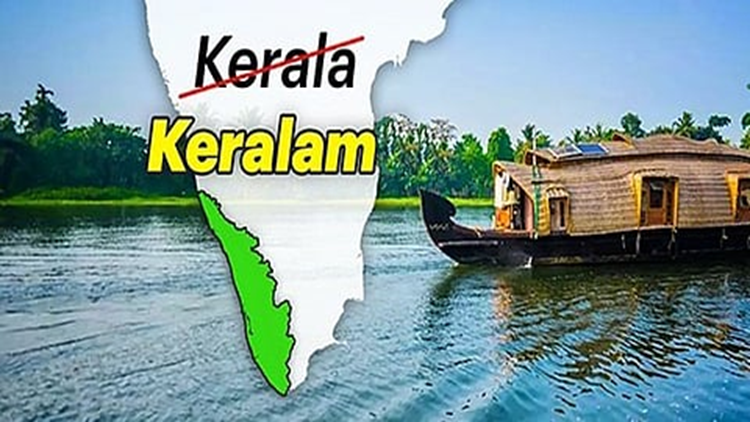
Recently, the Union Cabinet chaired by Prime Minister Narendra Modi approved the proposal to rename the state of “Kerala” to “Keralam.” This decision follows a unanimous resolution passed by the Kerala Legislative Assembly in June 2024, which urged the Central Government to align the official name with its Malayalam pronunciation and cultural heritage. The Union Cabinet has now set in motion the Kerala (Alteration of Name) Bill, 2026, which will be referred to the State Assembly by the President before being introduced in Parliament.
1. Constitutional Provisions
The power to change the name of a state is exclusively vested in the Parliament of India.
- Article 3: This article empowers Parliament to form new states and alter the areas, boundaries, or names of existing states.
- Procedure for Name Change:
- A Bill for renaming a state can be introduced in either House of Parliament only on the prior recommendation of the President.
- Before recommending the Bill, the President must refer it to the concerned State Legislature for expressing its views within a specified time frame.
- The views of the State Legislature are not binding on either the President or the Parliament; Parliament is free to accept or reject them.
- Article 4: It specifies that laws made under Article 3 (for renaming or boundary changes) are not considered amendments to the Constitution under Article 368. Consequently, such a Bill can be passed by a Simple Majority (majority of members present and voting).
2. Historical and Linguistic Roots
- Etymology: The word “Keralam” is believed to have originated from “Cheram,” referring to the Chera dynasty. In Malayalam, “alam” means region or land, making it the “land of the Cheras.” Another theory suggests the root is “keram” (coconut), reflecting the state’s dominant agricultural produce.
- Ancient References: The earliest epigraphic record of the region is found in Emperor Ashoka’s Rock Edict II (257 BCE), where the local ruler is referred to as “Keralaputra” (Sanskrit for “son of Kerala”).
- Linguistic Reorganisation: During the 1956 reorganisation of states on a linguistic basis, the state was formed for Malayalam speakers. While the native population has always used “Keralam,” the English spelling “Kerala” was an anglicized version that persisted in the First Schedule of the Constitution.
3. Comparison with Other States
- Recent Precedents: Several states have changed their names previously, including United Provinces to Uttar Pradesh (1950), Madras to Tamil Nadu (1969), Mysore to Karnataka (1973), Uttaranchal to Uttarakhand (2007), and Orissa to Odisha (2011).
- Pending Proposals: The West Bengal government’s proposal to rename the state as “Bangla” remains pending with the Centre, highlighting that the Union Government’s “No Objection” and subsequent Cabinet approval are critical hurdles.
Q. Consider the following statements regarding the procedure for altering the name of a State in India:

1. A Bill for the alteration of the name of a state can be introduced in the Lok Sabha only after the President's recommendation.

2. The President is constitutionally mandated to obtain and follow the views of the concerned State Legislature before recommending such a Bill to Parliament.

3. Any law providing for the change of name of a state is not deemed to be an amendment of the Constitution for the purposes of Article 368.

How many of the statements given above are correct?

(a) Only one
(b) Only two
(c) All three
(d) None

Correct Answer: (a) Only one

Explanation:
STATEMENT 1 IS INCORRECT: A Bill for altering the name of a state can be    introduced in either House of Parliament (Lok Sabha or Rajya Sabha), not just the Lok Sabha, provided it has the President's prior recommendation.
STATEMENT 2 IS INCORRECT: While the President must refer the Bill to the State Legislature for its views, those views are consultative and not binding on the Parliament or the President.
STATEMENT 3 IS CORRECT: According to Article 4, laws made under Articles 2 and 3 (including name changes) are not considered amendments under Article 368 and require only a simple majority.