Why in the News?
- Amid the ongoing Iran crisis, Indian rice exporters have approached the Union Commerce Ministry seeking assistance to clear pending payments from Iranian importers.
- Iran remains one of the largest importers of Indian basmati rice, but civil unrest and financial instability have disrupted order flows, payment cycles, and shipment schedules.
Overview of Rice Crop in India
Rice is the primary staple food for a large section of India’s population, especially in southern, eastern, and north-eastern regions andhas expanded also significantly into the north-western plains.. India is the second-largest producer of rice in the world after China and the largest exporter of rice globally.
- Role of Irrigation: Through intensive irrigation, rice is successfully grown in Punjab, Haryana, and western Uttar Pradesh, despite rainfall being below 100 cm.
- Farming System: Rice-growing regions are well suited to mixed farming systems (crop cultivation combined with livestock rearing).
- Nutritional Value: Unpolished rice is nutritionally superior and rich in Vitamins A, B, and calcium, whereas polished rice loses much of these nutrients during milling.
- Types of Rice:
- Long-grain rice: Basmati, Jasmine — long, fluffy, non-sticky.
- Medium-grain rice: Arborio, Calrose — soft and moist.
- Short-grain rice: Japanese sushi rice, glutinous rice — plump and sticky.
- Specialty rice: Brown rice (nutrient-rich), Black rice (high antioxidants), Wild rice (nutty, chewy).
- Labour Requirement in Rice Cultivation: Rice cultivation is a labour-intensive activity, especially during transplanting, weeding, and harvesting, and is therefore concentrated in densely populated regions.
- In Punjab and Haryana, rice farming relies heavily on migrant labour from Bihar and eastern Uttar Pradesh.
Climatic and Physiographic Conditions for Rice Crop in India
- Climatic Requirements
- Crop Type: Rice is a tropical and Kharif crop that requires heat, rainfall, and abundant labour.
- Temperature and Humidity: Warm and humid conditions allow rice to be grown two to three times a year in eastern and southern India.
- Cold Constraints: In northern and hilly regions, cold winters restrict rice cultivation to only one crop, usually in summer.
- Water Requirement
- Semi-Aquatic Nature: Rice needs continuous water supply through rainfall or irrigation, and the soil must never dry out during the growing season.
- Flooded Fields: Fields are typically flooded with 10–12 cm of standing water at the time of sowing.
- Topography and Types Based on Relief
- Lowland (Wet) Rice: Grown in well-watered plains and lowland areas, where water stagnation is possible.
- Below Sea-Level Cultivation: Rice is grown below sea level in the Kuttanad region of Kerala, using protective bunds.
- Upland (Dry) Rice: Cultivated on hill slopes and terraces, especially in north-eastern hill states, often under shifting cultivation or Jhumming. Water availability is low, hence termed dry or upland rice.
- Rainfall Thresholds
- Optimal Rainfall: An average annual rainfall above 150 cm is most suitable for rice cultivation.
- Rainfed Limit: The 100 cm isohyet marks the outer limit of rice cultivation under rainfed conditions.
Short Code:





Crop Seasons of Rice Crop in India
Rice has three cropping seasons—Kharif, Rabi, and Summer.
- Kharif Season: Rice is predominantly grown during the monsoon season, as warm and wet conditions are ideal for its growth.
- Rabi Season: Rice is cultivated only in well-irrigated areas during Rabi.
- Summer Crop: In certain regions, rice is grown during summer, particularly in the deltaic regions of West Bengal and the Krishna–Godavari Delta, where water availability is assured.
- Seasonal Pattern: Many rice-growing regions remain barren during peak summer months (April–May).
Soil Requirements for Rice Cultivation
Rice is predominantly cultivated in river valleys, floodplains, deltas, and coastal plains, where natural or artificial flooding of fields is feasible.
- Loamy Soils: Loamy soils possess low water-holding capacity and therefore require frequent irrigation. Such soils are commonly found in deltaic regions, Punjab, Haryana, and the North Indian plains.
- Clayey Soils: Clayey soils have high water-retention capacity, making them highly suitable for rice cultivation. These soils are typical of the coastal plains of southern India and the irrigated regions of Karnataka and Telangana.
- Soil pH Tolerance: Rice can grow in a wide range of soil conditions, including both acidic and alkaline soils, enhancing its adaptability.
Different Techniques of Rice Cultivation in India
| Method | Key Features | Regions Practised | Inputs & Labour | Yield Level |
| Broadcasting Method | Seeds are broadcast by hand over the field; simplest technique | Dry and less fertile areas; regions with labour scarcity | Minimum inputs and labour | Low yields |
| Drilling Method | One person ploughs while another sows seeds simultaneously | Dry regions of Peninsular India | Low inputs; limited labour | Low yields |
| Transplantation Method | Seedlings raised in a nursery and transplanted after ~1 month | Areas with fertile soil, high rainfall, or assured irrigation | Labour-intensive, high inputs; limited mechanisation | High yields |
| Japanese Method | Highly mechanised transplanting, weeding, and fertilisation | Developed countries like Japan and South Korea | High fertiliser use, full mechanisation | Very high yields |
| System of Rice Intensification (SRI) | Young seedlings, single planting, wide spacing, intermittent irrigation, soil aeration | Adopted selectively across India | Emphasises organic inputs, efficient use of land, water, and labour | Higher productivity with fewer resources |
What is Direct Seeding of Rice (DSR)?
- Direct Seeding of Rice is a cultivation technique in which rice seeds are sown directly in the main field, eliminating the need for nursery raising and transplanting.
- It reduces labour and water requirements, lowers cultivation costs, and shortens the crop duration, allowing earlier harvesting and possible multiple cropping.
- Owing to water scarcity and labour shortages, DSR is increasingly adopted as a sustainable rice farming practice.
Production and Productivity of Rice in India
India accounts for nearly 20% of global rice production and is the second-largest producer and consumer after China.
- Yield Comparison (2020): India’s average rice yield stood at 2.7 tonnes per hectare, compared to the global average of about 4.37 tonnes per hectare.
- High-Productivity Countries: Countries such as China, Australia, and the United States record significantly higher yields due to advanced technology.
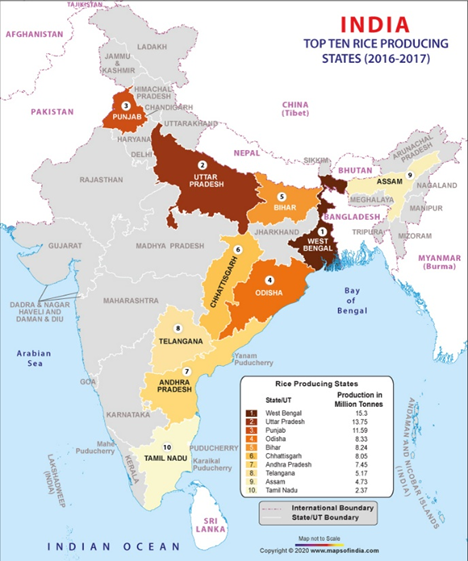
- Major Rice-Producing States in India:
- West Bengal: Ranks first due to extensive alluvial plains, though yields remain moderate.
- Uttar Pradesh: Ranks second, benefiting from Ganga–Yamuna alluvial deposits, but productivity is moderate
- Andhra Pradesh: Ranks third, supported by the Krishna–Godavari delta and irrigation, but faces cyclones and floods.
- Punjab: Ranks fourth, recording the highest yields due to HYV seeds, fertilisers, canal and tube-well irrigation, but suffers from groundwater depletion and soil degradation.
Rice Export and Import
- Global Export Leadership: India is the largest exporter of rice globally, surpassing Thailand in 2011–12.
- Basmati Rice Dominance: India is the leading exporter of basmati rice, mainly produced in Punjab, Haryana, and western Uttar Pradesh.
- Major Export Destinations: Key importing countries include Saudi Arabia, Iran, Iraq, and Yemen.
Q. Consider the following statements regarding rice cultivation in India:
1.	Rice is primarily a Kharif crop requiring high temperature, humidity, and rainfall above 100 cm.
2.	The 100 cm isohyet marks the outer limit of rice cultivation under rainfed conditions in India.
3.	Rice cannot be cultivated in acidic or alkaline soils.
4.	Direct Seeding of Rice (DSR) eliminates the need for nursery raising and transplanting and helps address labour shortages.

Which of the statements given above is/are correct?
(a) 1 and 2 only
(b) 1, 2, and 4 only
(c) 1, 3, and 4 only
(d) 2 and 3 only

Answer: (b) 1, 2, and 4 only

Explanation:
Statement 1: Correct. Rice is a tropical Kharif crop requiring temperatures above 25°C, high humidity, and rainfall above 100 cm.
Statement 2: Correct. In rainfed regions, the 100 cm isohyet marks the limit of rice cultivation.
Statement 3: Incorrect. Rice can grow in a wide range of soils, including acidic and alkaline soils.
Statement 4: Correct. DSR involves sowing seeds directly in the field, bypassing nursery and transplantation, reducing labour and water requirements, and allowing earlier harvests.