After Reading This Article You Can Solve This UPSC Mains Model Question:
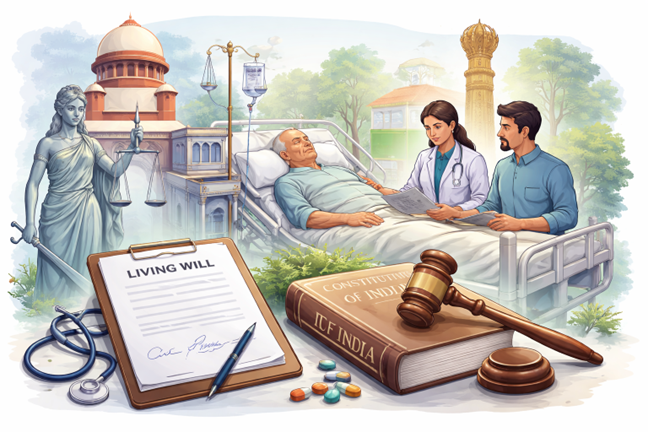
“The recognition of the Right to Die with Dignity reflects the evolving interpretation of Article 21 of the Indian Constitution.” Discuss in the light of recent Supreme Court judgments on euthanasia. 15 Marks (GS-2 Polity)
Context
In a landmark development, the Supreme Court in Harish Rana v. Union of India permitted the first-ever practical application of its passive euthanasia guidelines.
About Euthanasia
Derived from Greek words Eu (Good) and Thanatos (Death), it literally means “Good Death” or “Mercy Killing.” It refers to the practice of intentionally ending a life to relieve pain and suffering.
Classification based on Consent:
- Voluntary: With the patient’s explicit consent.
- Non-voluntary: Patient is unable to consent (e.g., coma), and the decision is made by family/guardians.
- Involuntary: Against the patient’s will (Equivalent to murder; globally illegal).
Active vs. Passive Euthanasia
| Feature | Active Euthanasia | Passive Euthanasia |
| Definition | Deliberate action to cause death | Withdrawal or withholding of life support |
| Nature | Direct intervention | Allowing natural death |
| Legal status in India | Illegal | Permitted (Under strict SC guidelines). |
| Example | Injecting lethal drug | Removing ventilator or feeding tube |
| SC 2026 Clarification | The term “Euthanasia” should now strictly refer to Active Euthanasia | Now officially termed “Withdrawing or Withholding of Medical Treatment” |
Legal and Constitutional Provisions on Euthanasia
- Article 21: The “Right to Life” is a fundamental right. The SC has interpreted this to mean a “Right to a Dignified Life,” which inherently includes a “Right to a Dignified Death.”
- Article 226: High Courts have the power to issue writs; often the first point of appeal for families seeking euthanasia for incompetent patients.
- Bharatiya Nyaya Sanhita (BNS), 2023: Active euthanasia attracts criminal liability under Section 100 (Culpable Homicide) or Section 101 (Murder).
Evolution of Judicial Proceedings on Euthanasia
The legal journey has shifted from “Sanctity of Life” to “Quality of Life”:
- Maruti Shripati Dubal (1987): Bombay HC held that “Right to Life” includes “Right to Die” (decriminalized suicide).
- Gian Kaur v. State of Punjab (1996): SC reversed the above, stating Article 21 is about protection of life, not its extinction.
- Aruna Shanbaug v. Union of India (2011): First-time recognition of Passive Euthanasia under “exceptional circumstances” with High Court approval.
- Common Cause v. Union of India (2018): SC declared the Right to Die with Dignity as a Fundamental Right. It legalized “Living Wills” (Advance Medical Directives).
- Harish Rana Case (2026): Confirmed that CANH (Clinically Assisted Nutrition and Hydration) qualifies as medical treatment and can be withdrawn if it offers no therapeutic benefit.
Arguments For and Against Euthanasia
The “Pro-Choice” Perspective
- Fundamental Right to Dignity: Under Article 21, the “Right to Life” is not merely animal existence; it includes the Right to Die with Dignity when life becomes an agonizing burden.
- Bodily Autonomy: An individual has the ultimate sovereignty over their own body, including the choice to refuse medical intervention (Living Wills).
- Relief from Futile Suffering: Modern medicine can keep a body “alive” (biologically) long after the person has “died” (mentally/socially). Euthanasia ends “meaningless” pain.
- Economic & Resource Logic: In a country like India with a high patient-to-bed ratio, utilizing intensive care resources for “terminally ill/brain-dead” patients limits access for those with a high chance of recovery.
- Compassion over Cruelty: Prolonging the life of a patient in a Persistent Vegetative State (PVS) via invasive tubes is increasingly viewed by the SC as “cruelty” rather than “care.”
The “Pro-Life” Perspective
- The “Slippery Slope” Risk: There is a grave danger of misuse by relatives to inherit property early or by the state to “clear” the burden of elderly/disabled populations.
- Sanctity of Life: Many religious and ethical frameworks believe life is a gift/sacred; its end should be natural, and humans should not “play God.”
- Medical Ethics: It contradicts the Hippocratic Oath (“First, do no harm”). It may damage the trust between a doctor and a patient.
- Palliative Care Gap: Critics argue the “demand” for euthanasia arises from a lack of quality pain management. If Palliative Care is robust, the desire to die often disappears.
- Potential for Recovery: Medical science is constantly evolving. A “terminal” condition today might have a cure tomorrow, and euthanasia is irreversible.
Way Forward
To move toward a more humane and efficient end-of-life framework, the following steps are essential:
- Enact a Comprehensive “End-of-Life Care Act”: The Supreme Court has specifically urged the Union Government to create a legislative bridge. This would provide permanent clarity, replacing the current “interim” judicial guidelines with a robust parliamentary law.
- Universalize Palliative Care: The “Right to Die with Dignity” is inseparable from the Right to Quality Palliative Care. Palliative care must be integrated into the Ayushman Bharat (PM-JAY) scheme and medical curricula to ensure that the transition to natural death is painless and managed with medical expertise.
- Digitization via ABHA: Living Wills should be seamlessly linked to the Ayushman Bharat Digital Health Account (ABHA). This ensures that in emergencies, doctors can instantly access a patient’s “Advance Medical Directive” without the family needing to produce physical documents.
- Standardize Medical Protocols: As established in the Harish Rana case, there is a need for standardized protocols for withdrawing Clinically Assisted Nutrition and Hydration (CANH). This prevents doctors from being accused of “starvation” or “active killing” while performing their duty of care.
- Public Awareness Campaigns: The concept of “Living Wills” remains largely urban and niche. A national awareness campaign is needed to normalize advance care planning, ensuring citizens exercise their autonomy while they are mentally competent.
Conclusion
India’s legal shift from “sanctity of life” to “quality of life” ensures constitutional empathy. Future legislation must now bridge the gap between judicial guidelines and clinical practice to institutionalize dignity.