Context
The Directorate General of Foreign Trade (DGFT) has extended the RoDTEP scheme for an additional six months. This extension aims to provide stability and certainty to Indian exporters amidst global economic fluctuations.
1. What is RoDTEP?
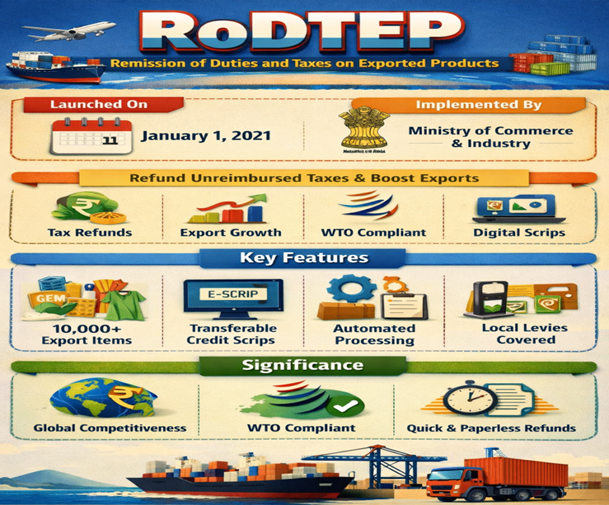
The Remission of Duties and Taxes on Exported Products (RoDTEP) is a flagship export promotion scheme aimed at refunding central, state, and local taxes incurred during the manufacturing and distribution of exported goods. By ensuring that such embedded taxes are not exported, the scheme enhances the global competitiveness of Indian products.
2. Launch
The scheme was implemented on January 1, 2021, replacing the earlier Merchandise Exports from India Scheme (MEIS), which was found to be non-compliant with WTO norms.
3. Implementing Authority
The scheme is administered by the Ministry of Commerce and Industry.
4. Objective
RoDTEP seeks to establish a comprehensive mechanism for reimbursing taxes, duties, and levies that are not covered under existing refund frameworks such as GST or Duty Drawback, thereby promoting export growth in both volume and value.
5. Key Features
- Wide Coverage: Encompasses over 10,000 export products across sectors such as agriculture, marine, leather, and gems and jewellery.
- Digital Duty Credit System: Benefits are provided in the form of transferable duty credit scrips, maintained electronically through the Customs portal.
- WTO Compliance: Based strictly on the principle of tax remission, ensuring conformity with World Trade Organization rules.
- Automated Processing: Rebates are calculated as a percentage of the Freight On Board (FOB) value and are automatically processed upon submission of shipping bills.
- Inclusion of Embedded Taxes: Covers previously unreimbursed costs such as mandi tax, VAT on fuel used in transportation, and electricity duties.
6. Significance
- Enhancing Export Competitiveness: By eliminating embedded taxes, Indian exports become more price-competitive in global markets.
- Liquidity Support to Exporters: Transferable digital scrips provide timely financial assistance, particularly during global disruptions such as geopolitical crises.
- Ease of Doing Business: The fully digital, paperless system minimizes delays, reduces human intervention, and improves transparency in the refund process.
Which one of the following is the objective of the Remission of Duties and Taxes on Exported Products (RoDTEP) scheme?

(a) Refund customs duties paid on imported raw materials.
(b) Reimburse embedded taxes and duties not refunded under existing schemes.
(c) Provide direct subsidies for export-oriented units.
(d) Increase export volumes by offering financial incentives.

Answer: B

Explanation:
The core objective of the Remission of Duties and Taxes on Exported Products (RoDTEP) scheme is to ensure that taxes and duties paid during the manufacturing and distribution of exported products are refunded to the exporter.

•	Unlike previous schemes, RoDTEP targets "embedded" costs—taxes that are not captured under GST or other refund mechanisms.

•	These include Mandi Tax, Vat on Fuel used for transportation of export goods, Electricity Duty on manufacturing, and Stamp Duty on export documents.