Context:
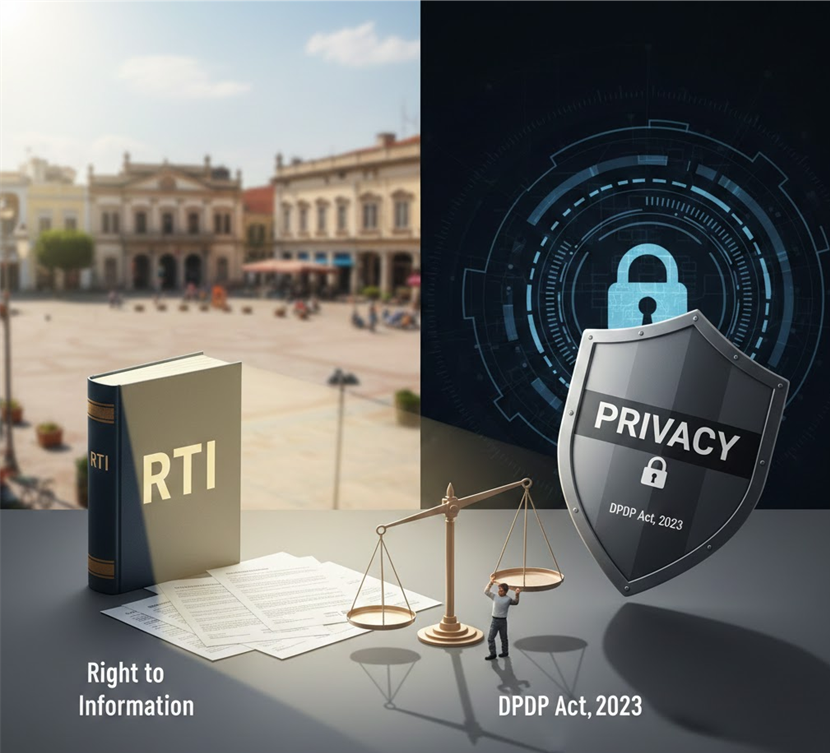
The Supreme Court has referred a series of petitions to a Constitution Bench to decide if the Digital Personal Data Protection (DPDP) Act, 2023, unconstitutionally weakens the Right to Information (RTI) Act, 2005. Under Article 145(3), such benches are formed when a case involves a “substantial question of law” regarding the Constitution.
1. The Legal Dispute: What Has Changed?
The conflict centers on Section 44(3) of the DPDP Act, which amends Section 8(1)(j) of the RTI Act.
I. The Deletion of the “Public Interest” Test
- Old Rule: Previously, a Public Information Officer (PIO) could release personal information if the “larger public interest” outweighed an individual’s privacy.
- New Rule: This “public interest” override has been removed. Now, personal information is under a near-total ban from disclosure.
II. The End of “Parliamentary Parity”
- The Original Proviso: The RTI Act once stated that information which cannot be denied to the Parliament or State Legislatures shall not be denied to any citizen.
- The Change: The DPDP Act has deleted this proviso. This creates a gap where the government might share data with MPs but refuse the same data to common citizens.
2.Constitutional Foundations: Article 19 vs. Article 21
The court must now balance two fundamental pillars of Indian democracy:
- Right to Know (Article 19): While not explicitly written in the Constitution, the SC in State of UP v. Raj Narain (1975) ruled that RTI is an implied part of the Freedom of Speech and Expression.
- Right to Privacy (Article 21): In the K.S. Puttaswamy (2017) case, the SC declared privacy a fundamental right.
The petitioners argue that while privacy is for individuals, it should not be used by public officials as a “shield” to hide their professional conduct or the use of public funds from the taxpayers.
3. Impact on Grassroots Accountability
The new law could make it harder for citizens to access:
- Beneficiary Lists: Names of people receiving benefits under schemes like MGNREGA or PDS.
- Official Records: Details of government appointments, asset declarations of bureaucrats, and audit reports.
- The “Chilling Effect”: Because the DPDP Act can impose fines up to ₹250 crore for data breaches, officials may become too afraid to release any information at all.
| About RTI Act Enactment & Enforcement: RTI Act passed in 2005; came into force on 12 October 2005; extends to whole of India (J&K included post-2019).Constitutional Basis: Derived from Article 19(1)(a) (Freedom of Speech & Expression); recognized as part of fundamental rights by the Supreme Court (e.g., State of UP vs Raj Narain, 1975).Coverage: Applies to all public authorities — Central/State governments, Parliament, State legislatures, local bodies, PSUs, statutory bodies, and NGOs substantially financed by the government.Definition of Information (Sec 2(f)): Includes records, documents, memos, emails, opinions, file notings, circulars, contracts, reports, data material in electronic form, etc.Public Information Officer (PIO): Every public authority must appoint PIOs/APIOs to receive and process RTI applications.Exemptions (Sec 8 & 9): Information affecting national security, sovereignty, foreign relations, trade secrets, cabinet papers, personal information, etc.; however, public interest override applies in many cases.Intelligence & Security Exemption (Sec 24): Certain agencies like Intelligence Bureau and Research and Analysis Wing are exempt, except in cases of corruption and human rights violations.Information Commissions:Central level → Central Information CommissionState level → State Information CommissionsAppointed by President/Governor on recommendation of committee (PM/CM + LoP + Cabinet Minister).RTI Amendment Act, 2019: Removed fixed 5-year tenure of CIC/ICs; tenure and salary now determined by Central Government.Important Points for Prelims:No reason required to seek information.File notings are disclosable.RTI is not absolute right.First state RTI law: Tamil Nadu (1997). |
Q. With respect to the Right to Information (RTI) Act, 2005 and the Digital Personal Data Protection (DPDP) Act, 2023, consider the following statements:

I. The Right to Information is an implied fundamental right derived from the Freedom of Speech and Expression under Article 19(1)(a).

II. The 2023 amendment has removed the statutory requirement to weigh "larger public interest" against "individual privacy" for the disclosure of personal data.

III. The DPDP Act, 2023, provides for the voluntary surrender of personal data to the Central Government in   exchange for market-value compensation.

 Which of the statements given above is/are correct?

 (a) I and II only
 (b) II and III only
 (c) I and III only
 (d) I, II and III

Answer: A

Explanation:
Statement I is Correct
•	Fundamental Right: The Supreme Court of India has held in multiple landmark cases (such as Raj Narain vs State of UP) that the Right to Information is an implied fundamental right.
•	Constitutional Basis: It is derived from Article 19(1)(a) (Freedom of Speech and Expression), as a citizen cannot effectively speak or express themselves without having the necessary information.
Statement II is Correct
•	The Conflict: Previously, under Section 8(1)(j) of the RTI Act, 2005, personal information could be disclosed if the Public Information Officer (PIO) was satisfied that the "larger public interest" justified the disclosure, despite the invasion of privacy.
•	The Change: The DPDP Act, 2023, amended Section 8(1)(j) of the RTI Act. It replaced the old provision with a blanket exemption for personal information.
•	Impact: The statutory "balancing test" (public interest vs. individual privacy) has been removed. Now, any information which relates to personal data is essentially exempt from disclosure under the RTI Act, making privacy the absolute priority over the right to know in these cases.
Statement III is Incorrect
•	Nature of DPDP Act: The Digital Personal Data Protection Act, 2023, is a regulatory framework for the processing of digital personal data.
•	No Compensation Clause: There is no provision in the Act for the "voluntary surrender of data in exchange for market-value compensation."
•	Core Focus: The Act focuses on the obligations of Data Fiduciaries (those who determine the purpose of data processing) and the rights of Data Principals (individuals to whom the data belongs), such as the right to correction, erasure, and grievance redressal.