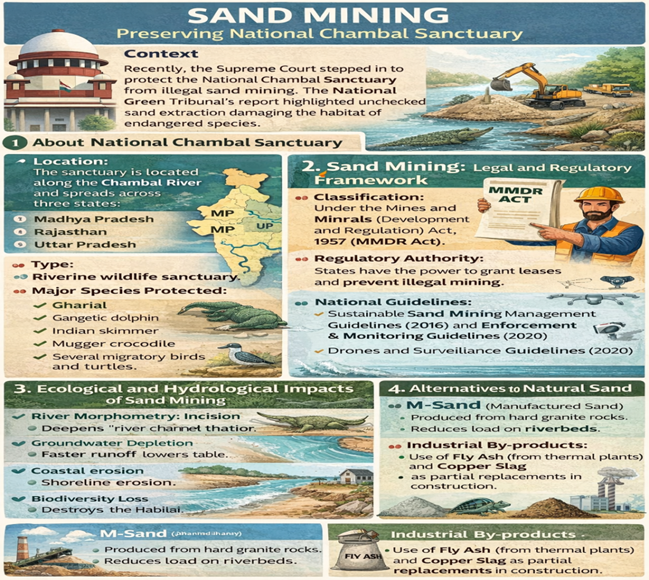
Context
Recently, the Supreme Court of India intervened to protect the National Chambal Sanctuary from illegal sand mining. The Court directed a three-member committee to monitor and control illegal mining activities in the river system.
The action followed a report submitted by the National Green Tribunal (NGT) highlighting that unchecked sand extraction in the Chambal River basin is damaging the habitat of several endangered aquatic and riverbank species.
1. About National Chambal Sanctuary
- Location: The sanctuary is located along the Chambal River and spreads across three states:
- Madhya Pradesh
- Rajasthan
- Uttar Pradesh
- Type: Riverine wildlife sanctuary
- Major Species Protected: The sanctuary is famous for protecting:
- Gharial
- Gangetic Dolphin
- Indian Skimmer
- Mugger Crocodile
- Several migratory birds and turtles.
2. Sand Mining: Legal and Regulatory Framework
- Classification: Under the Mines and Minerals (Development and Regulation) Act, 1957 (MMDR Act), sand is classified as a “Minor Mineral.”
- Regulatory Authority: The administrative and legislative power to frame rules for “Minor Minerals” entirely belongs to the State Governments (not the Central Government).
- State governments have the power to grant leases and prevent illegal mining.
- National Guidelines: The Sustainable Sand Mining Management Guidelines (2016) and the Enforcement & Monitoring Guidelines (2020) issued by the Ministry of Environment, Forest and Climate Change (MoEFCC) emphasize the use of drones and night-vision surveillance to track illegal activities.
- Further, Ministry of Mines, through Indian Bureau of Mines, has developed the Mining Surveillance System (MSS), in coordination with Bhaskaracharya Institute for Space Applications and Geo-informatics (BISAG), Gandhinagar and Ministry of Electronics and Information Technology (MEITY), to use space technology for curbing illegal mining activity in the country.
3. Ecological and Hydrological Impacts of sand mining
- River Morphometry: Excessive mining causes riverbed incision (deepening), which can lower the water table of the surrounding floodplains, affecting agriculture and drinking water.
- Groundwater Depletion: Sand acts as a “sponge” that recharges groundwater. Removing it leads to faster runoff and reduced seepage.
- Coastal Erosion: Sand mining in estuarine and coastal areas destroys natural barriers against storm surges and leads to saline water intrusion into freshwater aquifers.
- Biodiversity Loss: It destroys the breeding grounds of sensitive species like the Gharial (Critically Endangered) and various species of river turtles.
4. Alternatives to Natural Sand
- M-Sand (Manufactured Sand): Produced by crushing hard granite rocks. It is ecologically superior as it reduces the load on riverbeds.
- Industrial By-products: Use of Fly Ash (from thermal plants) and Copper Slag as partial replacements in construction.
Consider the following statements regarding the National Chambal Sanctuary:

1. It is spread across three states.
2. It is primarily created to conserve the Gharial.
3. It is located on the Yamuna River.

Which of the statements given above are correct?
(a) 1 and 2 only
(b) 2 only
(c) 1 and 3 only
(d) 1, 2 and 3

Answer: A

Explanation:
Based on the geographical and ecological facts regarding the National Chambal Sanctuary, here is the evaluation of the statements:
Correct Answer: (a) 1 and 2 only

Explanation:
•	Statement 1 is Correct: The National Chambal Sanctuary (also known as the National Chambal Gharial Wildlife Sanctuary) is a tri-state protected area. It is spread across Rajasthan, Madhya Pradesh, and Uttar Pradesh.
•	Statement 2 is Correct: It was set up in 1979 specifically to protect the Gharial (Gavialis gangeticus), which is listed as Critically Endangered on the IUCN Red List. It also protects the Red-crowned roof turtle and the Endangered Ganges River Dolphin.
•	Statement 3 is Incorrect: The sanctuary is located on the Chambal River, not the Yamuna River. While the Chambal River is a major tributary of the Yamuna, the sanctuary itself is situated along the pristine stretch of the Chambal.