Context
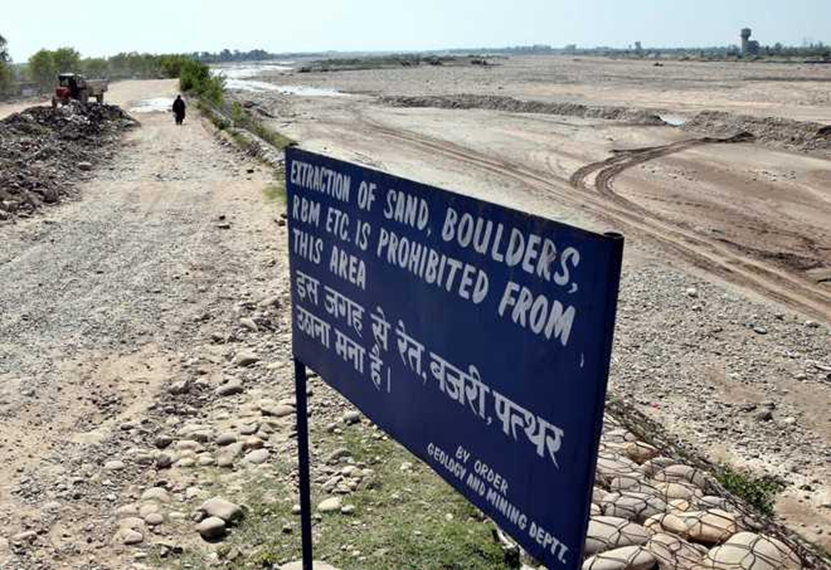
- Recently, the Supreme Court’s scrutiny of illegal mining in the National Chambal Sanctuary has brought the spotlight back to the “Sand Mafia” and the collapse of riverine governance. While sand is essential for the construction boom in North India, its extraction has moved from a regulated activity to an organized crime, threatening the structural integrity of bridges and the survival of aquatic species.
1. Legal Status: A “Minor Mineral”
In India, minerals are classified into ‘Major’ and ‘Minor’ under the Mines and Minerals (Development and Regulation) Act, 1957 (MMDR Act).
- Minor Mineral: Sand is classified as a minor mineral.
- Regulatory Authority: Unlike major minerals (where the Union has significant control), the State Governments have the power to frame rules for the grant of concessions, fixing royalty rates, and monitoring minor minerals.
- Constitutional Link: This falls under the State List (List II) of the Seventh Schedule, though the Union can provide a broad framework for conservation.
2. Ecological and Physical Impact
Unregulated or “instream” sand mining causes irreversible damage to river systems:
- Riverbed Incision: Excessive mining lowers the riverbed, leading to bank erosion and the deepening of the river channel.
- Loss of Biodiversity: As seen in the Chambal region, mining destroys the sandbars required by Gharials and Turtles for nesting.
- Water Quality: Increased turbidity (muddiness) affects the penetration of sunlight, harming aquatic plants and fish.
- Infrastructure Risk: By lowering the water table and eroding banks, mining can undermine the foundations of bridges and piers.
3. Regulatory Framework: Guidelines & Monitoring
To balance development with ecology, the MoEF&CC issued two key documents:
- Sustainable Sand Mining Management Guidelines (SSMG) 2016: Focused on the “District Survey Report” (DSR) to identify areas where mining is sustainable. It emphasizes that the amount of sand extracted should not exceed the annual rate of replenishment.
- Enforcement & Monitoring Guidelines 2020: Introduced technical tools like Drones, GPS tracking of vehicles, and Night Vision Surveillance to prevent illegal extraction. It also mandated “Replenishment Studies” to be conducted before renewing mining leases.
4. Environmental Clearance (EC)
Following the Supreme Court’s judgment in the Deepak Kumar vs. State of Haryana (2012) case:
- Mandatory EC: Environmental clearance is mandatory for mining minor minerals even in areas less than 5 hectares.
- Categorization: Large projects (Category A) require clearance from the Central Government (MoEF&CC), while smaller projects (Category B) are cleared by the State Environment Impact Assessment Authority (SEIAA).
Q. With reference to the management of sand mining in India, consider the following statements:

1. The power to frame rules to prevent illegal mining of minor minerals is vested entirely in the State Governments.

2. The "Sustainable Sand Mining Management Guidelines" mandate that sand extraction can only be permitted after a replenishment study proves the sustainability of the resource.

3. According to the 2012 Supreme Court ruling, environmental clearance is not required for mining leases involving an area of less than five hectares.

How many of the statements given above are correct?
(a) Only one
(b) Only two
(c) All three
(d) None

Solution: Answer: (b)

• STATEMENT 1 IS CORRECT: Section 23C of the MMDR Act, 1957, empowers State Governments to frame rules to prevent illegal mining, transportation, and storage of minerals.

• STATEMENT 2 IS CORRECT: Both the 2016 and 2020 guidelines emphasize that mining must be based on a District Survey Report and replenishment data to ensure the river's health.

• STATEMENT 3 IS INCORRECT: In the Deepak Kumar Case (2012), the Supreme Court made it mandatory to obtain Environmental Clearance even for lease areas less than five hectares.