After Reading This Article You Can Solve This UPSC Mains Model Questions:
Critically analyse the idea that institutional legitimacy in a democracy is strengthened more by transparency and accountability than by insulation from criticism. Illustrate with contemporary examples. 15 Marks (GS-2, Polity)
Introduction
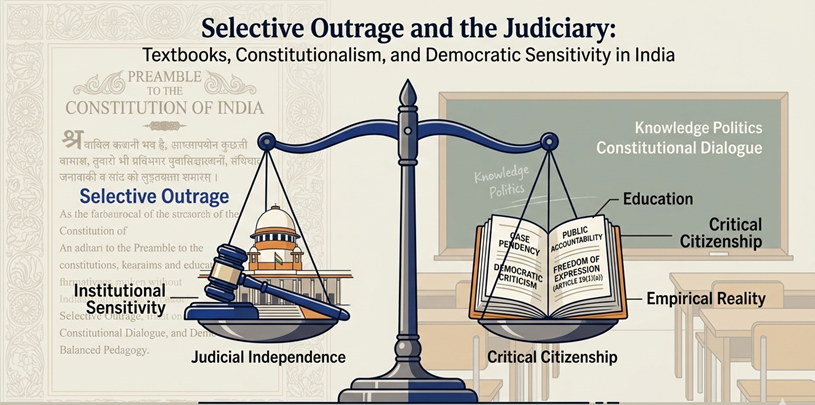
The controversy over references to the judiciary in an NCERT Class VIII textbook has revived constitutional debates. The Supreme Court’s strong response calling the passages a “deep-seated conspiracy” threatening judicial integrity has intensified concerns about institutional sensitivity.
The episode goes beyond textbook content. It touches upon fundamental concerns relating to:
- The limits of institutional criticism in democratic societies,
- The balance between judicial dignity and freedom of expression,
- The role of education in fostering critical citizenship,
- The evolving dynamics between judiciary, executive, and knowledge production.
Background: The Textbook Controversy
The controversy emerged after a Supreme Court Bench objected to textbook passages discussing:
- Judicial corruption,
- Case pendency,
- Citizen experiences within legal processes,
- Complaint and accountability mechanisms.
The Union government subsequently expressed regret, signalling administrative action against officials responsible for the content.
The judiciary viewed these references as damaging to institutional credibility, whereas critics argued that such discussions represent essential civic awareness grounded in empirical reality.
Constitutional Context: Judiciary and Freedom of Expression
The Indian Constitution simultaneously protects institutional authority and democratic critique.
1. Freedom of Speech and Expression, Article 19(1)(a)
Article 19(1)(a) guarantees citizens the right to freedom of speech and expression, which includes:
- Academic critique,
- Institutional evaluation,
- Civic education and discussion.
The Supreme Court itself has repeatedly held that democracy thrives on informed criticism (Romesh Thappar v. State of Madras, 1950).
However, Article 19(2) permits reasonable restrictions in the interests of:
- Contempt of court,
- Public order,
- Defamation.
The constitutional challenge lies in distinguishing legitimate criticism from institutional undermining.
2. Judicial Independence, Articles 124–147
Judicial independence forms part of the Basic Structure Doctrine (Kesavananda Bharati v. State of Kerala, 1973).
Relevant constitutional safeguards include:
- Security of tenure (Articles 124 & 217),
- Salaries charged on Consolidated Fund,
- Difficult removal process through impeachment,
- Separation of judiciary from executive (Article 50, Directive Principles).
These provisions ensure courts remain insulated from political pressure. Yet independence does not imply immunity from public scrutiny.
Key Issues Emerging from the observation
1. Institutional Sensitivity: Protection or Overreach?
· Textbooks as state-approved knowledge tools shape democratic consciousness more authoritatively than media commentary.
· The Court’s concern is that public trust underpins judicial authority, and references to corruption in official curricula may delegitimise adjudicatory power.
However, John Stuart Mill’s harm principle permits restrictions only when speech causes direct harm, not mere discomfort..
2. Structural Realities and Constitutional Discourse
Empirical data reveals significant institutional challenges:
- Over 5 crore pending cases across courts.
- More than 70,000 cases pending before the Supreme Court.
- Over 60 lakh cases in High Courts.
- Judge-to-population ratio of ~21 per million.
- High Court vacancies often between 25–35%.
These structural constraints, recognised in cases like Hussainara Khatoon (Article 21 – right to speedy trial), highlight systemic judicial challenges. The key question is whether discussing these realities amounts to defamation or represents responsible, transparent civic education.
3. Curriculum Control and Knowledge Politics
- The controversy also intersects with broader debates on curriculum revision. Recent reforms have altered medieval history narratives, emphasised ancient civilisation, and reframed colonial economic critique.
- Antonio Gramsci’s concept of cultural hegemony suggests that control over educational narratives shapes collective legitimacy. The issue arises when institutional reactions to criticism appear selective, especially in a context where textbook content is already subject to ideological recalibration.
4. Selective Outrage and Legitimacy Deficit
- Max Weber’s theory locates institutional legitimacy in public belief. Legitimacy weakens when institutions appear intolerant of scrutiny.
- Criticism is routinely directed at the executive, political leadership, bureaucracy, and historical actors. If judicial criticism uniquely invites strong institutional reaction, it creates “accountability asymmetry.”
A Larger Constitutional Question
The episode reveals an enduring dilemma in constitutional democracies:
- Should institutions prioritise image protection?
- Or embrace transparency to enhance long-term legitimacy?
Political scientist Bruce Ackerman’s constitutional dialogue theory suggests democracy evolves through continuous interaction between institutions and citizens.
Textbooks form part of this dialogue.
Comparative Constitutional Perspective
Democratic systems worldwide institutionalise judicial criticism:
- United States: Academic critique of Supreme Court decisions is routine.
- United Kingdom: Judicial performance and reforms openly debated in Parliament.
- Canada: Judicial transparency reports enhance public accountability.
Comparative constitutionalism shows that critique coexists with judicial respect.
Way Forward: Harmonising Institutional Respect with Democratic Literacy
- Preserve Judicial Dignity: Recognise courts as guardians of Fundamental Rights, interpreters of the Constitution, and checks on majoritarian excess; maintaining public trust is essential for constitutional governance.
- Institutionalise Responsible Critique: Encourage rational-critical debate in the public sphere, as emphasised by Jürgen Habermas, ensuring that institutions remain open to deliberative scrutiny rather than insulated from discussion.
- Adopt Balanced Civic Pedagogy: Educational materials should simultaneously present judicial achievements, explain structural limitations, and outline accountability mechanisms to avoid distortion or over-simplification.
- Embed Constitutional Morality in Education: In line with Dr. B.R. Ambedkar’s vision, civic education must cultivate critical reasoning, awareness of institutional limits, and understanding of accountability structures.
- Promote Critical Consciousness: Following Paulo Freire’s idea of “conscientization,” education should develop informed and engaged citizens; suppressing institutional discussion risks producing passive rather than constitutionally aware participants.
- Ensure Transparency Over Sanitisation: Replace defensive censorship with principled openness, allowing fact-based institutional discourse to strengthen, rather than weaken, democratic legitimacy.
Conclusion: Reform as the Basis of Institutional Authority
Ambedkar’s concept of constitutional morality requires institutions to tolerate responsible criticism, as respect in a democracy is built through transparency, not silence. A judiciary confident in its legitimacy can accommodate informed critique without perceiving it as an attack. Selective outrage erodes public trust, whereas principled openness strengthens constitutional democracy.