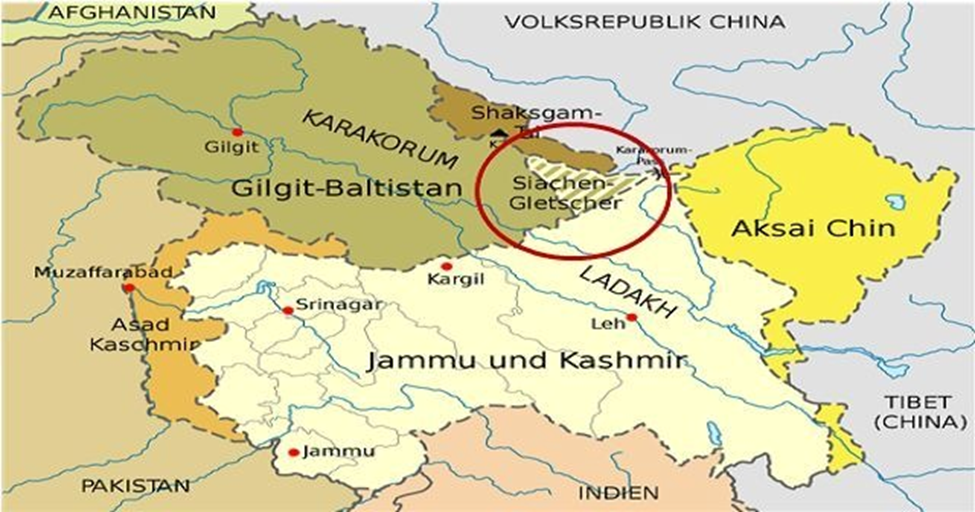
Why in the News?
- Shaksgam Valley returned to headlines amid escalating India-China tensions, as China asserted ownership and justified infrastructure projects like roads under the China-Pakistan Economic Corridor (CPEC) in the disputed region ceded by Pakistan in 1963.
- India rejected these claims outright, with MEA spokesperson Randhir Jaiswal reaffirming that the area remains part of Jammu and Kashmir, never recognizing the illegal agreement, and reserving rights for countermeasures.
1. About the valley
- Shaksgam Valley, also called the Trans-Karakoram Tract, is a sparsely inhabited, high-altitude valley in the western Karakoram Range; it lies north of the Siachen Glacier in the Hunza-Gilgit region.
- The valley borders China’s Xinjiang region to the north, Pakistan-occupied Kashmir (PoK) to the south/west, and India-controlled Siachen to the east.
2. Historical Background
- Before 1947, it was part of the princely state of Jammu & Kashmir. After Partition, Pakistan occupied parts of it.
- In 1963, Pakistan signed the Sino-Pakistan Boundary Agreement and ceded approximately 5,180 sq km of this territory to China.
- India has formally repudiated the 1963 agreement, maintaining that Pakistan lacked the legal competence to cede or transfer territory that forms an integral part of Jammu and Kashmir and Ladakh.
3. Current Status
- Administered by China as part of Xinjiang Uyghur Autonomous Region.
- India’s stand Shaksgam Valley as part of the old J&K state (now in Ladakh), rejecting both the 1963 pact and related infrastructure development as illegal.
4. Strategic Significance
- Its proximity to Siachen Glacier – the world’s highest battlefield- gives it immense military importance for surveillance and logistics.
- Control over this region affects India’s security calculus along the Line of Actual Control (LAC) with China and the Line of Control (LoC) with Pakistan.
- Recent Chinese infrastructure expansion enhances connectivity between Xinjiang and Gilgit-Baltistan and could shorten logistic routes near India’s northern frontiers.
5. India’s Official Position
- India repeatedly protests Chinese construction in Shaksgam, stating the valley is part of its territory and that the 1963 agreement and CPEC projects there are illegal and invalid.
Q: With reference to the Shaksgam Valley and its geopolitical context, consider the following statements:
1. The Shaksgam Valley is also known as the Trans-Karakoram Tract and lies north of the Siachen Glacier.
2. Pakistan ceded parts of the Shaksgam Valley to China under a 1963 boundary agreement, which India considers invalid because Pakistan had no legal right to transfer land that was part of Jammu & Kashmir.
3. India recognises the 1963 Sino-Pakistan boundary agreement and supports infrastructure development in the region under the China-Pakistan Economic Corridor (CPEC).

Which of the statements given above is/are correct?
A. 1 and 2 only
B. 2 and 3 only
C. 1 and 3 only
D. 1, 2 and 3

Answer: A
Explanation:
Statement 1 is correct because the Shaksgam Valley is also known as the Trans-Karakoram Tract and is located to the north of the Siachen Glacier in the Karakoram mountain range.
Statement 2 is correct as Pakistan ceded the Shaksgam Valley to China under the 1963 Sino-Pakistan Boundary Agreement, which India considers illegal and invalid since Pakistan had no legal authority to transfer territory belonging to the former state of Jammu and Kashmir.
Statement 3 is incorrect because India does not recognise the 1963 agreement and has consistently opposed Chinese infrastructure development and CPEC projects in the Shaksgam Valley, asserting it as part of Indian territory. Hence, the correct answer is Option A (1 and 2 only).