Context
Recently, the Defence Research and Development Organisation (DRDO) has made significant strides in the flight testing and refinement of the Solid Fuel Ducted Ramjet (SFDR) propulsion system, with recent reports highlighting its integration into future long-range air-to-air missiles (LRAAM) to ensure air superiority.
1. What is SFDR?
The SFDR is a missile propulsion system based on the Ramjet engine principle. Unlike standard rockets that carry both fuel and an oxidizer, the SFDR takes oxidizer (oxygen) from the atmosphere during flight. This significantly reduces the weight of the missile, allowing it to carry a larger payload or achieve a much longer range.
2. How it Works
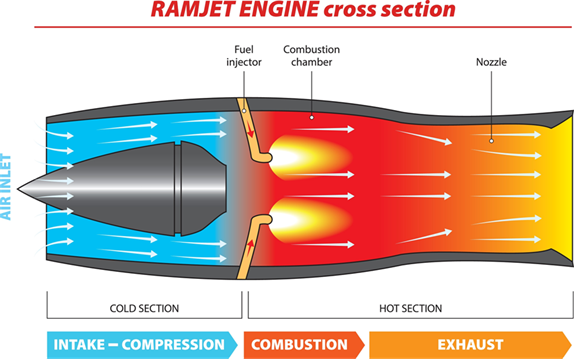
- Air-Breathing Mechanism: The missile uses its forward motion to compress incoming air into the engine (the “ram” effect).
- Solid Fuel Component: It utilizes a solid fuel propellant that reacts with the compressed atmospheric oxygen to create thrust.
- No Moving Parts: Ramjets are unique because they have no rotating compressors or turbines, making them simpler yet highly efficient at supersonic speeds.
- Boost-Sustain Phase: The missile is initially launched using a conventional solid rocket motor to reach supersonic speeds, after which the SFDR takes over for the sustained long-range cruise.
3. Key Technical Features
- Thrust Modulation: SFDR technology allows the missile to throttle its thrust based on the altitude and speed requirements, which is difficult to achieve with standard solid motors.
- Supersonic Speed: It is designed to operate optimally at speeds between Mach 2 and Mach 5.
- No-Escape Zone: Because the engine can maintain high speeds for a longer duration, it significantly increases the “No-Escape Zone” for enemy aircraft, making the missile much harder to evade.
4. Comparison with Conventional Systems
| Feature | Conventional Solid Rocket | SFDR (Ramjet) |
| Oxidizer | Carried on board | Taken from the atmosphere |
| Weight | Heavier (due to oxidizer) | Lighter and more efficient |
| Range | Limited | Significantly Extended |
| Speed | Decelerates after fuel burnout | Maintains high speed longer |
Q. With reference to the ‘Solid Fuel Ducted Ramjet (SFDR)’ technology, consider the following statements:
1. It is a propulsion system that eliminates the need for an onboard oxidizer by using atmospheric oxygen.
2. The SFDR-based missiles are primarily used for low-speed, subsonic cruise flight to ensure fuel efficiency.
3. The technology has been developed indigenously by the Defence Research and Development Organisation (DRDO).

How many of the statements given above are correct?
A) Only one
B) Only two
C) All three
D) None

Correct Answer: B) Only two
Explanation:
STATEMENT 1 IS CORRECT: SFDR is an air-breathing engine that uses a ramjet to suck in atmospheric oxygen, negating the need for an internal oxidizer.
STATEMENT 2 IS INCORRECT: SFDR technology is specifically designed for supersonic speeds (typically Mach 2 to Mach 5); ramjets do not function efficiently at subsonic speeds as they require high velocity to compress incoming air.