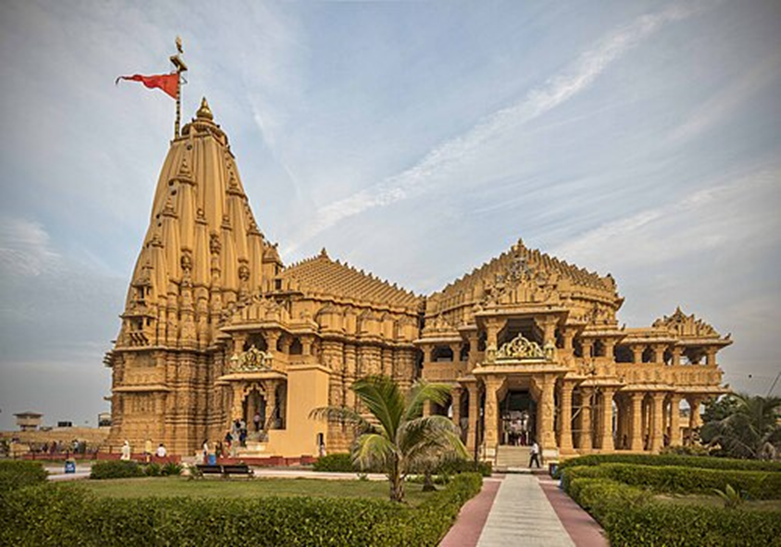
Why in the News?
- The Prime Minister of India highlighted the millennium-long continuity and resilience of the Somnath Temple, marking one thousand years since its destruction during Mahmud of Ghazni’s invasion in 1026 CE.
- He also highlighted, Ahilyabai Holkar’s role in restoring temples like Somnath and Kashi Vishwanath, and recalled Swami Vivekananda’s view that such temples embody India’s history and spirit more deeply than written texts.
Somnath Temple: Key Facts & Historical Significance
1. Location & Identity
- Located at Prabhas Patan, near Veraval, in Gir Somnath district, Gujarat
- Dedicated to Lord Shiva.
- Revered as the first of the 12 Jyotirlingas of Shiva
- Situated at the confluence of sacred Triveni Sangam, the confluence of the Kapila, Hiran, and the mythical Saraswati rivers (Arabian coast)
2. Religious & Cultural Importance
- One of Hinduism’s most sacred pilgrimage sites
- Mentioned in several ancient texts, including:
- Skanda Purana
- Shiva Purana
- Bhagavata Purana
- Symbolises Shaivite tradition and India’s civilizational continuity.
3. Etymology & Symbolism
- “Somnath” means “Lord of the Moon”
- Legend: Moon God (Soma) worshipped Shiva here to regain his lost radiance.
4. Ancient History
- Believed to have existed since ancient times, possibly pre-Mauryan era
- The shore temple of Somnath is believed to have been built in 4 phases-in gold by Lord Soma, in silver by Ravi, in wood by lord Krishna and in stone by King Bhimadeva.
- The first temple at the site, dedicated to Soma (the Moon God), is believed to have been built by the Chaulukya (Solanki) king Mularaja sometime before 997 CE.
5. Attacks & Destruction
- 1026 CE: The site was invaded and plundered by Mahmud of Ghazni during the reign of Bhima I.
- The raid of 1026 by Mahmud is confirmed by the 11th-century Persian historian Al-Biruni.
- The temple was repeatedly destroyed and rebuilt over centuries.
- Subsequent destructions occurred during:
- Delhi Sultanate period: Khalji’s Invasion
- Mughal era (notably under Aurangzeb)
6. Reconstruction & Resilience
- Rebuilt multiple times by Hindu rulers and devotees
- Major restorations associated with:
- Chalukyas: Kumarpala
- Chudasama dynasty: Mahipala I
- Marathas: Ahilyabai Holkar
7. Modern Reconstruction (Present Structure)
- Present temple reconstructed in Chaulukya (Solanki) style
- Reconstruction initiated after independence:
- Sardar Vallabhbhai Patel played a key role.
- Inaugurated by Dr. Rajendra Prasad, India’s first President.
8. Temple Architecture
- The present temple is a Māru-Gurjara architecture (also called Chaulukya or Solanki style) temple.
- The new Somnath temple is intricately carved, two level temple with pillared mandapa and 212 relief panels.
- A notable inscription (The Baan Stambh ) states that from the temple’s southern arrow, there is no landmass till the South Pole, symbolizing cosmic alignment.
9. National & Intellectual Significance
- Swami Vivekananda visited Somnath in the 1890s.
- In his 1897 Chennai lecture, he stated:
- “Temples like Somnath reveal India’s history and spirit more than books”
Consider the following statements about the Somnath Temple:
1. The present temple is built in the Chaulukya (Solanki) style of architecture.
2. The Baan Stambh inscription reflects ancient Indian geographical knowledge, noting no landmass between Somnath and the South Pole.
3. Literary references to Somnath are entirely absent in early classical Sanskrit sources.

Which of the statements given above are correct?
(a) 1 and 2 only
(b) 2 and 3 only
(c) 1 and 3 only
(d) 1, 2 and 3

Answer: A

Explanation:
Statement 1 is correct: The Somnath Temple in Gujarat, India, whose current structure, rebuilt after numerous destructions, follows the Māru-Gurjara or Chaulukya (Solanki) style of Hindu temple architecture, noted for its intricate carvings, grand shikhara (spire), and elements like Surya-kunds (sun tanks).
Statement 2 is correct:  A notable inscription (The Baan Stambh ) states that from the temple’s southern arrow, there is no landmass till the South Pole, symbolizing cosmic alignment.
Statement 3 is incorrect: The Somnath Temple is indeed mentioned in ancient Hindu texts like the Skanda Purana, Shiva Purana, and Bhagavata Purana (also called Srimad Bhagvat), highlighting its immense spiritual significance as the first of the 12 Jyotirlingas, dedicated to Lord Shiva as "Lord of the Moon,"