Recently, a tragic stampede at the Venkateswara Swamy Temple in Kasibugga, Srikakulam district (Andhra Pradesh), claimed nine lives, including children, during Ekadashi celebrations. This marks the third major stampede in Andhra Pradesh in 2025, following incidents at Visakhapatnam’s Simhachalam temple and Tirupati.
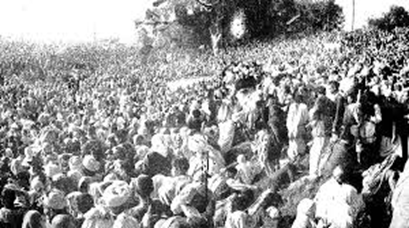
Stampede Incidents in India
India has witnessed several devastating stampede incidents over the years, with nearly 80% of them occurring during religious or pilgrimage gatherings. Some of the major tragedies include the following:
- Allahabad Kumbh Mela Stampede (1954) – The most catastrophic in Kumbh Mela’s history, claiming around 800 lives.
- Mandhardevi Temple Stampede, Wai (2005) – At Maharashtra’s Mandhardevi temple, around 340 devotees died amid chaos during an annual pilgrimage.
- Hathras Stampede (2024) – On July 2, 2024, during a religious congregation in Uttar Pradesh’s Hathras district, 121 people, mostly women, died following an uncontrolled rush.
- Prayagraj Kumbh Mela (January 2025): At least 30 pilgrims died and over 60 were injured during the Mauni Amavasya bath.
- New Delhi Railway Station (February 2025): 18 deaths occurred when Kumbh pilgrims rushed to board a crowded train.
- Bengaluru IPL Victory Parade (June 2025): A crowd surge during Royal Challengers Bangalore’s victory celebration killed 12 people.
What is a Stampede
- A stampede or crowd crush occurs when people move suddenly and uncontrollably, usually in confined spaces, resulting in trampling or compressive asphyxia.
- NDMA classifies stampedes as “man-made disasters” under the Disaster Management Act, 2005.
- There are two types:
- Unidirectional crush – crowd pushes in one direction and gets obstructed.
- Turbulent crush – people move chaotically in multiple directions.
India’s Data on Stampedes
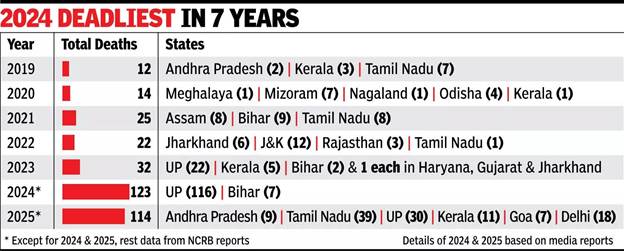
- According to National Crime Records Bureau (NCRB) data, 3,074 people died in stampedes between 2000 and 2022, and nearly 4,000 incidents have been recorded in the past three decades.
- 114 deaths reported in 2025 (till November) – second-highest in recent years.
- 92 stampede incidents (2017 – 2022) caused 128 deaths, per NCRB data.
- States frequently affected include Uttar Pradesh, Maharashtra, Bihar, Andhra Pradesh, and Tamil Nadu.
Causes and Systemic Failures
The Srikakulam tragedy reflects recurring administrative, infrastructural, and behavioural failures seen in past events like the 2011 Sabarimala crush and the 2024 Hathras incident.
- Inadequate Planning and Infrastructure
- Combined entry and exit routes, weak temporary structures, and use of under-construction areas for crowd movement.
- Severe overshooting of capacity without adequate stewarding or alternate circulation paths.
- Lack of Accountability and Licensing
- Many private temples and local religious gatherings operate without registration or official supervision.
- Permissions are often granted without verifying crowd safety compliance.
- Poor Coordination Among Agencies
- Absence of integrated planning between district administration, police, and event organizers leads to delayed responses and confusion.
- Limited Use of Technology
- Negligible adoption of CCTV surveillance, drones, crowd analytics, or digital monitoring tools.
- Weak Safety Culture
- Public disregard for safety norms, encroachments near temples, and unregulated pathways contribute to chaotic conditions.
- Behavioural Dynamics of Crowds:
- Experts note that in dense crowds, individuals react to non-verbal cues rather than instructions.
- Panic spreads silently, and when people are pressed tightly, compressive asphyxia occurs — a leading cause of deaths during stampedes.
- Once someone falls, others trip, creating a domino effect leading to pile-ups.
Challenges in Implementing NDMA Guidelines
- Poor Implementation by Local Authorities:
- Despite NDMA issuing detailed crowd safety guidelines, local authorities often fail to adopt them effectively due to bureaucratic delays, limited awareness, and lack of enforcement.
- Rising Urban Pressure
- Rapid urbanization and population growth have strained public spaces, making crowd management more complex.
- The UN’s Department of Economic and Social Affairs projects a 30% rise in India’s urban population within a decade, which will further intensify congestion and complicate crowd safety planning.
- Cultural Acceptance of Overcrowding
- A widespread social tolerance for crowded spaces reduces public concern for safety. For example, during the 2014 Mahashivaratri at Kashi Vishwanath Temple, overcrowding went largely ignored.
- Studies indicate that over 80% of attendees at large religious events in India do not perceive overcrowding as hazardous until a crisis unfolds.
- Weak Governance and Coordination
- Poor inter-agency coordination, lack of accountability, and weak enforcement of safety protocols are major concerns.
- According to CSDS findings, over 60% of stampede-related deaths between 2000 and 2015 were linked to inadequate enforcement of management guidelines.
- Deficient Infrastructure and Resources
- Many venues lack essential safety facilities such as medical posts, surveillance systems, and controlled entry-exit routes.
- A 2017 report by the Ministry of Home Affairs found that only 43% of major gathering sites in India had even basic crowd safety infrastructure.
Way Forward
- Strict Licensing and Accountability: Enforce mandatory registration for all large gatherings and link permissions to compliance with NDMA safety plans.
- Real-Time Crowd Monitoring: Use CCTV, drones, and AI-based density analytics for real-time alerts and crowd control.
- Infrastructure and Space Management:
- Ensure wide pathways, multiple exits, and load-tested barricades.
- Remove unauthorized stalls and encroachments from public routes.
- Trained Manpower: Deploy trained crowd stewards and police personnel with clear responsibilities.
- Public Awareness: Launch mass campaigns to educate people on orderly movement and crowd discipline.
- Regular Audits and Coordination: Conduct joint inspections by NDMA, SDMAs, and local authorities before major events.
About NDMA (National Disaster Management Authority)
The National Disaster Management Authority (NDMA) was established under the Disaster Management Act, 2005, functioning under the Ministry of Home Affairs and chaired by the Prime Minister of India. It is the apex body and performs key functions:
- Prepares the National Disaster Management Plan (NDMP).
- Coordinates with State and District Disaster Management Authorities.
- Promotes capacity-building, public awareness, and resilience.
- Classifies stampedes as man-made disasters and provides operational guidance for large gatherings and events.
NDMA Guidelines on Crowd Management (2014)
After repeated stampede incidents, NDMA released specific Guidelines on Managing Crowds and Congregations to ensure public safety.
Key Features
- Phased Approach : The NDMA prescribes a three-phase approach for crowd management:
- Pre-event Planning – Risk assessment, site inspection, infrastructure audit, and coordination plans.
- During Event Execution – Monitoring crowd movement, maintaining communication, and real-time surveillance.
- Post-event Review – Evaluating performance, documenting lessons learned, and revising plans for future events.
- Risk Assessment and Capacity Planning
- Authorities must conduct Hazard, Risk, and Vulnerability Assessment (HRVA) before any large event.
- Determine the safe crowd capacity of the venue and avoid overcrowding beyond this limit.
- Assess potential triggers like infrastructure failure, fire hazards, or panic situations.
- Stakeholder Coordination
- Roles must be clearly defined for district administration, police, fire services, medical teams, and organisers.
- Establish a Unified Command Structure for coordinated decision-making and communication.
- Infrastructure and Venue Safety
- Ensure dedicated entry and exit points, adequate signage, and unidirectional flow of visitors.
- Provision of emergency exits, first aid stations, firefighting equipment, and control rooms.
- Conduct mock drills before events to test preparedness.
- Information and Communication Management
- Use of public address systems, digital boards, and real-time crowd monitoring.
- Display clear instructions in multiple languages.
- Establish a centralised information system linking local police, disaster response units, and health facilities.
- Behavioural and Cultural Considerations
- Understand crowd psychology, especially in religious or emotionally charged events.
- Sensitise volunteers and police to handle crowds without using excessive force.
- Emergency Response Planning
- Develop an Emergency Evacuation Plan (EEP) for every venue.
- Keep ambulances, rapid response teams, and communication lines ready for deployment.
- Maintain liaison with nearby hospitals and fire stations.
- Use of Technology
- Encourage GIS mapping, drones, and CCTV-based crowd density analysis for real-time monitoring.
- Deploy early warning systems for surge detection
- Training and Capacity Building
- Regular training of police, municipal staff, volunteers, and NGOs in crowd psychology and control techniques.
- Conduct mock exercises in coordination with the National Institute of Disaster Management (NIDM).
- Post-Event Review and Documentation
- Conduct debriefing sessions after each event to evaluate what worked and what did not.
- Maintain a database of crowd incidents for future planning and research.
National Building Code (NBC)
The National Building Code of India (NBC), issued by the Bureau of Indian Standards (BIS), was first published in 1970 and revised in 2016. It provides standards for safe building design, occupancy, and disaster resilience.
Key Provisions Relevant to Crowd Safety
- Exit and Egress Routes: Minimum exit width and number of exits proportional to crowd size.
- Occupancy Load: Defined maximum permissible density for halls, temples, and open areas.
- Fire and Structural Safety: Fire-resistant materials, emergency lighting, and alarm systems.
- Accessibility: Barrier-free movement, open pathways, and visible signage for evacuation.
The NBC complements NDMA’s guidelines by ensuring that structural safety aligns with operational safety, especially in large public venues.
Did You Know
Globally, countries like South Korea (2022 Halloween crush) and Germany (2010 Love Parade) learned from similar tragedies by enforcing strict post-incident reforms, preventing recurrence. India’s failure lies not in lack of policy but in absence of compliance culture.