Context
The Union Ministry of Tribal Affairs has initiated inquiries into the Odisha government’s decision to shut down Forest Rights Act (FRA) Cells. These cells were established under State and Central schemes to accelerate the implementation of the landmark 2006 law.
The State has recently directed the dissolution of all FRA Cells at 50 sub-divisional levels and ordered the clearing of pending claims by the end of March 2026.
1. Forest Rights Act 2006 Historical Background
- For centuries, forest-dwelling communities lived in harmony with forests, depending on them for livelihood and culture.
- Colonial laws like the Indian Forest Act 1878 and Indian Forest Act 1927 transferred forest control to the government, restricting tribal rights and practices.
- After independence, post-1950 forest policies continued to favor commercial forestry, leading to displacement and protests by the late 20th century.
- To address these injustices, the Forest Rights Act was passed in December 2006 and came into force on 1 January 2008.
2. The Forest Rights Act (FRA), 2006
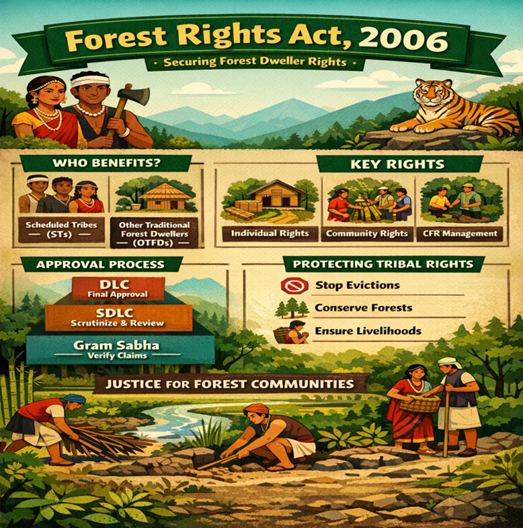
- Core Objective: The law aims to recognize the historical rights of Scheduled Tribes (STs) and other traditional forest dwellers over the forest lands they have inhabited and used for livelihoods for generations.
- Nodal Ministry: Union Ministry of Tribal Affairs
- Types of Rights: The Act provides for the recognition of:
- Individual Forest Rights (IFR): Right to cultivate forest land (up to 4 hectares) for livelihood.( The Act does not allow transfer or sale of forest land rights)
- Community Forest Rights (CFR): Rights over grazing grounds, water bodies, minor forest produce (MFP), and community forest resources.
- Habitat Rights: Special rights for Particularly Vulnerable Tribal Groups (PVTGs).
- Rights to Rehabilitation and Development: Protection from eviction without proper resettlement.
- Eligibility: Rights can be claimed by any member or community that has for at least three generations (75 years) before the 13th day of December 2005 lived in the forest.
- Critical wildlife habitats: It provides that critical wildlife habitats of National Parks & Sanctuaries must remain inviolate for wildlife conservation.
- Special Note: Critical tiger habitats (also known as core areas of tiger reserves) are established under the Wildlife (Protection) Act (WLPA), 1972.
3. Forest Rights Act 2006 Implementation Mechanism
- Gram Sabha: Empowered to start the process of identifying and deciding the type and extent of individual as well as community forest rights.
- Sub-Divisional Level Committee (SDLC): Formed by the State Government to review and verify the resolutions submitted by the Gram Sabha.
- District Level Committee (DLC): Acts as the final authority for granting approval of forest rights.
4. Forest Rights Act 2006 Constitutional Framework
- Article 46: Directs the State to protect the interests of Scheduled Tribes and weaker sections.
- Article 48A: The State is mandated to take active measures to protect and enhance the natural environment, including forests, lakes, rivers, and wildlife.
- Article 51A(g): Fundamental duty of every citizen to protect the natural environment.
- Article 244: Provides for the administration of Scheduled Areas and Tribal Areas.
5. Current Status of Implementation in Odisha
- Performance Rank: Odisha has issued the second-highest number of forest rights titles in India, following Chhattisgarh.
- Pendency Rate: Despite high performance, the State has the sixth-highest pendency rate in the country.
6. Challenges (as highlighted by the Xaxa Committee):
- Arbitrary rejection of claims without clear justification.
- Absence of fixed timelines for processing and disposing of claims.
- Forest rights of people displaced due to development projects remain largely unrecognized and unresolved.
- Procedural complexities and lack of awareness among beneficiaries.
7. Key Schemes Involved
- DA-JGUA (Dharti Aaba Janjatiya Gram Utkarsh Abhiyan): A Central scheme launched in 2024 aims to address critical gaps in health, education, and livelihoods in over 63,000 villages, covering more than 5 crore tribal people across the country.
- PM-JANMAN: Aims tobring tribal communities mainstream, implemented by the Ministry of Tribal Affairs with states.
Consider the following statements regarding the Forest Rights Act (FRA), 2006:

I. The Act recognizes the rights of forest-dwelling Scheduled Tribes (STs) and Other Traditional Forest Dwellers (OTFDs).

II. It allows recognition of individual forest land rights up to 4 hectares per family for cultivation.

III. The Sub-Divisional Level Committee has the authority to initiate the process of determining forest rights.

IV. It recognizes bamboo as a minor forest produce.

Which of the statements given above are correct?

(a) I and II only
(b) I, II and IV only
(c) II, III and IV only
(d) I, II, III and IV

Answer: B

Explanation:

•  Statement I is Correct: The Act specifically aims to recognize and vest forest rights in both Scheduled Tribes (STs) and Other Traditional Forest Dwellers (OTFDs) who have been residing in such forests for generations.
•  Statement II is Correct: Under the Act, the recognition and vesting of individual forest rights are restricted to the area under actual occupation, not exceeding 4 hectares per family for self-cultivation.
•  Statement III is Incorrect: According to the Act, the authority to initiate the process for determining the nature and extent of forest rights lies with the Gram Sabha, not the Sub-Divisional Level Committee. The Sub-Divisional and District Level Committees are responsible for the subsequent screening and approval of these claims.
•  Statement IV is Correct: The Act defines Minor Forest Produce (MFP) to include all non-timber forest produce of plant origin, specifically including bamboo, brushwood, stumps, cane, tusser, cocoons, honey, wax, lac, tendu or kendu leaves, medicinal plants, and herbs.