After Reading This Article You Can Solve This UPSC Mains Model Questions:
Discuss how geopolitical conflicts in West Asia influence global energy flows and reshape power dynamics among major countries like the U.S., Russia, and India. 15 Marks (GS-2, International Relations)
Introduction
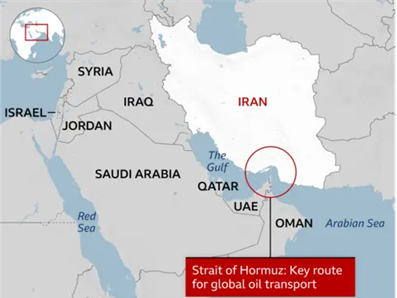
In simple words, a narrow sea passage called the Strait of Hormuz is like the main pipe that carries almost one-fifth of the world’s traded oil. After the recent US-Israel military action against Iran, Iran blocked ships through this strait of Hormuz. This sudden stop has caused oil prices to jump above $110 per barrel, created chaos in energy markets, and forced big countries like India, the USA, and Russia to change their plans quickly.
Significance of the Strait of Hormuz as a Global Energy Chokepoint
The Strait of Hormuz is a narrow waterway located between Iran (north) and Oman and the UAE (south). It connects the Persian Gulf (home to huge oil producers like Saudi Arabia, UAE, Iraq, Kuwait, and Iran) to the Gulf of Oman and the open Arabian Sea (leading to the Indian Ocean).
- Narrowest point: Only 21–33 km wide (about the width of a small city).
- Daily transit (pre-closure, 2024–2025 data): Around 20–21 million barrels per day of crude oil and products — roughly 20–25% of global seaborne oil trade and about 20% of total world oil consumption.
- Also carries ~20% of global LNG (liquefied natural gas).
- 80–90% goes to Asia (China, India, Japan, South Korea).
- Alternatives (pipelines like Saudi Arabia’s East-West pipeline) can handle only 3.5–7 million barrels per day max, far less than needed.
Why it matters: It’s a global “chokepoint.” Any block here creates instant supply shortages, panic buying, and price spikes worldwide. Right now, with the closure, hundreds of tankers are waiting, and Gulf exports are shifting to limited pipelines or getting stuck.
Energy Production andConsumption Dynamics in the World
Oil and natural gas together supply slightly more than half of the world’s total energy (IEA 2024 data), while the remaining portion comes from coal, renewables, nuclear, and other sources.
- Main uses:
- Fuel for transport (cars, trucks, airplanes, ships)
- Generation of electricity
- Production of cooking gas (LPG)
- Essential raw materials for industries (plastics, chemicals, fertilizers)
- Production and Consumption Pattern
- Major producers: Concentrated in West Asia (Persian Gulf region), especially Saudi Arabia, UAE, Iran, Iraq, and Kuwait — the world’s leading exporters of crude oil and natural gas.
- Major consumers: Rapidly growing economies in East Asia and South Asia, particularly China, India, and Japan.
- Limited domestic reserves: These Asian countries have very little oil of their own (although China is a significant producer of natural gas).
- Heavy Reliance on Imports
- China, India, and Japan depend heavily on imported crude oil and natural gas to support their expanding economies and populations.
- A large share of these imports especially from the Persian Gulf passes through the narrow Strait of Hormuz, making this chokepoint critical for global energy security.
Thus, there is a clear mismatch of huge production in West Asia and massive demand in Asia creating strong dependence on safe passage through the Strait of Hormuz.
Major Players in Global Oil
Only a few regions and countries dominate global oil reserves and production:
1. OPEC (Organization of the Petroleum Exporting Countries)
(Role: coordinates production levels to influence global oil prices and ensure supply stability)
- It consists of around 12–13 major oil-producing countries.
- Leading members: Saudi Arabia (dominant leader), UAE, Iran, Iraq, Kuwait, etc.
- OPEC countries together hold over 70% of global oil reserves
- They regulate the market through output cuts or increases to maintain price stability.
- West Asia (Persian Gulf Countries)
- The key producers include Saudi Arabia, UAE, Iran, Iraq, and Kuwait.
- This region holds a major share of global oil reserves and controls large export flows through the Strait of Hormuz.
- Most of these countries are part of OPEC, which gives the region strong influence over global oil supply.
3. Other Strategic Players
- Venezuela and Iran together hold a massive share of global reserves (~39%)
- For example, Venezuela alone has around 17% of global oil reserves
- However, their current production remains limited due to: Sanctions and Infrastructure constraints
Shifting Power Dynamics among United States, Russia, and India
1. America’s Central Role in Energy Geopolitics
The United States is both a major producer and consumer of energy:
- Its economy is dominated by high‑energy sectors (transport, industry, manufacturing), leading to very high per capita energy use.
- US per capita energy consumption is roughly 10 times higher than India’s and about 2.4 times higher than China’s because of this, securing reliable energy supplies has long been a core driver of US foreign policy.
A. Historical Shift in West Asian Oil Control
From the 1950s onward, control over West Asian oil shifted:
- Initially dominated by large American and European oil companies.
- Gradually transferred to state‑owned national oil companies in the producing countries.
By the 1970s, sharp oil price spikes occurred as Arab members gained more influence in OPEC (Organization of the Petroleum Exporting Countries), using oil as a political and economic weapon.
B. US Strategic Responses
The United States countered these shifts with a two pronged strategy:
1. Boosting Domestic Production
- Heavily expanded shale oil extraction (oil trapped in hard shale rock, extracted using modern technology called fracking and horizontal drilling), especially from the mid 2000s onward.
- As a result, the US became the world’s largest oil producer, reducing dependence on imports.
2. Shaping Global Oil Geopolitics
Through military and political interventions, including:
- Gulf War (1990–1991)
- Iraq War (2003–2011)
- Recent actions in Venezuela (2026)
- Ongoing US–Israel conflict with Iran
These moves aimed to secure energy routes, influence regional regimes, and maintain access to Gulf oil.
C. “Future Oil” Calculus
- Countries like Iran and Venezuela together hold a large share of global proven oil reserves (~39%), making them crucial for future energy supply,
- For the U.S., access to these reserves is important for long-term strategic and economic planning. However, the Strait of Hormuz closure has disrupted these plans in the short term.
- At the same time, it has benefited Russia, as reduced West Asian supply has increased reliance on Russian oil, making it a key stabiliser of global energy prices.
2. Russia’s Rise as a Beneficiary
- After the 2022 Russia-Ukraine war, Russia faced Western sanctions, becoming isolated in Europe and struggling to export oil freely.
- Now, with West Asian production and exports hit hard, Russian oil is suddenly essential.
- Outside West Asia, Russia is the only major country with a large tradable oil surplus (ready for export).
A. Russian Oil and India’s Role
Oil markets are tightly linked — small changes in one area can create massive ripples worldwide.
India’s Position
- India ranks as the world’s second-largest importer of crude oil and third-largest consumer.
- Disruptions raise prices for fuel, transport, food, and everyday goods in India.
- India’s buying decisions also influence global oil prices significantly.
B. Europe’s Energy Shift
- European nations have limited domestic reserves and historically relied on Russian imports for winter heating.
- Post-2022 sanctions forced Europe to pivot toward West Asian sources.
C. India’s Pivot to Russian Oil
- To secure affordable supplies, India increased purchases of discounted Russian crude.
- Share of Russian oil in India’s imports jumped dramatically: from 2.5% in 2021 to 39% in 2023 (peaking around 36–44% in 2023–2024; recent data shows decline to ~33% in 2025 overall, with monthly lows around 27% due to sanctions pressure, but still significant).
- India refines imported crude into products like petrol, diesel, LPG, and petrochemicals.
- With large refining capacity, India (and China) export some refined products.
- Indian refiners earned strong profits from processing cheap Russian crude and selling outputs.
Western Response to the Strait of Hormuz Crisis
- Despite public criticism, Western leaders quietly supported this shift because India’s diversion to sanctioned Russian oil helped stabilize global prices from 2022 onward.
- Current Strain: With the Strait of Hormuz closed and oil prices surpassing $110 per barrel, the US now urgently wants increased purchases of stranded sanctioned Russian oil to ease market pressure.
India’s Multi-Pronged Response to the Energy Crisis
1. Government Regulation under Essential Commodities Act (ECA), 1955
- The government invoked the Essential Commodities Act, 1955 through the Natural Gas (Supply Regulation) Order, 2026 to manage the crisis.
- A priority-based allocation system has been introduced:
- Top priority: PNG (households), CNG (transport), LPG production
- Reduced supply:
- Fertilizer sector (~70%)
- Other industries (~80%)
- To prevent hoarding and panic buying, a 25-day gap between LPG bookings has been enforced.
2. Diversification of Energy Imports
- India is reducing dependence on vulnerable routes like the Strait of Hormuz.
- It has expanded imports from alternative suppliers such as: Algeria, Norway, Canada, Australia
- Supplies are being routed through longer but safer routes like the Cape of Good Hope to ensure continuity.
3. Increased Dependence on Russian Oil
- India has stepped up oil imports from Russia to compensate for supply disruptions from West Asia. This has been made possible by a temporary easing of Western sanctions, helping India maintain a steady energy supply.
4. Enhancing Domestic Energy Production
- The government has directed refineries to increase domestic production, especially LPG.
- As a result LPG output has increased by ~10% in the short term
- The additional supply is being prioritised for households to meet essential needs.
Way Forward: Building Resilience Against Future Energy Shocks
1. For India: Strengthening Energy Security
- India should diversify its import basket by sourcing oil from multiple regions such as Russia, West Asia, the United States, and Africa to reduce overdependence on any single route.
- It must expand Strategic Petroleum Reserves (SPR) from the current limited capacity (around 2 weeks) towards 90 days of reserve cover, in line with global best practices.
- There is a need to accelerate the transition to renewable energy (solar, wind) and promote electric vehicles (EVs) to reduce long-term dependence on fossil fuels.
- India should also strengthen its refining capacity and flexibility to process diverse crude types efficiently and maintain export competitiveness.
2. For the United States and Russia: Stabilising Global Supply
- The United States should prioritise diplomatic efforts to ensure the reopening and security of critical chokepoints like the Strait of Hormuz, while also boosting domestic shale oil production to ease global supply pressures.
- Russia, as a major surplus producer, can play a constructive role by offering stable, long-term supply contracts, especially to energy-importing countries like India, thereby contributing to market stability.
3. For the Global Community: Ensuring Systemic Stability
- Countries should invest in alternative energy transport routes, such as pipelines and new LNG terminals, to reduce dependence on vulnerable chokepoints.
- Greater coordination among oil-producing nations, including through platforms like OPEC+, is necessary to manage supply and avoid extreme price volatility.
- There must be a faster transition towards renewable energy, as global agencies like the International Energy Agency (IEA) highlight its potential to meet a large share of future energy demand.
- Finally, nations should emphasise diplomacy and conflict resolution to ensure stable trade flows.
Conclusion
The Strait of Hormuz crisis highlights the deep interlinkage between energy security and geopolitics, where disruptions in a single chokepoint can trigger global economic and strategic shifts. Going forward, a balanced approach combining diversification, domestic resilience, clean energy transition, and international cooperation will be essential to ensure a stable and secure energy future.