After Reading This Article You Can Solve This UPSC Mains PYQ 2024:
The West is fostering India as an alternative to reduce dependence on China’s supply chain and as a strategic ally to counter China’s political and economic dominance.’ Explain this statement with examples. 10 Marks (GS-2, International Relation)
Introduction
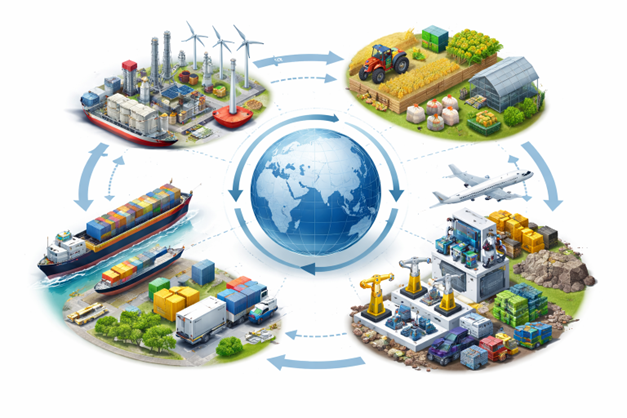
In the traditional economic sense, a supply chain is a linear network of organizations, people and resources involved in moving a product from supplier to customer. However, Supply Chain Resilience (SCR) is the adaptive capacity of an ecosystem to anticipate, resist and recover from unexpected disruptions whether they are geopolitical (wars, sanctions), environmental (climate change), or systemic (pandemics).
Why Supply Chain Resilience is Critical for India
The global shift from “Efficiency-First” (Just-in-Time) to “Resilience-First” (Just-in-Case) is driven by India’s need to decouple its growth from external shocks.
1. Shielding from “Imported Inflation”
- The Energy-Inflation Link: 85% crude dependency means a $10/barrel price hike drains $13–14 billion in forex and spikes the CPI by 30–40 bps.
- The Fiscal Burden: Supply shocks in natural gas (e.g., Russia-Ukraine) inflate the fertilizer subsidy bill, straining the fiscal deficit and threatening food security for the common man.
2. Transitioning to “Deep Manufacturing”
- The “Midstream” Gap: Reliance on a single source (China) for 70% of APIs and critical semiconductors creates a “choke-point” for our $300 billion electronics and pharma targets.
3. Safeguarding “Strategic Autonomy”
- Weaponization of Markets: Over-dependence on specific geographies for critical inputs (e.g., Lithium for EVs) allows foreign powers to use supply disruptions as diplomatic leverage.
- The “China Plus One” Edge: A resilient, predictable supply chain is India’s primary USP to attract MNCs looking to diversify their manufacturing base away from China.
4. Powering the “Green Transition”
India’s Net Zero 2070 goal necessitates a massive shift to EVs and Renewables.
- The Mineral Challenge: To avoid replacing “Oil Dependency” with “Mineral Dependency” (Lithium, Cobalt, REEs), India must secure resilient supply chains through KABIL and circular economy (recycling) initiatives.
5. Mitigating “Climate-Induced” Volatility
- Agri-Resilience: Erratic monsoons and heatwaves frequently shock the supply of pulses and oilseeds. Building climate-resilient supply chains and strategic reserves is vital to preventing rural distress and food inflation.
Sector-wise Analysis of Supply Chain Risks
1. Energy Supply Chains: The “Import-Inflation” Trap
Energy is India’s primary shock-transmission channel.
- Import Reality: India imports ~85% crude oil and ~50% natural gas. Price spikes in chokepoints like the Strait of Hormuz instantly inflate transport and manufacturing costs.
- Strategic Gap: Current Strategic Petroleum Reserves (SPR) cover only ~9.5 days of net imports—insufficient for prolonged geopolitical conflicts.
- Macro-Impact: A $10/barrel hike typically increases CPI inflation by 30–40 bps and swells the Current Account Deficit (CAD).
2. Food & Fertilizer: The “Rural Distress” Link
Despite being a net exporter of food, India’s production inputs are externally anchored.
- The “P&K” Gap: While Urea is largely domestic, India relies heavily on imports for Phosphatic (P) and Potassic (K) fertilizers from Morocco, Jordan, and Russia.
- Edible Oil/Pulses: India meets only 44% of edible oil demand domestically. Supply shifts in Indonesia (Palm) or South America (Soybean) trigger immediate “Agri-inflation.”
- Fiscal Risk: Global gas price hikes lead to a skyrocketing Fertilizer Subsidy bill, straining the fiscal deficit.
3. Manufacturing & Tech: The “Midstream” Gap
India dominates assembly (“Downstream”) but lacks component depth (“Upstream”).
- Pharma (API Risk): India relies on China for 65–70% of Active Pharmaceutical Ingredients. Any disruption in China threatens India’s “Pharmacy of the World” status.
- Electronics/Semiconductors: The $300bn electronics target is vulnerable to the Taiwan-South Korea “Fab” concentration. Current value-addition remains low at 15–20%.
- Capital Goods: Dependence on imported high-end industrial machinery (Robotics/CNC) limits indigenous industrial competitiveness.
4. Critical Minerals & Future-Tech: “Green” Dependency
The transition to a “Green Economy” creates new structural risks.
- Concentration Risk: Minerals like Lithium, Cobalt, and REEs (essential for EVs/Defense) are globally concentrated, with China controlling >60% of processing.
- Energy Security 2.0: Moving to 500 GW of non-fossil capacity risks replacing Middle East oil dependency with Chinese mineral dependency.
- Tech Chokepoints: Quantum computing and AI chips are held by a few global players, exposing India to potential “Technology Denials.”
Government Initiatives for Supply Chain Resilience
- Production Linked Incentive (PLI) Schemes: Targeting 14 key sectors (e.g., ACC Batteries, Pharma), the scheme incentivizes incremental production to shift India from low-value assembly to high-value component-level manufacturing.
- PM Gati Shakti & National Logistics Policy (NLP): A digital and physical integration of 16 ministries to reduce logistics costs from 14% to 8% of GDP.
- National Green Hydrogen Mission: Aiming for 5 MMT p.a. by 2030, it seeks to decarbonize “hard-to-abate” sectors like Steel and Refineries, reducing long-term reliance on imported fossil fuels like Natural Gas.
- KABIL (Khanij Bidesh India Ltd): A specialized Joint Venture to secure “Energy Security 2.0” by acquiring strategic overseas assets of critical minerals like Lithium and Cobalt for the EV and Defense sectors.
- India Semiconductor Mission (ISM): A $10 billion incentive framework to establish domestic “Fabs” and display ecosystems, breaking the “Silicon Dependency” on East Asia for digital sovereignty.
- Strategic Petroleum Reserves (SPR) – Phase II: Expansion of storage at Chandikhol and Padur to increase India’s fuel buffer, safeguarding the economy against maritime blockades or West Asian geopolitical shocks.
Global Trends
1. “Friend-Shoring” & “Ally-Shoring”: Countries are shifting supply chains to “Trusted Partners” with shared values (e.g., US-India-EU) to prevent economic coercion by adversarial nations.
2. The “China Plus One” Strategy: MNCs are diversifying their manufacturing bases away from China to India, Vietnam, and Mexico to mitigate “Single-Source” risks. India, Vietnam, and Mexico
3. Decoupling vs. De-risking: Led by the EU and G7, there is a trend of “De-risking”—reducing critical dependencies on specific nations (like China for Rare Earths or Russia for Gas) without completely “Decoupling” or isolating from global trade.
Challenges in Building Supply Chain Resilience
- High Logistics Costs: Despite PM Gati Shakti, India’s logistics cost remains 13–14% of GDP. This “internal tax” makes domestic intermediate goods more expensive than imported alternatives, hindering import substitution.
- Inverted Duty Structure: In several sectors, import duties on raw materials exceed those on finished goods. This discourages domestic value-addition and incentivizes “assembly” over “production.”
- MSME Technology Gap: Most Indian MSMEs lack the economies of scale and R&D required to produce high-precision intermediates (e.g., specialized chemicals) that meet global “Six Sigma” quality standards.
- Critical Mineral “Blind Spot”: India has limited domestic reserves of Lithium, Cobalt, and REEs. Securing these from the “Lithium Triangle” or Australia involves intense geopolitical competition and high capital risk.
- Long Gestation Periods: High-tech resilience, like the India Semiconductor Mission, requires decades of sustained investment in “water-power-talent” ecosystems. It is a long-term marathon, not a quick fix for immediate shocks.
- “Efficiency vs. Resilience” Trade-off: Building buffers and localizing is expensive. Shifting from “Lowest-Cost” sources (China) to “Trusted-Sources” can lead to higher end-consumer prices and inflationary pressure.
Way Forward: Strategies for a Resilient India
- Deepening “Midstream” Manufacturing: Pivot from final assembly to the domestic production of high-value intermediates (APIs, semiconductors, specialized chemicals) to eliminate “up-stream chokepoints.”
- Accelerated “Resource Diplomacy”: Use KABIL to aggressively secure long-term “Off-take Agreements” for critical minerals (Lithium, Cobalt) in the Lithium Triangle and Africa, insulating the Green Energy transition.
- Reducing Logistical Friction: Fully operationalize PM Gati Shakti and the National Logistics Policy to slash logistics costs to 8% of GDP, making domestic components price-competitive against global imports.
- Institutionalizing Multi-Sectoral Buffers: Expand Strategic Reserves beyond oil (SPR Phase II) to include Edible Oils, Pulses, and Fertilizers, acting as a shock absorber against maritime and price disruptions.
- Strengthening “Trust-Based” Networks: Leverage mini-lateral frameworks like SCRI (Japan/Australia) and iCET (USA) to facilitate “Friend-Shoring” and secure access to sensitive high-end technologies.
- Mainstreaming the Circular Economy: Promote “Urban Mining” to recover Rare Earth Elements from e-waste, reducing primary raw material import demand and enhancing environmental sustainability.
Conclusion
Future-proofing India’s $5 trillion trajectory requires transitioning from a “Global Price-Taker” to a “Strategic Value-Maker.” By integrating Aatmanirbharta with Trust-based Global Value Chains, India can ensure a resilient, shock-proof, and sovereign economic era.