Context
The Supreme Court of India has refused to allow the Haryana government to proceed with its proposed Aravalli jungle safari project until experts clearly define the official boundary (“range”) of the Aravalli hills.
This safari project aims to set up big cat zones and house hundreds of species of birds, reptiles and butterflies in an area of 10,000 acres in the eco-fragile Aravali range in Gurugram and Nuh districts.
Ongoing Debate
- The Supreme Court of India (Nov–Dec 2025) reviewed a committee led by Ministry of Environment, Forest and Climate Change to frame a uniform definition of the Aravalli range for mining regulation, stressing its role in preventing desertification, recharging groundwater, and conserving biodiversity.
- Aravalli Hills Definition: Any landform rising 100 metres or more above the surrounding local terrain.
- Aravalli Ranges Definition: Clusters of two or more such hills located within 500 metres of each other.
What are the Criticisms Regarding the New Definition of Aravalli Hills?
- Major Exclusion: A 100-m threshold may exclude over 90% of the Aravalli landscape, raising ecological concerns.
- Mining Risk: Unprotected areas could face mining, construction, and urban expansion.
- Ecological Break: Peak-centric definition ignores foothills, valleys, and ridges.
- Water Threat: Damage to slopes may reduce groundwater recharge.
- Desertification Risk: Weakening the barrier could accelerate Thar Desert spread, affecting India’s commitments under the UN Convention to Combat Desertification.
About the Aravalli Hills:
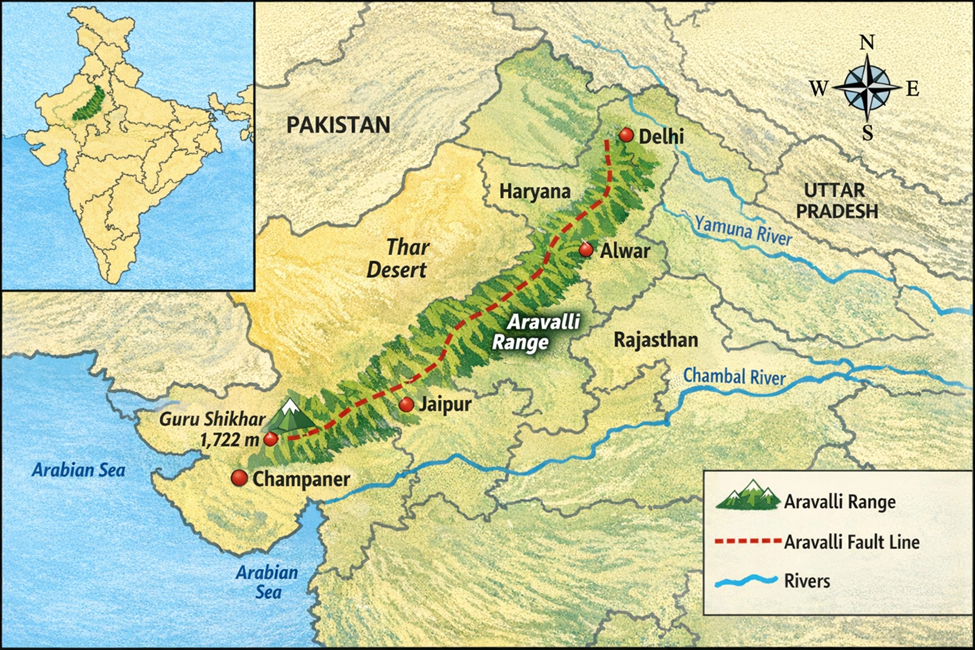
- The Aravalli Hills and Ranges are among India’s oldest geological formations, stretching from Delhi through Haryana, Rajasthan, and into Gujarat.
- Type: An ancient fold mountain chain, now worn down into residual hills (300–900 m).
- Highest Peak: Guru Shikhar (1,722 m) on Mount Abu.
- Hydrological Role: The Aravalli range, located in a semi-arid region (500–700 mm rainfall), acts as a major watershed separating the Ganga–Indus drainage divide and river systems flowing toward the Bay of Bengal and the Arabian Sea.
Significance of the Aravalli Range
- River Source: Several rivers originate in the Aravallis, including Luni, Banas, Sahibi and Sabarmati.
- Barrier Against Desertification: Acts as a natural wall preventing the eastward spread of the Thar Desert.
- Aravalli Green Wall Initiative: A project to develop a 1,400 km long, 5 km wide green buffer across 29 districts in Gujarat, Rajasthan, Haryana, and Delhi to curb desertification, reduce land degradation, and prevent the eastward spread of the Thar Desert.
- Aquifer Recharge: Fractured and weathered Aravalli rocks allow rainwater percolation, enabling recharge of underground aquifers.
- Mineral Resources: Rich in marble, granite, copper, zinc, and lead ores.
- Cultural and Heritage Significance: The Aravalli range houses UNESCO World Heritage Sites like Chittorgarh and Kumbhalgarh forts.
 Consider the following statements:

I. Aravalli hills are spread over five States only.
II. Several rivers originate in the Aravallis, including Luni, Banas, Sahibi and Sabarmati.

Which of the statements given above is/are correct?
(a) 1 only
(b) 2 only
(c) Both 1 and 2
(d) Neither 1 nor 2

Answer: B

Explanation:
Statement I is Incorrect: The Aravalli Range does not spread over five states. It spans approximately 670 km (430 miles) across three states and one Union Territory:( Gujarata, Rajasthan, Haryana and Delhi).
Statement II is Correct. The Aravallis act as a major watershed. Several significant rivers originate from these hills:

•	Luni: Originates near Ajmer and flows towards the Rann of Kutch. It is notable for being an endorheic river     (does not reach the ocean).
•	Banas: A tributary of the Chambal River, it originates in the Khamnor Hills of the Aravalli Range.
•	Sahibi: An ephemeral river flowing through Rajasthan and Haryana.
•	Sabarmati: Originates in the Udaipur district of the Aravallis and flows into the Gulf of Khambhat.