Context
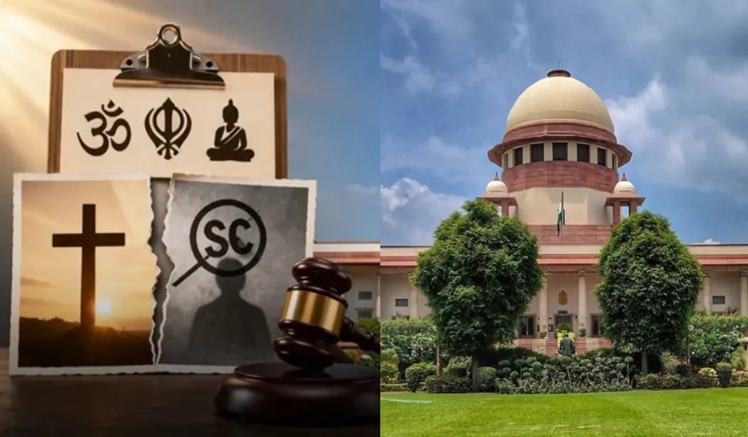
Recently, the Supreme Court of India, in a significant judgment reaffirmed that the Scheduled Caste status is essentially tied to specific religious identities as per the Constitution (Scheduled Castes) Order, 1950. The court held that any person professing a religion other than Hinduism, Sikhism, or Buddhism automatically loses their Scheduled Caste status and the associated benefits, such as reservation and protection under the SC/ST (Prevention of Atrocities) Act, regardless of their birth. This ruling emphasizes that conversion to Christianity or Islam results in the immediate cessation of SC entitlements because these religions are theologically considered to not recognize the institution of caste.
Key Legal and Constitutional Provisions
- Article 341: This article empowers the President to specify the castes, races, or tribes which shall be deemed to be Scheduled Castes in relation to a particular State or Union Territory.
- Constitution (Scheduled Castes) Order, 1950: Initially, only Hindus were eligible for SC status. It was amended in 1956 to include Sikhs and in 1990 to include Buddhists.
- The “Profess” Criteria: The Supreme Court clarified that “professing” a religion involves a public declaration or practice. A person cannot “simultaneously profess” a non-notified religion (like Christianity) and claim SC benefits.
- Re-conversion: For a person to reclaim SC status after re-converting to Hinduism, Sikhism, or Buddhism, they must establish their original caste identity and show that they have been accepted back by their original community.
Landmark Verdict on Sub-Classification (Davinder Singh Case)
While the recent 2026 ruling focused on religion, a landmark 7-judge Constitution Bench ruling (2024) drastically changed the landscape of SC reservations:
- Overruled E.V. Chinnaiah (2004): The court overturned the previous view that SCs are a “homogeneous group.”
- Permissibility of Sub-classification: States are now permitted to sub-classify SCs and STs to provide preferential treatment (sub-quotas) to the “more backward” groups within these categories.
- Empirical Data Requirement: States must justify sub-classification based on quantifiable and demonstrable data regarding the inadequacy of representation; it cannot be done based on political whims.
- Creamy Layer Concept: For the first time, a majority of judges observed that the “creamy layer” principle (excluding the affluent) should also be applied to SCs and STs to ensure benefits reach the most needy.
Q. Consider the following statements regarding the Scheduled Caste (SC) status in India:

1. The President has the sole authority to include or exclude a caste from the Scheduled Castes list through a public notification under Article 341.

2. According to the Constitution (Scheduled Castes) Order 1950, a person belonging to a Scheduled Caste community retains their status even after converting to Islam or Christianity.

3. The Supreme Court has ruled that States can sub-classify Scheduled Castes to provide sub-quotas, provided they have empirical data to justify the move.

Which of the statements given above is/are correct?
A) 1 and 2 only
B) 3 only
C) 1 and 3 only
D) 1, 2, and 3

Solution: B

•	STATEMENT 1 IS INCORRECT: While the President issues the initial notification, any subsequent inclusion or exclusion from the list can only be done by Parliament by law (Article 341(2)).
•	STATEMENT 2 IS INCORRECT: As per the recent Supreme Court ruling and the 1950 Order, SC status is lost immediately upon conversion to religions other than Hinduism, Sikhism, or Buddhism.
•	STATEMENT 3 IS CORRECT: In the Davinder Singh case, the Supreme Court upheld the power of States to sub-classify based on empirical data to ensure benefits reach the most disadvantaged sub-groups.