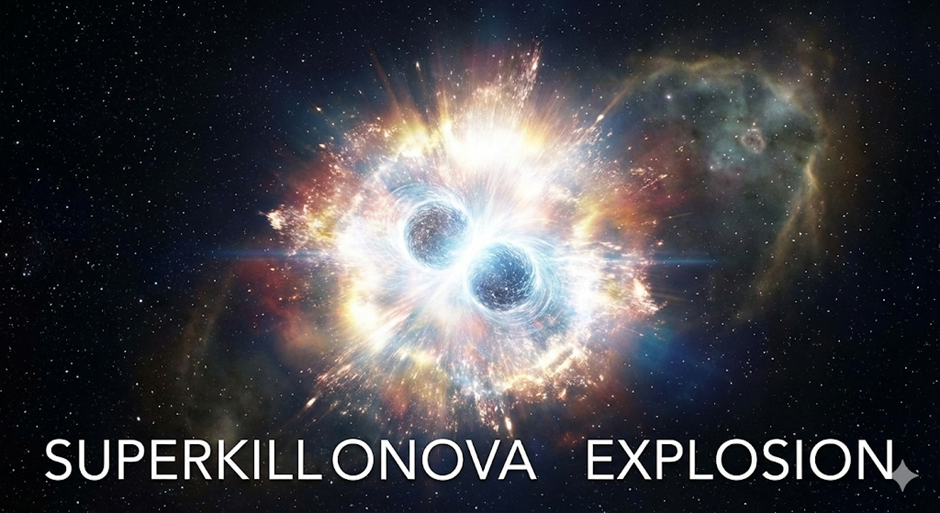
An international team of researchers, including scientists from IIT-Bombay and the Indian Institute of Astrophysics (Bengaluru), has identified a rare cosmic explosion known as a Superkilonova approximately 1.3 billion light-years away.
Distinguishing Kilonova & Superkilonova
What is a Kilonova?
- Definition: A high-energy astronomical event triggered by the collision of two neutron stars or the merger of a neutron star with a black hole.
- Nucleosynthesis: It functions as a cosmic factory, synthesizing heavy, radioactive elements like Gold, Platinum, and Neodymium via rapid neutron capture.
- Observation: The radioactive decay of these elements emits radiation in the optical and infrared spectrums. These events are frequently associated with Gamma-Ray Bursts (GRBs).
What Defines A Superkilonova?
- The Distinction: A Superkilonova is a rare, enhanced variant of a merger that possesses an additional energy source.
- Key Characteristics: This extra energy renders the explosion significantly brighter, bluer, and longer-lasting than a standard kilonova.
- Hybrid Fingerprint: Observational data reveals a unique transition: the event initially exhibits the light signature of a kilonova (rapid fading) but subsequently
Understanding Neutron Stars:-
How are they Formed?
- Gravitational Collapse: They originate when a massive star exhausts its nuclear fuel and collapses under its own gravity.
- Core Fusion: The immense pressure in the collapsing core crushes protons and electrons together to synthesize neutrons.
- The Mass Limit: A neutron star forms if the collapsing core is between 1 and 3 solar masses. (Cores exceeding this limit collapse further into Black Holes).
What Are Their Physical Attributes?
- Extreme Density: They are the densest class of stellar remnants, typically measuring just 20 km in diameter.
- Mass: Despite their compact size, they contain a mass between 1.18 and 1.97 times that of the Sun.
How Do We Observe Them?
Neutron stars are categorized based on their distinct emission patterns:
- Pulsars (Cosmic Lighthouses): Rotating neutron stars that emit beams of radiation at highly regular intervals (ranging from milliseconds to seconds) from their magnetic poles.
- Magnetars: A rare subtype characterized by ultra-high magnetic fields, which are orders of magnitude stronger than Earth’s magnetic field.
- Rotating Radio Transients (RRATs): Mysterious sources that emit single, irregular radio bursts (intervals of minutes to hours). Unlike pulsars, the exact mechanism behind RRATs remains unknown.
Q. With respect to the formation of Neutron Stars, consider the following statements:
1. They are formed when a massive star collapses, crushing protons and electrons into neutrons.
2. If the core of a collapsing star is more than 3 times of solar masses, it stabilizes as a neutron star.

Which of the statements given above is/are correct?
(a) 1 only
(b) 2 only
(c) Both 1 and 2
(d) Neither 1 nor 2

Answer: A

Explanation:

Statement 1 is correct: Neutron stars are formed when the core of a massive star collapses, crushing together every proton and electron into a neutron.
Statement 2 is incorrect: If the core is between about 1 and 3 times of solar masses, it becomes a neutron star. Stars with higher masses (above 3 solar masses) will continue to collapse into stellar-mass black holes.