Why In the News?
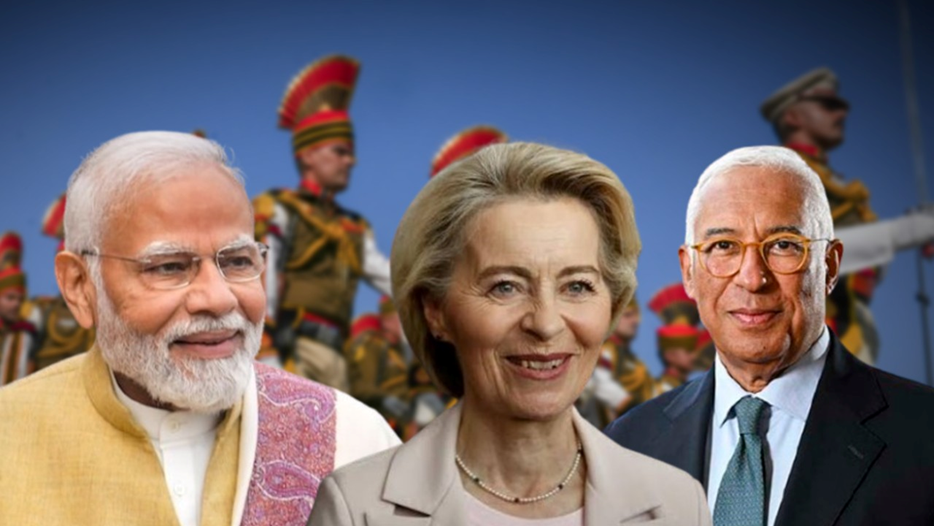
Recently, the President of the European Commission, Ursula von der Leyen, and the President of the European Council, António Costa, visited India as the chief guests for the 77th Republic Day celebrations.
This historic visit coincided with the 16th India-EU Summit, where both sides aimed to finalize a landmark Free Trade Agreement (FTA) and established a new Security and Defence Partnership to enhance strategic autonomy in a multipolar world.
1. The European Union (EU)
The European Union is a unique supranational political and economic union of 27 member states. It operates through a system of independent institutions that balance the interests of the Union with those of individual nations.
- Evolution: The EU was formally established by the Maastricht Treaty (1993), following earlier stages of integration, like the European Coal and Steel Community (1951) and the European Economic Community (1958).
- Key Treaties: The Lisbon Treaty (2009) is the current governing framework that enhanced the powers of the European Parliament and created the permanent post of President of the European Council.
- The Eurozone: While there are 27 members, only 20 countries use the Euro as their official currency. Notable EU members that do not use the Euro include Denmark, Sweden, Poland, and Hungary.





2. The European Council
The European Council is the body that defines the general political direction and priorities of the union.
- Nature: It is a summit-level body and does not exercise legislative functions (it does not pass laws).
- Composition: It consists of the Heads of State or Government of the 27 member states, the President of the European Council, and the President of the European Commission.
- Leadership: The President is elected for a 2.5-year term, renewable once.
- Function: It acts as a collective presidency and deals with complex or sensitive issues that cannot be resolved at lower levels of intergovernmental cooperation.
3. The European Commission
The European Commission is the executive branch of the EU and represents the interests of the Union as a whole, rather than individual national interests.
- Right of Initiative: It is the only institution that can formally propose new EU legislation.
- Composition: It consists of a College of 27 Commissioners (one from each member state), including the President.
- Guardian of Treaties: It ensures that EU laws are correctly applied and can take legal action against member states in the Court of Justice.
- International Negotiator: It represents the EU in international forums and negotiates trade agreements, such as the ongoing India-EU FTA.
4. Important Countries That Are NOT Part of the EU
For the UPSC Prelims, it is essential to distinguish between “European” countries and “EU” member states. Many prominent nations in Europe remain outside the Union for various economic or political reasons.
I. Major Non-EU Powers
- United Kingdom (UK): The first and only sovereign country to leave the EU (following the Brexit referendum), officially departing in 2020.
- Switzerland: A member of the European Free Trade Association (EFTA) but not the EU. It maintains access to the single market through a complex web of bilateral agreements and is part of the Schengen Area.
- Norway: Also an EFTA member. It participates in the EU’s single market through the European Economic Area (EEA) agreement but has rejected full EU membership in national referendums.
- Turkey (Türkiye): A long-standing candidate for membership, but negotiations have been effectively frozen for years due to political and human rights concerns.
- Russia & Belarus: These nations are geographically in Europe but are not members and have strained relations with the Union.
II. The Candidate Countries (Aspiring Members)
The EU is currently undergoing an Enlargement Process. As of early 2026, the following countries are official candidates:
- Ukraine (Granted status in 2022)
- Moldova
- Georgia
- Western Balkans: Albania, Bosnia and Herzegovina, Montenegro, North Macedonia, and Serbia.
Q. Consider the following statements regarding European organizations and countries:
I.	The European Commission is the only EU institution that can propose new legislation.
II.	Norway and Switzerland are members of the European Union but have opted out of the Eurozone.
III.	Ukraine and Moldova were officially granted EU candidate status following the 2022 geopolitical crisis.

Which of the statements given above are correct?
(a) I and II only
(b) II and III only
(c) I and III only
(d) I, II and III

Correct Answer: (c)
Explanation
STATEMENT I IS CORRECT: The European Commission holds the "Right of Initiative," making it the sole body to propose laws.
STATEMENT II IS INCORRECT: Norway and Switzerland are not members of the European Union. While they participate in the Single Market (via EEA/Bilateral deals), they remain outside the political union.
STATEMENT III IS CORRECT: Ukraine and Moldova were fast-tracked to candidate status in June 2022 as a response to the Russian invasion of Ukraine.
Practice Today’s MCQs