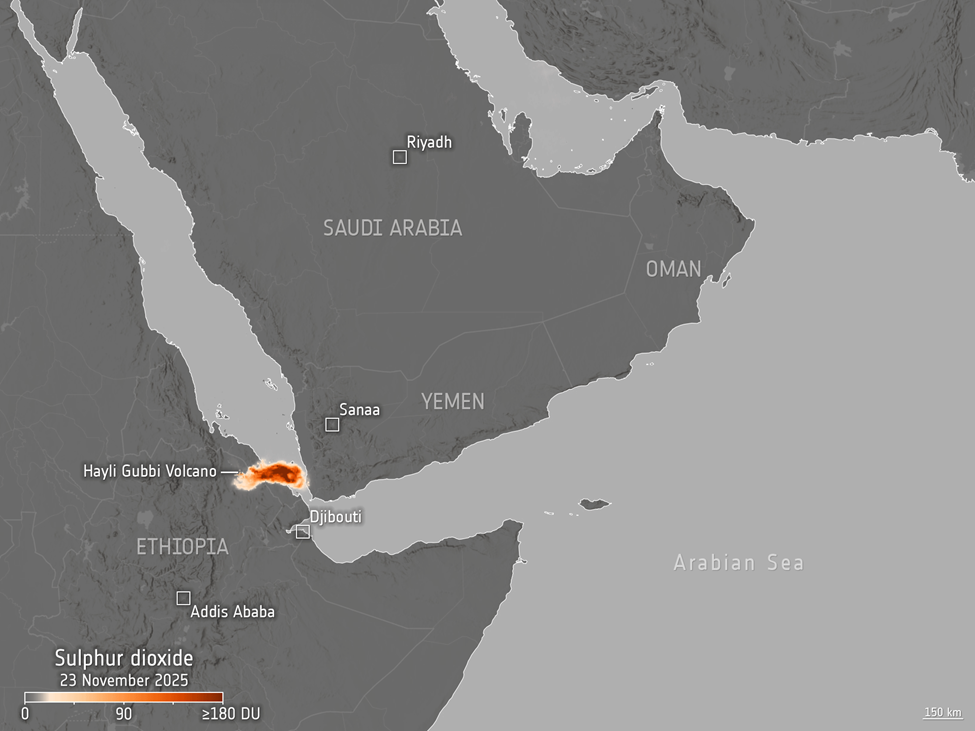
Event Overview & Trajectory
- The Event: On November 23, 2025, the Hayli Gubbi volcano in Ethiopia, dormant for nearly 12,000 years, experienced a massive Sub-Plinian eruption.
- Plume Dynamics: The eruption generated an ash column rising to 45,000 ft (FL450).
- Dispersion Path: Driven by high-altitude westerly winds and jet streams, the plume drifted across the Red Sea, Yemen, and Oman, moving toward the Arabian Sea and Western India.
- Current Concern: Primary risks involve aviation safety (due to volcanic glass in engines) and upper-atmosphere visibility. Ground-level air quality impact in India is expected to be minimal due to the plume’s high altitude.
Geological Setting & Tectonics
- Location: Situated in the Afar Depression (Ethiopia), within the Erta Ale volcanic range.
- Volcano Type: Shield Volcano—characterised by a broad, low-gradient structure formed by fluid basaltic lava flows.
- Tectonic Driver: The volcano sits on the East African Rift System (EARS), a divergent boundary where the Nubian Plate and Somali Plate are separating.
- The “Triple Junction”: The region is geologically unique as the meeting point of the Red Sea Rift, Gulf of Aden Rift, and East African Rift, aided by a deep mantle plume that thins the crust.
Mechanism of Eruption
- Plate Divergence: The pulling apart of tectonic plates creates deep fissures.
- Crustal Thinning: Reduced pressure allows magma from the mantle plume to ascend rapidly.
- Seismic Precursors: The eruption was likely preceded by earthquake swarms indicating magma movement through fissures.
Plume Composition & Atmospheric Impact:
- Constituents: The cloud contains silicate ash, rock fragments, volcanic glass shards, and Sulphur Dioxide (SO2).
- Aviation Hazard: Volcanic glass (silica) melts inside jet engines, causing failure; this necessitates flight diversions.
- Climatic Effect: High-altitude aerosols and SO2 can reflect solar radiation, potentially causing temporary localized cooling or haze.
Socio-Economic & Environmental Consequences
- Aviation & Trade: Disruption of flight routes over the Red Sea and Arabian Peninsula increases logistics costs and travel delays.
- Agriculture (Local): In the Afar region, heavy ashfall threatens crop yields, contaminates water bodies, and affects livestock grazing.
ecological Damage: Ash deposits alter soil pH and damage local vegetation, while gas emissions degrade regional air quality.
Regional Fact File: Ethiopia & African Volcanology
- Geopolitical Borders: Ethiopia is landlocked, bordered by Eritrea (North), Djibouti (Northeast), Somalia (East), Kenya (South), South Sudan (West), and Sudan (Northwest).
- Other Notable African Volcanoes:
- Mt. Nyiragongo (DR Congo): Famous for fast-moving lava lakes.
- Erta Ale (Ethiopia): Known for persistent lava lake activity.
- Dabbahu & Alayta (Ethiopia): Active rift volcanoes in the Afar region.
Event Overview & Trajectory
- The Event: On November 23, 2025, the Hayli Gubbi volcano in Ethiopia, dormant for nearly 12,000 years, experienced a massive Sub-Plinian eruption.
- Plume Dynamics: The eruption generated an ash column rising to 45,000 ft (FL450).
- Dispersion Path: Driven by high-altitude westerly winds and jet streams, the plume drifted across the Red Sea, Yemen, and Oman, moving toward the Arabian Sea and Western India.
- Current Concern: Primary risks involve aviation safety (due to volcanic glass in engines) and upper-atmosphere visibility. Ground-level air quality impact in India is expected to be minimal due to the plume’s high altitude.
Geological Setting & Tectonics
- Location: Situated in the Afar Depression (Ethiopia), within the Erta Ale volcanic range.
- Volcano Type: Shield Volcano—characterised by a broad, low-gradient structure formed by fluid basaltic lava flows.
- Tectonic Driver: The volcano sits on the East African Rift System (EARS), a divergent boundary where the Nubian Plate and Somali Plate are separating.
- The “Triple Junction”: The region is geologically unique as the meeting point of the Red Sea Rift, Gulf of Aden Rift, and East African Rift, aided by a deep mantle plume that thins the crust.
Mechanism of Eruption
- Plate Divergence: The pulling apart of tectonic plates creates deep fissures.
- Crustal Thinning: Reduced pressure allows magma from the mantle plume to ascend rapidly.
- Seismic Precursors: The eruption was likely preceded by earthquake swarms indicating magma movement through fissures.
Plume Composition & Atmospheric Impact:
- Constituents: The cloud contains silicate ash, rock fragments, volcanic glass shards, and Sulphur Dioxide (SO2).
- Aviation Hazard: Volcanic glass (silica) melts inside jet engines, causing failure; this necessitates flight diversions.
- Climatic Effect: High-altitude aerosols and SO2 can reflect solar radiation, potentially causing temporary localized cooling or haze.
Socio-Economic & Environmental Consequences
- Aviation & Trade: Disruption of flight routes over the Red Sea and Arabian Peninsula increases logistics costs and travel delays.
- Agriculture (Local): In the Afar region, heavy ashfall threatens crop yields, contaminates water bodies, and affects livestock grazing.
ecological Damage: Ash deposits alter soil pH and damage local vegetation, while gas emissions degrade regional air quality.
Regional Fact File: Ethiopia & African Volcanology
- Geopolitical Borders: Ethiopia is landlocked, bordered by Eritrea (North), Djibouti (Northeast), Somalia (East), Kenya (South), South Sudan (West), and Sudan (Northwest).
- Other Notable African Volcanoes:
- Mt. Nyiragongo (DR Congo): Famous for fast-moving lava lakes.
- Erta Ale (Ethiopia): Known for persistent lava lake activity.
- Dabbahu & Alayta (Ethiopia): Active rift volcanoes in the Afar region.