Context
Recently, a 60-year-old farmer in Gujarat’s Gir Somnath district who killed a leopard using a sickle and spear in a “fight for survival” has reignited the debate on human-wildlife conflict and legal protections.
1. General Profile
- Scientific Name: Panthera pardus fusca.
- Biological Classification: It is the smallest of the “Big Cats” (Tiger, Lion, Leopard, Snow Leopard, and Clouded Leopard) found in India.
- Adaptability: Leopards are highly adaptable and are found in diverse habitats, including tropical rainforests, dry deciduous forests, temperate forests, and even near human-dominated agricultural landscapes.
- Exclusions: They are generally absent in the extremely arid deserts and above the timber line in the high Himalayas.
2. Characteristics & Behavior
- Nocturnal: They are primarily active at night and are solitary animals.
- Arboreal Skills: They are expert climbers and often drag their prey up into trees to protect it from other scavengers and predators like tigers or hyenas.
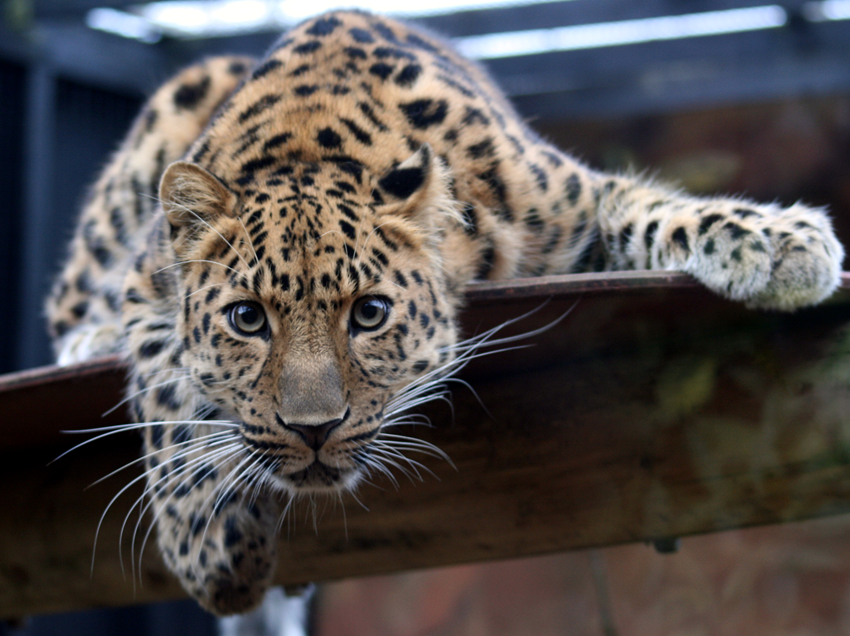
- Physical Appearance: They possess a tawny coat with rosettes (rose-like markings), which are unique to each individual, allowing researchers to identify them via camera traps.
- Melanism: “Black Panthers” are not a separate species but are melanistic leopards that have high melanin content, though their spots are still visible under certain light.
3. Conservation Status
- IUCN Red List: Vulnerable.
- Wildlife (Protection) Act, 1972: Schedule I (highest level of legal protection).
- CITES: Appendix I.
4. Regional Distribution
Findings of the 2022 Population Estimation (5th Cycle)
| Region | Status | Remark |
| Central India & Eastern Ghats | Stable/Growing | Recorded the largest growth rate of 1.5% per annum. |
| Shivalik Hills & Gangetic Plains | Declined | Population fell by -3.4% per annum. |
| Northeast Hills | Low Density | Sampling was limited to Tiger Reserves and partial areas. |
5. State-wise Rankings
- Madhya Pradesh: Houses the largest population (3,907).
- Maharashtra: Follows with 1,985 individuals.
- Karnataka: Ranked third with 1,879 individuals.
- Tamil Nadu: Ranked fourth with 1,070 individuals.
Note: Tiger Reserves with the highest leopard populations include Nagarjunasagar Srisailam (Andhra Pradesh), followed by Panna and Satpura (Madhya Pradesh).
6. Major Threats
- Habitat Fragmentation: Loss of connectivity between protected areas.
- Human-Wildlife Conflict: Approximately 65% of leopards in the Shivalik landscape live outside protected areas, leading to frequent encounters.
- Poaching: Illegal trade of skins and body parts remains a significant threat.
- Prey Depletion: Loss of natural prey drives leopards toward livestock and human settlements.
Q. Consider the following statements regarding the "Status of Leopards in India" report 2022:
1. The report covers 100% of the leopard habitat in India, including the high-altitude Himalayas.
2. Madhya Pradesh has the highest number of leopards among all Indian states.
3. While the overall population in India has grown, the Shivalik Hills and Gangetic Plains saw a decline.
4. Leopards are currently listed as "Endangered" on the IUCN Red List.

How many of the above statements are correct?
A) Only one
B) Only two
C) Only three
D) All four

Answer: B) Only two
Solution:
STATEMENT 1 INCORRECT: The 2022 estimation represents only about 70% of the leopard habitat. High-altitude Himalayas and semi-arid parts of the country (not part of tiger habitats) were not sampled.
STATEMENT 2 CORRECT: Madhya Pradesh houses the largest population of leopards in India (3,907).
STATEMENT 3 CORRECT: The population grew at 1.08% annually at the national level, but the Shivalik Hills and Gangetic Plains experienced a decline of 3.4% per annum.
STATEMENT 4 INCORRECT: The Indian Leopard is classified as "Vulnerable" on the IUCN Red List, not Endangered.