Context
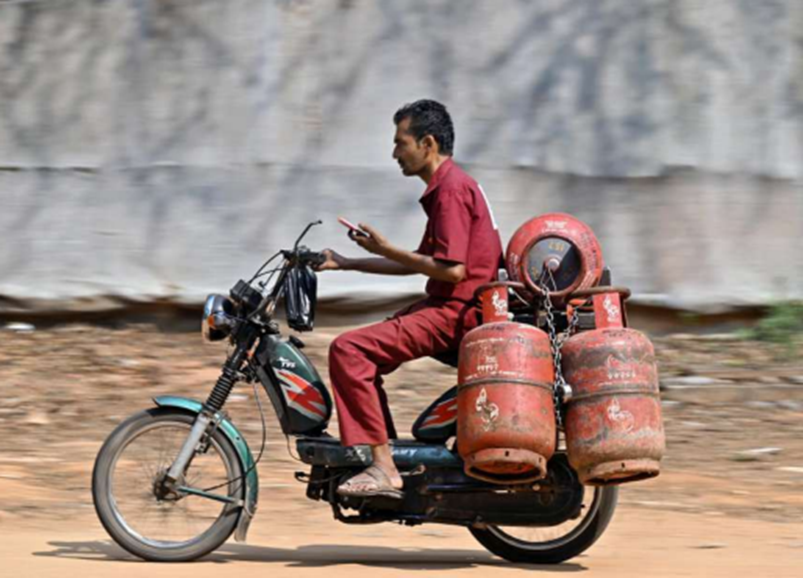
India is currently pushing for a massive expansion of Piped Natural Gas (PNG) to replace Liquified Petroleum Gas (LPG) for domestic cooking. Recent government data indicates that while India has 32 crore LPG connections, domestic natural gas production is now sufficient to cater to 30 crore connections if converted to PNG. This shift is part of India’s broader goal to increase the share of natural gas in its energy mix from the current ~6.7% to 15% by 2030.
1. Comparative Analysis: LPG, CNG, and PNG
| Feature | CNG (Compressed Natural Gas) | PNG (Piped Natural Gas) | LPG (Liquefied Petroleum Gas) |
| Nature/Form | Gas (compressed at high pressure) | Gas (supplied via pipeline) | Liquid (stored under pressure) |
| Main Composition | Methane (CH4) | Methane (CH4) | Propane + Butane |
| Storage | Cylinders (200–250 bar pressure) | No storage (direct supply) | Cylinders (moderate pressure) |
| Mode of Delivery | Fuel stations (cylinders) | Pipeline network (CGD system) | Cylinders (portable) |
| Primary Use | Transport fuel (vehicles) | Domestic & industrial use | Domestic & commercial cooking |
| Safety | Lighter than air (disperses fast) | Lighter than air | Heavier than air (can accumulate at floor level) |
| Environmental Impact | Cleanest fossil fuel | Clean | More polluting than CNG/PNG |
2. Why is India Pushing for PNG? (The Strategic Drivers)
- Reduction of Import Dependence: India imports nearly 60% of its LPG requirements.
- 90% of these imports were historically routed through the Strait of Hormuz (now a geopolitical flashpoint due to conflict in West Asia).
- Cost and Efficiency: Natural gas is much lighter than LPG. While energy density varies slightly, PNG acts as a “drop-in replacement” for LPG without requiring significant equipment changes for households.
- Domestic Production Surplus: Major fields like the KG-DWN-98/2 Block (ONGC) in the Krishna-Godavari basin are ramping up production, projected to increase India’s total gas production by 10-15%.
- Infrastructure Efficiency: Pipelines eliminate the need for the “last-mile delivery” of heavy cylinders via trucks, reducing the carbon footprint of the supply chain.
3. Major Gas Pipelines
- Location of Natural Gas Fields: Krishna-Godavari (KG) Basin, Mumbai High, Cauvery Basin and Assam’s Digboi, Dibrugarh, Sivasagar regions.
- Pipeline Geography: HAJIRA-VIJAIPUR-JAGDISHPUR (HVJ) pipeline, Jagdishpur-Haldia & Bokaro-Dhamra Pipeline (JHBDPL): Part of the Pradhan Mantri Urja Ganga project, Dahej-Uran-Dabhol-Panvel Pipeline (DUPL/DPPL): Operated by GAIL.
4. Regulatory Body: The Petroleum and Natural Gas Regulatory Board (PNGRB)
- Establishment: Set up under the PNGRB Act, 2006, effective from March 31, 2006.
- Mandate: Regulate downstream activities (refining, processing, storage, transport, distribution, marketing, and sale).
- Functions: Protects consumer interests, ensures uninterrupted supply, and authorizes City Gas Distribution (CGD) networks.
- Exclusion: Upstream activities (production of crude oil and natural gas) are outside its jurisdiction.
- Appellate Authority: The Appellate Tribunal for Electricity, established under the Electricity Act 2003, handles appeals against PNGRB decisions.
With reference to the Petroleum and Natural Gas Regulatory Board (PNGRB), consider the following statements:

1. It regulates upstream activities like exploration and production of natural gas.
2. It authorizes City Gas Distribution (CGD) networks.
3. Appeals against its decisions lie with the Appellate Tribunal for Electricity.

Which of the statements given above is/are correct?
(a) 2 and 3 only
(b) 1 and 2 only
(c) 1 and 3 only
(d) 1, 2 and 3

Answer: A

Explanation:
Statement 1: Incorrect
The PNGRB does not regulate upstream activities (exploration and production).
•	Upstream (Exploration & Production) is regulated by the Directorate General of Hydrocarbons (DGH).
•	PNGRB is responsible for Downstream activities (refining, processing, storage, transportation, distribution, and sale of petroleum, petroleum products, and natural gas).
Statement 2: Correct
One of the primary functions of PNGRB is to grant authorizations to entities for laying, building, operating, or expanding City Gas Distribution (CGD) networks. This includes the infrastructure for both PNG (domestic/industrial) and CNG (transport).
Statement 3: Correct
Under the PNGRB Act, 2006, any person aggrieved by an order or decision made by the Board can file an appeal. These appeals lie with the Appellate Tribunal for Electricity (APTEL), which was established under the Electricity Act, 2003, but also serves as the appellate body for the petroleum and natural gas sector.