Why in the News?
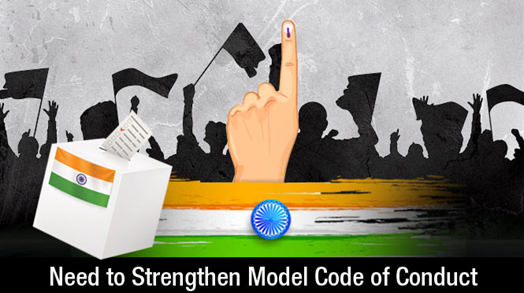
The Model Code of Conduct (MCC) is currently under intense scrutiny because successive ruling governments, both at the Centre and in the States, are being accused of violating its ‘spirit’ even while meticulously adhering to the ‘letter of the law’ (the explicit legal provisions).
- The Allegation of Breach: The core issue involves the ruling party using the loophole of an ‘ongoing scheme’ to make direct financial transfers or launch projects just before or during the election period. This is seen as a form of inducement to voters, subverting the principle of a level playing field.
- Case in Point (Bihar): The specific example highlighted is the alleged misuse of the Mukhya Mantri Mahila Rojgar Yojana where one-time cash grants (₹10,000) were scheduled to be transferred to women beneficiaries after the election dates were announced, with some transfers coinciding directly with the polling phases.
Context and Background of the MCC
The Model Code of Conduct is a crucial pillar of India’s electoral framework.
Understanding its foundational nature is essential for analyzing its current challenges.
A. Origin and Evolution
- Origin: The MCC originated during the 1960 Kerala Assembly elections as a basic set of guidelines. It was later adopted for the 1962 Lok Sabha elections.
- Formal Inclusion of Ruling Party (1979): The MCC was significantly strengthened in 1979 to include specific restrictions on the ‘Party in Power’ to curb the misuse of public resources and official machinery.
- Judicial Intervention (2013): Following a Supreme Court directive, the ECI formally included guidelines on Election Manifestos to prevent irrational promises and ensure transparency regarding the financial feasibility of schemes.
B. Legal Status and Enforceability Challenge
| Status/Challenge | Description | Implication |
| Legal Status | It is a ‘Soft Law’—a set of norms evolved through political consensus. It is not statutory (not a law passed by Parliament). | Relies on the moral authority of the ECI and the political will of parties. |
| Enforcement | Violations are addressed by invoking corresponding provisions of existing laws like the Indian Penal Code (IPC) or the Representation of the People Act, 1951 (RP Act). | The ECI lacks the explicit power to disqualify a candidate for MCC violations alone; it can only censure, reprimand, or recommend prosecution. |
| ECI’s Stance on Legalisation | The ECI has historically opposed making the MCC legally binding, arguing that elections are time-bound (around 45 days) and judicial proceedings would lead to prolonged delays, rendering swift justice impossible. | This position, however, creates a vacuum that allows politicians to find “loopholes” in the MCC’s provisions. |
Key Judgements Related to the Model Code of Conduct (MCC)
- Association for Democratic Reforms v. Union of India / Electoral Bond Case (2024): In February 2024, the Supreme Court of India invalidated the Electoral Bond Scheme, emphasizing that anonymous and unlimited corporate contributions distorted electoral competition in favor of the ruling party. The Court highlighted that such funding could lead to quid pro quo arrangements, undermining the fundamental principle of a level playing field in elections, which is central to the objectives of the MCC.
- Ashwini Kumar Upadhyay v. Union of India (2022): The Court observed that the distribution of freebies using public funds often serves the purpose of boosting a political party’s popularity and electoral prospects. However, it clarified that not every promise made during an election constitutes a “freebie.” Schemes aimed at genuine public welfare cannot automatically be considered a violation of the free and fair conduct of elections.
- Subramaniam Balaji v. State of Tamil Nadu (2013): The Supreme Court directed the Election Commission to incorporate guidelines on election manifestos into the MCC. These recommendations were subsequently adopted in the code for the 2014 general elections, ensuring that parties present responsible and transparent commitments to voters.
- Neelalohithadasan Nadar v. George Mascrene (1994):Although this case does not directly address MCC violations, it reinforces principles crucial to electoral integrity. The Court asserted that the sanctity of the electoral process takes precedence over the secrecy of individual ballots.
- Election Commission of India v. State of Tamil Nadu and Others (1993): The Supreme Court underlined that the Election Commission of India is a high constitutional authority entrusted with ensuring free, fair, and pure elections. The powers granted to the Commission correspond to the significant constitutional duties it carries. Additionally, Section 125 of the Representation of People Act, 1951, prescribes a maximum imprisonment of three years for actions promoting enmity or hatred among citizens on religious grounds. The Court noted that it could issue standing directions for the ECI to initiate criminal proceedings under this provision and, if necessary, restrain violators from participating in campaigns until the completion of elections.
The Challenge to Fair Elections
The current issue points to a critical systemic failure where political actors manipulate the very rules they agree to follow, undermining the constitutional mandate of the ECI under Article 324 to ensure free and fair elections.
A. The Conflict: Letter vs. Spirit
- The Letter (Adherence): Governments ensure that schemes are announced before the MCC comes into force or frame them in a way that technically qualifies them as ‘ongoing projects’ (which are generally permitted to continue).
- The Spirit (Violation): The timing of the actual disbursement of funds or the laying of foundation stones, especially immediate, large-scale direct cash transfers (DBT), is orchestrated to peak just before the vote, effectively functioning as a bribe or inducement.
- Impact: This behavior demonstrates a “Machiavellian ability” by political actors to exploit the non-statutory nature of the code, turning it into a “sham” that compromises the integrity of the election process.
B. Governance Paralysis and the ‘Simultaneous Polls’ Debate
The repeated imposition of the MCC due to frequent elections is cited as a major hurdle to governance, which links directly to the debate over ‘One Nation, One Election’ (Simultaneous Polls).
- The Core Argument for Simultaneous Polls: Proponents argue that frequent imposition of the MCC leads to “administrative and developmental paralysis” because the government is restricted from announcing new policies or projects.
- The Article’s Counter-Argument: If governments are constantly breaching the spirit of the MCC anyway (by finding loopholes), then the “governance paralysis” argument becomes a “farcical reason” for pushing simultaneous polls. The issue is political dishonesty, not the code itself.
- Mains Perspective: If the restrictive provisions of the MCC were either strictly enforced or simply abolished (as suggested in the article), one of the major justifications for simultaneous elections would be eliminated.
C. The ECI: A ‘Toothless Tiger’?
The ECI faces a dual challenge: the lack of statutory power and the fear of judicial delay.
- Lack of Deterrence: Since the worst penalty the ECI can inflict (short of invoking the RP Act) is censure or reprimand, influential leaders face little deterrence against breaching the spirit of the code.
- New Malpractices: The problem is exacerbated by the continuous invention of new forms of malpractices, forcing the ECI into a constant ‘wild goose chase’ to amend the code.
Conclusion and Way Forward (Recommendations for Reform)
The crisis of the MCC is essentially a crisis of political ethics. To restore the credibility of the electoral process, one of two hard choices must be made:
| Strategy | Description | Implication for Free & Fair Elections |
| Option 1: Stricter Enforcement | The ECI must be empowered (or use its plenary powers under Article 324) to take swift, punitive action against violations of the spirit, especially for financial inducements, without waiting for the slow process of the RP Act. | Ensures a genuine level playing field but may lead to increased conflict between the Executive and the ECI. |
| Option 2: Abolish Restrictive Clauses | The provisions that restrict the announcement of new government programmes and financial schemes should be done away with since they are constantly breached in intent. | Removes the element of hypocrisy and governance paralysis, but places a high burden on voters to discern legitimate welfare from outright electoral bribery. |
| The Moral Imperative | Political parties must re-commit to the code as a voluntary ethical standard, respecting its consensus-based foundation to uphold the sanctity of democracy. | The most effective solution, demanding constitutional morality from all stakeholders. |
Source: The malleable Code of Conduct – The Hindu
UPSC CSE PYQ
| Year | Question |
| 2022 | Discuss the role of the Election Commission of India in the light of the evolution of the Model Code of Conduct. |