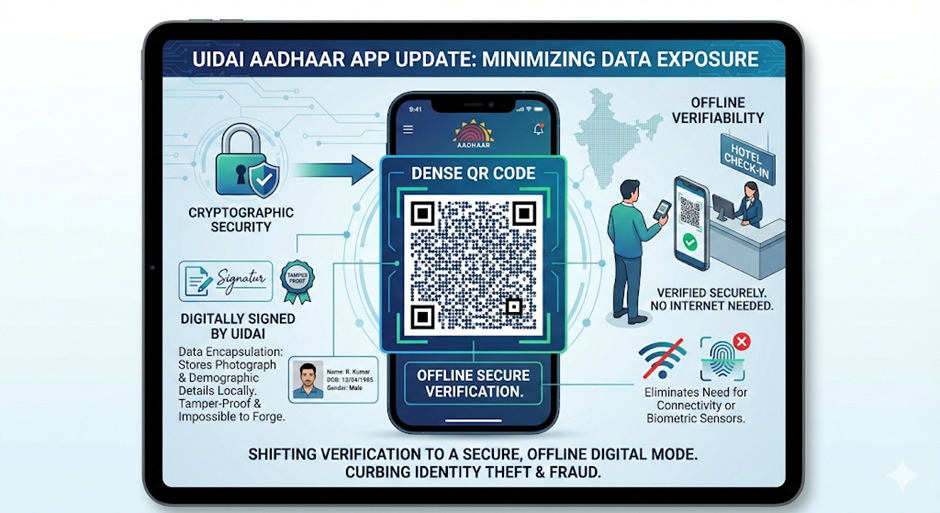
The Unique Identification Authority of India (UIDAI) is testing a new feature within the Aadhaar app to minimize data exposure. The initiative aims to shift verification from physical document sharing to a secure, offline digital mode, thereby curbing identity theft and fraud.
The ‘Dense’ QR Code
The update centers on a high-information density Quick Response (QR) code designed for offline utility.
- Data Encapsulation: Unlike standard QRs, this “dense” version stores the user’s photograph and demographic details locally within the code.
- Cryptographic Security: The data is digitally signed by UIDAI. This signature ensures that the QR code cannot be tampered with or generated by unauthorized entities, making it practically impossible to forge.
- Offline Verifiability: It positions Aadhaar as a unique ID that is verifiable offline, eliminating the need for internet connectivity or biometric sensors at the point of verification (e.g., hotel check-ins).
Offline Verification Seeking Entities (OVSEs)
UIDAI has formalized the role of entities that verify IDs without storing them.
- Definition: OVSEs are entities (like hotels, airport kiosks) that verify identity for a service but are not legally required to store the data permanently.
- The Shift: UIDAI discourages OVSEs from collecting physical photocopies of Aadhaar.
- The Procedure: They should scan the dense QR code to view a verified, temporary digital record. This prevents the accumulation of sensitive personal data in private databases.
Privacy Tool: The Masked Aadhaar
A key tool for citizens to prevent demographic fraud (skimming).
- Data Concealment: The first 8 digits of the Aadhaar number are replaced with characters like “xxxx-xxxx”, leaving only the last 4 digits visible.
- Legal Status: Recognized as a valid proof of identity by the RBI (for KYC) and UIDAI.
- Purpose: It allows identity verification without revealing the full 12-digit unique ID, preventing unauthorized profiling or tracking.
About UIDAI :-
Unique Identification Authority of India (UIDAI)
I. Nature & Establishment
- Status: Statutory Authority established under the Aadhaar Act, 2016.
- Predecessor: functioned as an attached office of the Planning Commission (2009-2016).
- Nodal Ministry: Ministry of Electronics and Information Technology (MeitY).
II. Composition (Appointments by Central Govt)
- Chairperson: One (can be full-time or part-time).
- Members: Two part-time members.
- CEO: Member-Secretary of the Authority.