After Reading This Article You Can Solve This UPSC Mains Model Question:
The proposed delimitation exercise after 2026 has the potential to reshape India’s federal balance. Critically examine its implications for political representation, federalism, and regional equity. 15 Marks (GS-2, Polity)
Context
The looming Census and subsequent Delimitation exercise have brought the “existential fault-line” between the Peninsular States (South) and the Great Indian Plain (North/Hindi Heartland) into sharp focus.
Nature of the Asymmetry (North–South Divide)
- Economic–Political Mismatch
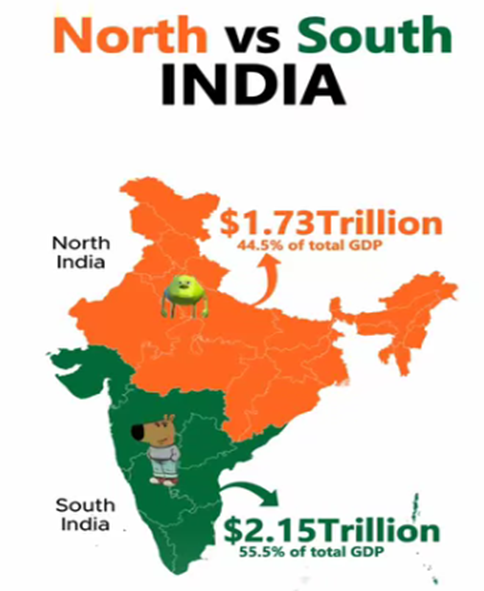
- South generates higher GDP & tax revenues and contributes a disproportionately high share to the divisible tax pool.
- North holds greater political representation (population-based seats)
- Demographic Asymmetry
- North: High fertility, population growth
- South: Low fertility, ageing. It has reached a “Replacement Level” of fertility, leading to a stabilizing (and eventually shrinking) population.
- Human Development Gap
- South: Better education, health, HDI in states like Kerala and Tamil Nadu are on par with upper-middle-income European or South American nations.
- North: Persistent deficits in literacy, healthcare in Bihar and Uttar Pradesh remain comparable to sub-Saharan Africa
- Structural Divergence
- South: Diversified economy → manufacturing + services + global integration
- North: Dominated by low-productivity agriculture, Slower industrialisation and job creation
- Internal Inequality (Within South)
- Wealth is concentrated in urban clusters (e.g., Bengaluru, Hyderabad, Chennai)
- A “middle-income trap” tendency — growth without deep social transformation. Issues of patriarchy, casteism, and weak rule of law persist.
- High per capita income hasn’t translated to high daily wages for laborers. (e.g., TN per capita is 3x Bihar’s, but agricultural wages aren’t even 2x).
| About Delimitation About: Delimitation refers to the process of redrawing or fixing the boundaries of electoral constituencies for the Lok Sabha and State Legislative Assemblies so that each constituency represents an approximately equal population. Objective: Its aim is to uphold the democratic principle of “one person, one vote, one value” by adjusting constituency boundaries in line with changing population patterns. Constitutional Mandate: Article 82: Requires Parliament to pass a Delimitation Act after every Census for reallocation of Lok Sabha seats among States and readjustment of constituencies. Article 170: Provides for similar readjustment in State Legislative Assemblies. Delimitation Commission: An independent, high-powered body constituted by the Central Government. Composition: Chairperson: Sitting or retired Supreme Court judge Chief Election Commissioner (or nominee) State Election Commissioners of concerned States Key features: Its decisions carry legal force Not subject to judicial challenge (with limited exceptions) Orders are placed before Parliament and State Legislatures but cannot be altered Constituted four times: 1952, 1963, 1973, and 2002. Freeze on Delimitation: 42nd Constitutional Amendment Act, 1976: Froze Lok Sabha seat allocation based on the 1971 Census Intended to avoid penalising States that implemented population control measures 84th Amendment Act, 2001: Extended this freeze until the first Census after 2026 Although the 2002 Delimitation Commission revised internal constituency boundaries (using 2001 Census), Inter-state seat distribution still relies on 1971 population data Judicial Review: In the Kishorchandra Chhanganlal Rathod Case (2024), the Supreme Court clarified that: Delimitation Commission’s orders can be judicially reviewed only in exceptional cases, Specifically when they are arbitrary or violate constitutional principles. |
The Delimitation Dilemma (Political Risk)
The core of India’s existential crisis lies in the upcoming redistribution of Lok Sabha seats based on the next Census.
1. The Demographic Penalty
- Success Punished: Southern states proactively implemented population control. If seats are redistributed purely by current population, their parliamentary share will fall dramatically.
- Reward for Failure: Northern states with higher fertility rates will gain a political windfall, effectively increasing their dominance in the Union.
2. Wealth vs. Voice
- Decoupling: The region generating the most tax revenue (the South) will have its voice “muted” by the sheer demographic weight of the region that consumes it (the North).
- The “Extractive” Friction: This creates a perception of the South being an extractive colony—contributing wealth but losing the agency to influence national policy.
3. Historical Precedent of Failure
- The USSR/Yugoslavia Warning: The text notes these are the only historical examples where an economically prosperous minority was forced to subsidize a politically dominant but impoverished majority. Both entities eventually fractured.
4. Structural Integrity at Stake
- From Squabble to Rupture: Unlike routine debates over tax shares, this is an existential fault-line. Without a “grand bargain” or a fairer system like Digressive Proportionality, the trajectory suggests a potential rupture in the structural integrity of the Indian Union.
Way Forward: A New Social Contract
To bridge the North-South fault-line, the discourse must move from regional rhetoric to a structural “Grand Bargain.”
1. Political Reimagining
- Adopt Digressive Proportionality: Shift from “Strict Proportionality” (population-only) to a system that balances state equality. This prevents any single region from achieving hegemonic control.
- Sober Dialogue: Move beyond reactive regionalism to an intellectual, federal dialogue between New Delhi and State capitals.
2. Internal Reform in the South
- Break the “Middle-Income Trap”: Focus on internal inclusivity rather than just aggregate GDP or “Unicorn” counts.
- Social Transformation: Address persistent “great unifiers” of the Indian experience—casteism, patriarchy, and misogyny—to translate economic wealth into social progress.
- Human Capital: Prioritize the literacy rates of the poorest districts (e.g., Dharmapuri) and the daily wages of agricultural laborers over elite-centric growth.
3. National Convergence Strategy
- Beyond “Extractive” Growth: Move from an extractive economic model to a social contract where prosperity is shared by the many, not just a narrow elite.
- Migrant Integration: Address the “internal outsider” status of North-to-South migrants. Create a cohesive social fabric where mobility leads to shared political and social stakes.
- Institutional Strengthening: Southern states must improve the rule of law and institutional quality to truly “pull” the rest of the country upward.
Conclusion
India’s stability hinges on a New Social Contract that reconciles the Peninsula’s economic dynamism with the Heartland’s demographic weight. Through digressive proportionality and internal social reform, India can transform this existential fault-line into a resilient, decentralized, and truly unified power.