After Reading This Article You Can Solve This UPSC Mains Model Question:
Discuss the relevance of the QUAD for India’s strategic interests in the Indian Ocean and the wider Indo-Pacific. (15 marks/250 words) (GS-2 International Relations)
Context:
For the first time since its 2017 revival, the Quad did not hold a Leader-level Summit in 2025 (originally to be hosted by India). While the “top-tier” meetings paused, the “middle-tier” (Foreign Ministers and Working Groups) accelerated, proving that the Quad had moved beyond being a leader-driven hobby to a bureaucratic habit.
About Quad:
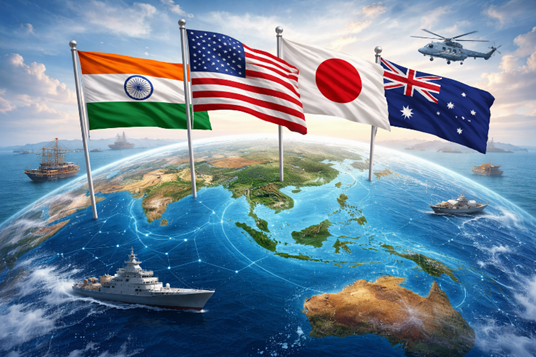
- Members: India, USA, Japan, Australia.
- Origins: Traces back to the 2004 Tsunami Core Group. Formally proposed by Shinzo Abe in 2007, revived in 2017.
- Nature: An informal strategic forum. It is not a military alliance (not an “Asian NATO”) and has no permanent secretariat.
- Shared Vision: A “Free, Open, and Inclusive Indo-Pacific” (FOIP).
Key Initiatives:
The Quad has shifted from “statements” to “deliverables.” Memorize these specific terms:
| Initiative | Sector | Key Feature |
| IPMDA | Maritime Security | Indo-Pacific Partnership for Maritime Domain Awareness. Uses commercial satellite data to track “dark shipping” and IUU (Illegal, Unreported, and Unregulated) fishing. |
| MAITRI | Maritime Training | Maritime Initiative for Training in the Indo-Pacific. A regional workshop (first hosted by India in 2025) to train littoral states in law enforcement. |
| Quad Cancer Moonshot | Health | Launched in late 2024; primary focus on Cervical Cancer. India committed $7.5 million and 40 million vaccine doses (CERVAVAC). |
| Open RAN | Technology | Deployment of secure, 5G-alternative telecommunications in Palau and the Philippines to counter high-risk vendors. |
| Quad-at-Sea | Security | The first-ever Ship Observer Mission (2025) involving cross-embarkation of Coast Guard officers on each other’s vessels. |
| AI-ENGAGE | Agriculture | Harnessing AI and robotics to transform agricultural practices for Indo-Pacific farmers. |
Strategic Relevance: Why the “Interregnum” Mattered:
1. Shift from Optics to Institutional Depth
The interregnum enabled the Quad to move beyond summit symbolism towards working-level coordination in areas such as maritime domain awareness, supply-chain resilience, and critical technologies. This strengthened long-term sustainability of the grouping.
2. Avoidance of Premature Militarization
By deliberately limiting overt military posturing, the Quad avoided being perceived as an alliance or “Asian NATO”. This reduced escalation risks and preserved strategic space for diplomacy in the Indo-Pacific.
3. Enhanced Regional Acceptability
A lower-profile Quad reassured ASEAN and Indian Ocean littoral states, aligning with their preference for inclusive, non-exclusive regionalism. This reinforced ASEAN centrality and UNCLOS-based order.
4. Alignment with India’s Strategic Autonomy
For India, the interregnum aligned well with its preference for issue-based minilateralism, allowing cooperation without compromising strategic autonomy or provoking binary bloc politics.
5. Strategic Signaling without Provocation
Despite restrained optics, the Quad maintained normative signaling—support for freedom of navigation, rule of law, and peaceful dispute resolution—sending a calibrated message against unilateral actions without explicit confrontation.
Challenges During the Quad’s Interregnum Phase:
1. Lack of Formal Institutional Structure
The Quad remains an informal minilateral without a permanent secretariat, charter, or enforcement mechanism, making coordination dependent on political will and leadership continuity.
2. Divergent Strategic Priorities
Member states differ in threat perception and strategic emphasis—ranging from alliance-based security approaches to strategic autonomy—which limits consensus on hard security issues.
3. Dependence on Political Cycles
Electoral transitions and domestic political priorities in member countries periodically slow momentum, highlighting the Quad’s vulnerability to internal political disruptions.
4. Ambiguity of Strategic Purpose
The Quad’s deliberate avoidance of alliance-like commitments, while increasing regional acceptability, also creates uncertainty about its long-term strategic intent.
5. Limited Operational Deliverables
Despite progress in functional areas, the absence of binding commitments reduces the Quad’s ability to deliver tangible, measurable outcomes at scale.
6. Managing China Factor Without Escalation
Balancing deterrence with restraint remains difficult—overt signaling risks escalation, while excessive caution may dilute credibility.
7. Regional Perception Management
Sustaining trust among ASEAN and Indian Ocean states requires continuous reassurance that the Quad complements, rather than undermines, existing regional institutions.
India’s Approach during the Quad’s Interregnum:
India adopted a calibrated, stabilising, and autonomy-preserving approach towards the Quad during its interregnum phase, ensuring continuity without escalation.
1. Strategic Restraint with Sustained Engagement
India supported continued Quad cooperation while avoiding aggressive rhetoric or alliance-like posturing. This helped maintain momentum without provoking regional polarisation.
2. Preference for Issue-based Minilateralism
India emphasised functional cooperation—maritime domain awareness (MDA), humanitarian assistance and disaster relief (HADR), supply-chain resilience, and emerging technologies—over hard military commitments.
3. Preservation of Strategic Autonomy
The interregnum aligned with India’s long-standing foreign policy principle of strategic autonomy, allowing cooperation with Quad partners without compromising independent decision-making.
4. Bridging Quad and Indian Ocean Architecture
India consciously linked Quad initiatives with Indian Ocean–centric platforms (IORA, IONS) and the SAGAR vision, preventing the Quad from becoming Indo-Pacific-exclusive or ASEAN-alienating.
5. Normative Leadership without Confrontation
India consistently highlighted:
- UNCLOS-based maritime order
- Freedom of navigation
- Peaceful dispute resolution
This ensured normative signaling without direct confrontation with China.
6. Balancing Global South Leadership
India ensured Quad engagement did not overshadow its role as a Global South voice, maintaining credibility among developing and littoral states.
Way Forward:
1. Gradual Institutionalization without Alliance Form
The Quad should strengthen coordination through issue-based working groups, regularized ministerial meetings, and standard operating procedures, while avoiding rigid treaty obligations.
2. Deliver Tangible Public Goods
Focus on visible, region-facing outcomes such as maritime domain awareness (MDA), disaster response coordination, climate resilience, health security, and digital connectivity to build regional trust.
3. Deepen Maritime Security Cooperation
Expand information sharing, joint surveillance, and capacity building for Indian Ocean littoral states, reinforcing UNCLOS-based maritime order without overt militarization.
4. Complement, Not Compete with, Regional Institutions
Ensure Quad initiatives align with ASEAN centrality and Indian Ocean platforms (IORA, IONS), positioning the Quad as a force multiplier rather than a parallel bloc.
5. Build Resilient Supply Chains
Operationalize cooperation on critical minerals, semiconductors, and trusted technology networks to reduce economic coercion risks.
6. Sustain India’s Strategic Autonomy
India should continue leveraging the Quad as a flexible minilateral, maintaining independent decision-making while shaping its agenda towards inclusivity and development.
Conclusion:
The 2025 interregnum was the “Silent Spring” of the Quad. It allowed the grouping to build a robust, institutionalized foundation of “Habits of Cooperation” that are now immune to bilateral turbulence. For India, this year confirmed that its “Multilateralism” is no longer a choice between blocs, but a leadership role in a coalition of consequence.