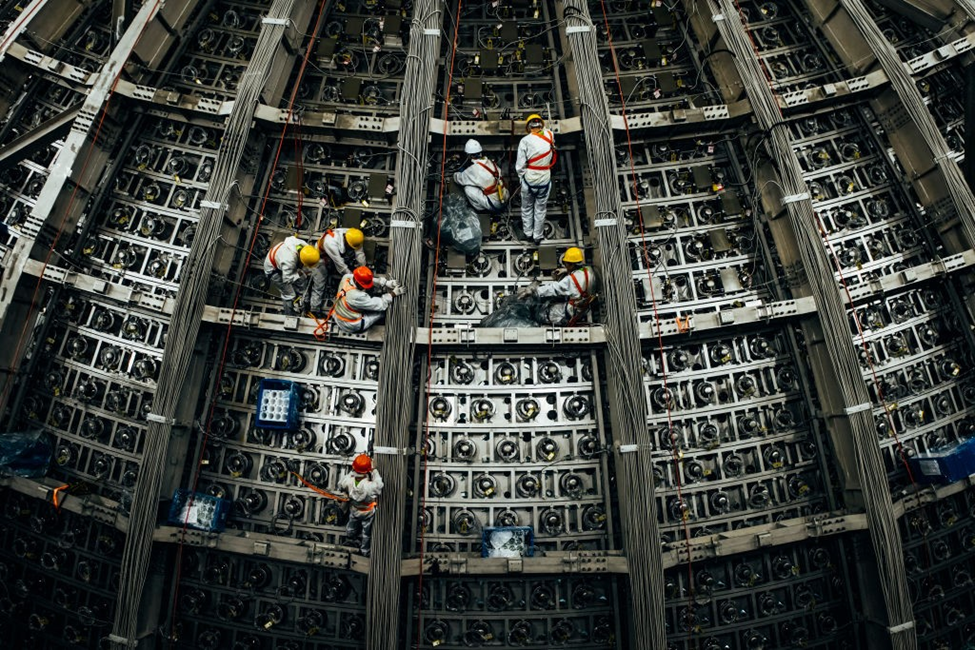
Why is this in the News?
China has officially completed the construction of the Jiangmen Underground Neutrino Observatory (JUNO). This development highlights the widening gap in “Big Science” capabilities between China and India, as the India-based Neutrino Observatory (INO) remains stalled due to regulatory and social hurdles.
What are Neutrinos?
- Nature: Lightest subatomic particles with mass; electrically neutral.
- Interaction: Known as “Ghost Particles” due to extremely weak interactions with matter; they interact solely via the Weak Nuclear Force and Gravity.
- Abundance:
- Most abundant particles in the universe possessing mass.
- Second most abundant particles overall (after Photons/Light).
- Permeability: Trillions pass through the human body every second without interaction.
Classification & Sources
- 3 known types of Neutrinos: Electron neutrino, Muon neutrino, and Tau neutrino.
- Primary Sources: Solar fusion (Solar neutrinos), Cosmic rays, Supernovae, Nuclear reactors, and the Early Universe (Relic neutrinos).
ABOUT JIANGMEN UNDERGROUND NEUTRINO OBSERVATORY (JUNO)
1. Operational Context
- Location: 700 meters underground near Jiangmen (Guangdong Province), Southern China.
- Infrastructure: Features a 600-tonne spherical detector with light-detecting tubes, submerged in a 12-storey cylindrical water pool to shield against interference.
2. Core Objectives
- Mass Hierarchy: To determine the ordering of neutrino masses (identifying the lightest and heaviest types).
- Multi-Spectrum Study: Observation of reactor neutrinos, supernova bursts, solar/atmospheric neutrinos, and Geo-neutrinos (from Earth’s interior).
- Collaboration: A multi-nation project involving France, Germany, Italy, Russia, the U.S., and Taiwan.
GLOBAL NEUTRINO OBSERVATORIES
1. International Facilities
- IceCube (Antarctica): The largest neutrino telescope; uses Antarctic ice to detect high-energy astrophysical neutrinos.
- Super-Kamiokande (Japan): Underground water Cherenkov detector; famous for confirming neutrino oscillations.
- DUNE (USA): Deep Underground Neutrino Experiment; uses liquid argon to probe CP violation and mass hierarchy.
- KM3NeT (Mediterranean Sea): Located underwater; focuses on high-energy cosmic sources.
2. The Indian Context
- India-based Neutrino Observatory (INO):
- Proposed Location: Bodi West Hills, Theni District, Tamil Nadu.
- Focus: Study of Atmospheric Neutrinos using a Magnetized Iron Calorimeter (ICAL).
- Status: Currently stalled due to environmental and clearance issues.