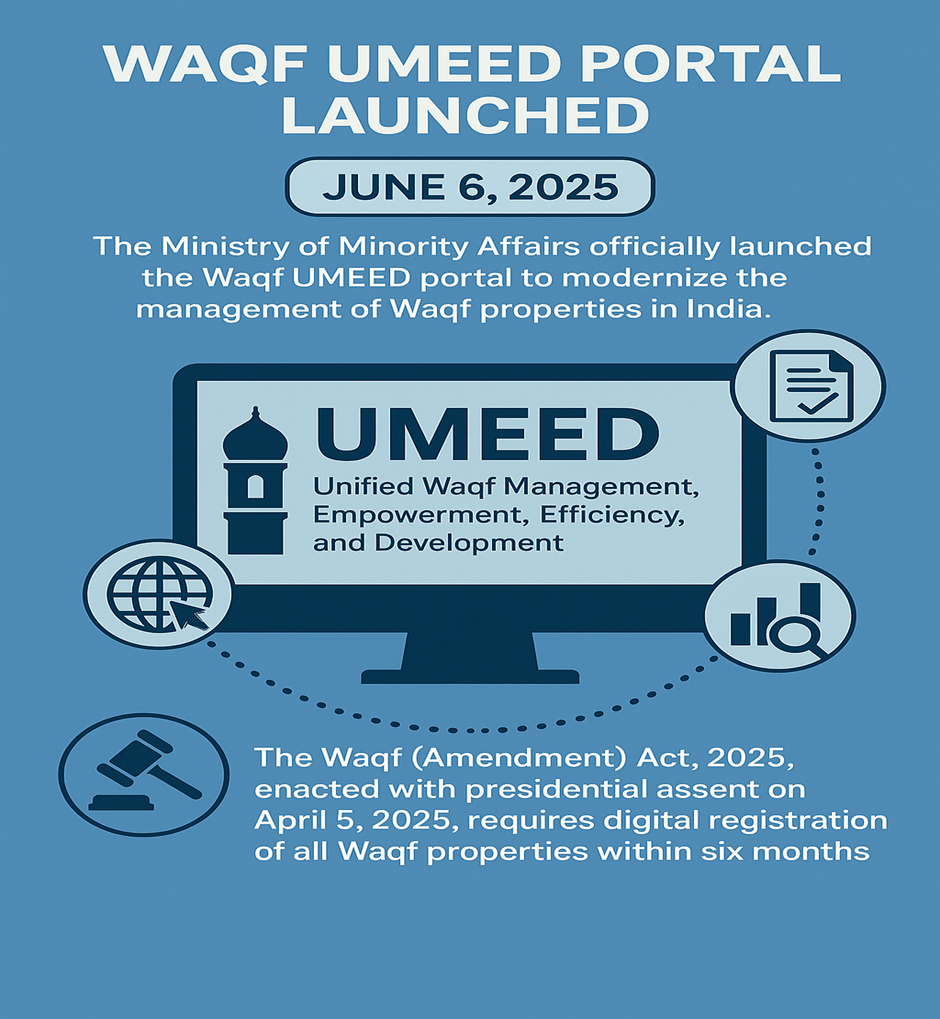
The Ministry of Minority Affairs has strictly adhered to the six-month deadline (ending December 6) for the mandatory registration of Waqf properties on the UMEED Portal.
The Latest Development: Deadline & Compliance
- Strict Deadline: The six-month window mandated by the Waqf (Amendment) Act, 2025 for registration has concluded. The Ministry cited Supreme Court directions for not extending this timeline administratively.
- Humanitarian Relief: No penal action will be taken for the next 3 months against mutawallis (custodians) who attempted registration but failed due to technical or procedural delays.
- Remedial Mechanism: Unregistered entities can approach the State Waqf Tribunal, which holds the statutory authority to grant an extension of up to 6 months upon satisfaction of the cause.
- Current Status: Only ~20% (1.5 lakh) of the estimated 8.72 lakh properties have been registered. Top performing states include Karnataka, Punjab, and J&K.
What is the UMEED Portal?
- Acronym: Unified Waqf Management, Empowerment, Efficiency, and Development.
- Nodal Agency: Ministry of Minority Affairs.
- Objective: To serve as a centralized digital repository for real-time uploading, verification, geotagging, and monitoring of Waqf assets, replacing the earlier WAMSI portal.
- Key Mandates:
- Geotagging: Registration requires precise measurements and geolocation data.
- Dispute Trigger: Properties unregistered after the deadline are automatically flagged as “disputed” and referred to the Tribunal.
Legal Framework: Waqf (Amendment) Act, 2025
The portal operates under the aegis of the recently amended Act, which introduced significant structural reforms:
- Judicial Oversight: Decisions of the Waqf Tribunal are now appealable in the High Court (within 90 days), removing the earlier finality of Tribunal orders.
- Women-Centric Protection: Property held in the name of a woman cannot be designated as Waqf. However, women, children, and EWS remain eligible beneficiaries.
- Limitation Period: The Act introduced the rigid 6-month deadline for the digital transition of legacy data.
| Term | Definition |
| Waqf | A permanent dedication of movable or immovable property for religious, pious, or charitable purposes under Islamic Law. Once designated, it cannot be sold, transferred, or inherited. |
| Mutawalli | The manager or custodian appointed to administer the Waqf property. |
| Waqf Tribunal | A quasi-judicial body at the state level established to adjudicate disputes regarding Waqf properties. |