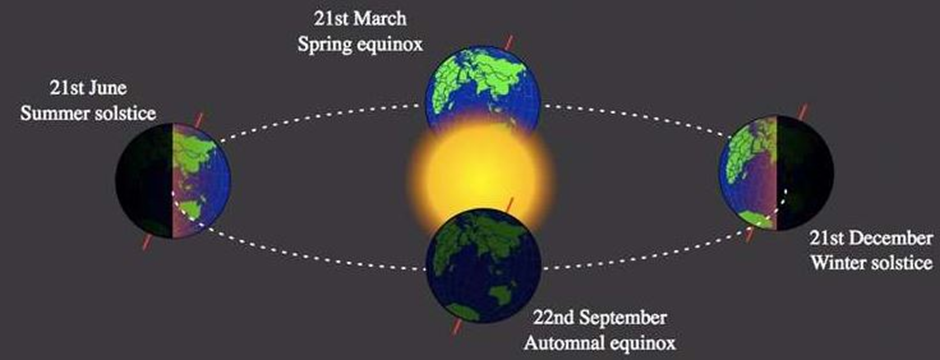
What Drives The Solstice?
- The Mechanism: The phenomenon is driven by Earth’s axial tilt of 23.4 degrees. The solstice occurs when one of the Earth’s poles is tilted furthest away from the Sun.
- The Result: It marks the shortest day and the longest night of the year in that hemisphere.
- Etymology: The term is derived from the Latin solstitium (sol = Sun, stitium = to stop), implying the sun stands still in its seasonal movement before reversing direction.
Global Timing: Northern Vs. Southern Hemispheres
- Northern Hemisphere: The Winter Solstice typically falls on December 21 or 22.
- During this time, the North Pole points away from the Sun.
- It experiences the fewest hours of sunlight.
- Southern Hemisphere: The Winter Solstice occurs on June 20 or 21.
- Post-Solstice Trend: In the Northern Hemisphere, every day following the December solstice gradually becomes longer until the Summer Solstice in June.
Cultural & Astronomical Relevance
- Symbolism: Historically, it symbolizes the “death and rebirth” of the Sun.
- Monuments: Ancient structures like Stonehenge are aligned with the sunset or sunrise of the winter solstice.
- Cosmic Coincidence: The December solstice often coincides with the peak of the Ursid Meteor Shower, caused by debris from comet 8P/Tuttle.
With respect to the timing of the Solstice across hemispheres, consider the following statements:
1.	The Winter Solstice occurs in the Southern Hemisphere around June 20 or 21.
2.	The term 'Solstice' is derived from a Latin word meaning 'the death of the Sun'.
Which of the statements given above is/are correct?
(a) 1 only
(b) 2 only
(c) Both 1 and 2
(d) Neither 1 nor 2

Answer: A
Explanation:
Statement 1 is correct: The Southern Hemisphere experiences its Winter Solstice in June, while the Northern Hemisphere experiences it in December.
Statement 2 is incorrect: The word is derived from solstitium (Sol = Sun, stitium = to stop), implying the Sun stops its movement, not its death (though it symbolically marks death/rebirth).