Context
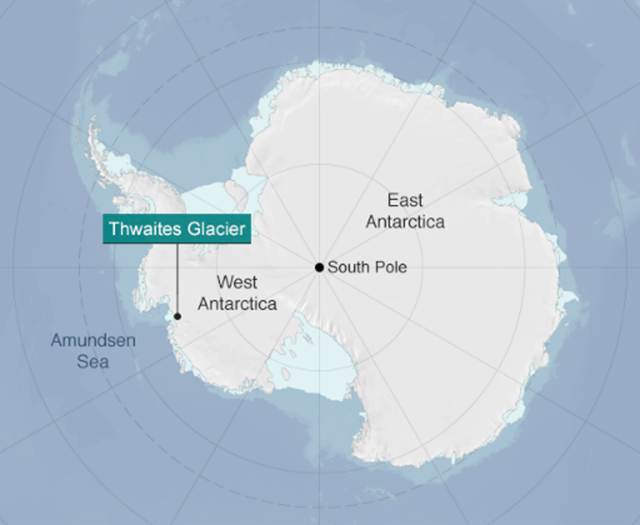
Recently, a major international scientific expedition led by the British Antarctic Survey (BAS) and South Korean researchers commenced a high-stakes drilling mission on the Thwaites Glacier to investigate its rapid melting from beneath.
1. Geographical Profile
- Location: It is an unusually broad and vast glacier located in West Antarctica.
- Drainage: It flows into Pine Island Bay, which is part of the Amundsen Sea.
- Size: The glacier is approximately 120 km wide (the widest in the world) and covers an area of 1.9 lakh sq km, roughly the size of Great Britain or the state of Florida.
- Basin: It is a key component of the West Antarctic Ice Sheet (WAIS), acting as a “cork” that prevents interior ice from flowing rapidly into the ocean.
2. Why the “Doomsday” Label?
- Sea Level Contribution: Currently, Thwaites contributes about 4% to the annual global sea-level rise.
- Potential Rise: If the glacier collapses entirely, it contains enough ice to raise global sea levels by approximately 65 cm (over 2 feet).
- Chain Reaction: Its collapse could destabilize neighboring glaciers (like Pine Island Glacier), potentially leading to a total sea-level rise of up to 3 meters (10 feet), which would submerge major coastal cities like Mumbai, New York, and Shanghai.
3. International Collaboration
- ITGC: The International Thwaites Glacier Collaboration is a multi-year, multi-million dollar joint project between the US (National Science Foundation) and the UK (Natural Environment Research Council) to study the glacier’s fate.
Q. With reference to the Thwaites Glacier, often mentioned in the news, consider the following statements:

I. It is the widest glacier in the world and is located in the East Antarctic region.
II. The "grounding line" of the glacier refers to the point where the ice starts floating over the ocean instead of resting on the seabed.
III. The melting of this glacier is primarily driven by "warm water infiltration" beneath its ice shelf rather than just atmospheric warming.

Which of the statements given above are correct?
A) I and II only
B) II and III only
C) I and III only
D) I, II, and III

Correct Answer: B

Explanation:
• STATEMENT I INCORRECT: While it is the widest glacier in the world, it is located in West Antarctica, not East Antarctica.
• STATEMENT II CORRECT: The grounding line is the critical junction where the glacier transitions from resting on the bedrock to becoming a floating ice shelf. Its retreat is a primary indicator of glacial instability.
• STATEMENT III CORRECT: Recent scientific findings emphasize that relatively warm ocean water (Circumpolar Deep Water) reaching the base of the glacier is the dominant cause of its rapid thinning and retreat.