After reading this article you can solve this UPSC PYQ-
Discuss the role of the civil aviation sector in India’s economic growth. What are the key challenges faced by this sector? 2016 (GS-3, Infrastructure)
Context- In the first few days of December, IndiGo saw a near-total meltdown of its operations, with over 5,000 “flights cancelled in the first 10 days, carrying on from delays and nearly 900 “flights cancelled in November
Introduction
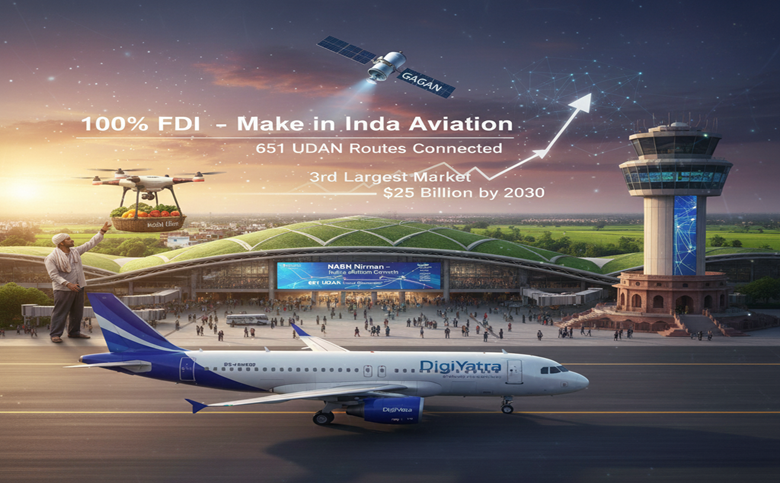
The Civil Aviation sector is a critical pillar of India’s economy, being the third-largest domestic aviation market globally (376 million passengers in FY24) and projected to rise from a $15 billion market in 2025 to $25 billion by 2030. It contributes about 1.5% of the GDP and supports over 7.7 million jobs.
Significance and Role in the Economy:
Civil Aviation plays a crucial multiplier role in the economy, impacting GDP, employment, and trade.
- Economic Catalyst:
- GDP Contribution: Directly contributes to the GDP and indirectly supports allied industries like tourism, hospitality, and trade.
- Data: India is the third-largest domestic civil aviation market globally. Domestic air passenger traffic is expected to cross one billion annually by 2047 (MoCA Vision 2047).
- Enhanced Connectivity and Inclusive Growth:
- Links remote and underserved regions to major cities, fostering balanced regional development.
- Crucial for connecting the North-Eastern States, Hill States, and Islands.
- Employment Generation: Provides large-scale direct and indirect employment (pilots, ground staff, MRO, air traffic control, etc.).
- Data: The sector is projected to support 25 million jobs by 2047.
- Strategic Importance: Supports national security, disaster relief operations, and medical evacuations.
- Trade and Logistics: Facilitates swift movement of high-value, time-sensitive, and perishable goods (e.g., pharmaceuticals, electronics, agricultural produce).
Regulatory and Institutional Framework:
The sector is primarily governed by the Ministry of Civil Aviation (MoCA), with several key regulatory bodies:
- Directorate General of Civil Aviation (DGCA)- Primary safety regulator; issues licenses, monitors airworthiness, and enforces safety standards (Administered by MoCA, but ICAO recommends an independent oversight body).
- Airports Authority of India (AAI)- Manages and operates 137+ airports, provides Air Traffic Management (ATM), Communication, Navigation, and Surveillance (CNS) services.
- Bureau of Civil Aviation Security (BCAS)- Regulatory authority for civil aviation security in India.
- Airports Economic Regulatory Authority (AERA)- Regulates tariffs and other aeronautical charges for major airports.
Major Challenges and Issues:
- Infrastructure and Capacity Constraints
- Airport Saturation: Major airports like Delhi (IGIA) and Mumbai are operating close to or at saturation, leading to congestion and delays.
- Air Traffic Management (ATM): Modernization of Air Traffic Infrastructure (ATI) is crucial for managing the busy airspace.
- Aviation Safety and Regulatory Oversight:
- Regulatory Independence: The International Civil Aviation Organization (ICAO) warned in 2006 for an independent aviation authority. The Directorate General of Civil Aviation (DGCA) remains under the Ministry, leading to concerns about regulatory capture and commercial interests being prioritized over safety.
- Manpower Shortage: Key regulatory bodies like DGCA and Bureau of Civil Aviation Security (BCAS) face significant staff shortages (e.g., up to 53% vacancy in DGCA), hindering effective oversight and timely investigations.
- Financial and Operational Viability:
- High Operating Costs: Aviation Turbine Fuel (ATF) constitutes a large percentage of operating costs. Dollar-denominated costs increase expenses when the Rupee weakens.
- MRO (Maintenance, Repair, and Overhaul): The MRO sector is under-developed due to high Customs Duties and GST, which discourages domestic maintenance and leads to airlines sending aircraft abroad for major checks.
- Route Mortality: Over 100 UDAN routes closed after VGF subsidies ended due to a lack of commercial viability, highlighting sustainability issues in regional connectivity.
- Recent Issue: IndiGo Operational Crisis and FDTL Norms (December 2025):
- The implementation of stricter Flight Duty Time Limitations (FDTL), which included increasing weekly rest from 36 to 48 hours and extending the night operation window, revealed a structural problem of chronic understaffing in major airlines like IndiGo.
- The subsequent mass flight cancellations (over 2,000 flights canceled by IndiGo) due to pilot shortages forced the DGCA to temporarily relax the FDTL norms, highlighting the tension between safety regulations and operational stability/commercial pressures. This incident was a clear example of regulatory weakness and the consequences of insufficient crew buffers.
Key Government Initiatives and Policies:
A. National Civil Aviation Policy (NCAP), 2016
- Aims to make flying affordable, create an integrated ecosystem, and ensure safe, secure, and sustainable growth.
- Key Provisions:
- UDAN Scheme (RCS): Central element, focus on regional connectivity.
- MRO Hub: Rationalised taxation (e.g., uniform 5% IGST for MRO services) to make India a global Maintenance, Repair, and Overhaul (MRO) hub.
- FDI: 100% FDI is allowed under the automatic route for Greenfield airport projects.
B. UDAN (Ude Desh Ka Aam Nagrik) Scheme
- Objective: To stimulate regional air connectivity and make air travel affordable for the common man.
- Mechanism: It caps airfare at ₹2,500 for a one-hour flight to unserved/underserved airports, offering Viability Gap Funding (VGF) to airlines for operational losses.
- Achievements: As of late 2025, over 157 lakh passengers have travelled, and 93 airports (including heliports and water aerodromes) have been made operational under the scheme.
- Related Schemes:
- Krishi UDAN: Launched in 2020 to transport agricultural produce and perishables, especially to benefit the North-Eastern and tribal regions, by offering freight subsidies.
C. Infrastructure and Technology Initiatives
- NABH (NextGen Airports for Bharat) Nirman: Focuses on modernising and expanding airport capacity.
- Goal: The number of operational airports has nearly doubled from 74 in 2014 to 148 (as of early 2025). The target is over 200 airports by 2025 and over 350 by 2047.
- DigiYatra: Biometric-based seamless passenger processing using facial recognition technology.
- Data Example: Over 12.1 million users have downloaded the app (till late 2025), enhancing security and passenger experience.
- GAGAN (GPS-Aided GEO Augmented Navigation): Joint effort by ISRO and AAI to improve flight navigation accuracy and operational efficiency.
- Legal Modernization: The passage of the Bharatiya Vayuyan Adhiniyam, 2024 modernized the sector by replacing the colonial-era Aircraft Act, 1934, and the Protection of Interest in Aircraft Objects Bill, 2025 to align with the Cape Town Convention, 2001, to reduce aircraft leasing costs.
D. Aircraft Leasing & Financing at GIFT City: Aims to develop India’s domestic aircraft leasing ecosystem to reduce dependence on foreign leasing firms and address currency risk (dollar-denominated costs).
Way Forward:
- Strengthening Regulation and Safety:
- Empowering DGCA: Granting administrative and financial autonomy to DGCA and increasing its staffing and technical capacity for rigorous, preventive audits (instead of reactive inspections after accidents) as per ICAO standards. India’s ICAO Effective Implementation (EI) score of 85.65% is above the global average, but continuous improvement is necessary.
- Pilot Fatigue Management: Implementing stricter FDTL norms in phases while ensuring airlines comply with mandatory crew requirements to prevent fatigue-related risks.
- Boosting MRO and Manufacturing:
- Tax Rationalization: Lowering GST on MRO services to 5% and removing high custom duties on spares to attract OEMs and make India a global hub for aircraft maintenance. The government is promoting the ‘Make in India’ – Aviation initiative.
- Sustainable Regional Connectivity:
- Focusing on long-term viability of UDAN routes through market creation, non-aeronautical revenue generation, and improving allied infrastructure like tourism.
- Modernizing Airspace:
- Implementing technologies like the Instrument Landing System (ILS) at all airports to mitigate flight disruptions caused by adverse weather conditions (like fog/smog).
- Bring ATF under GST:
- Rationalise taxes to reduce operational costs and enhance airline profitability, as recommended by industry experts and parliamentary committees.
CONCLUSION
The Civil Aviation sector, with its robust policy framework and ambitious growth plans (like the Vision 2047), is strategically positioned to be the “Skyway to Viksit Bharat,” connecting the nation, boosting trade, and strengthening India’s global stature.