Why In the News?
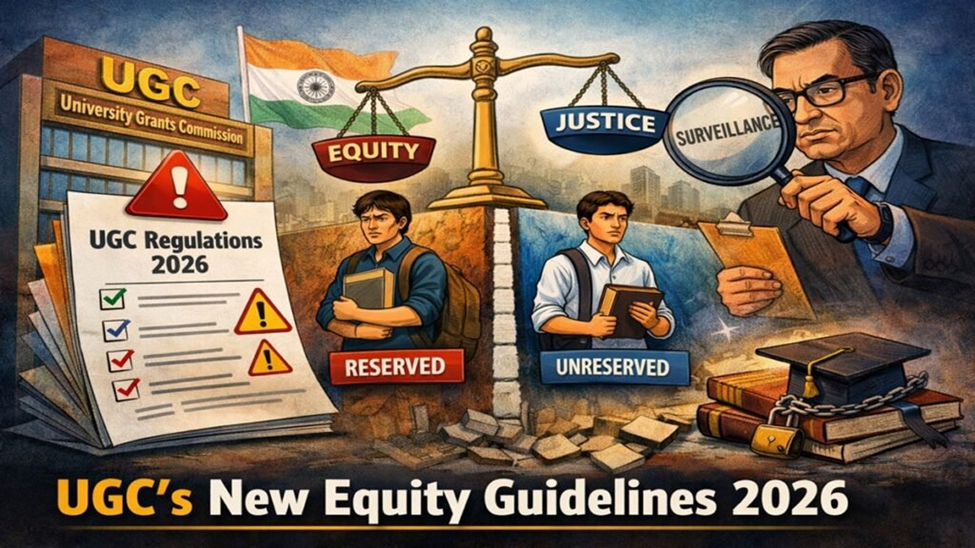
Recently, the University Grants Commission (UGC) notified the “Promotion of Equity in Higher Education Institutions Regulations, 2026”, replacing the previous 2012 framework.
This notification followed a long-standing legal battle in the Supreme Court (Radhika Vemula vs. Union of India) and aimed to provide a more robust, enforceable mechanism to curb caste-based discrimination and promote social inclusion on campuses.
1. Evolution and Background
The regulations are a response to growing concerns regarding “institutional casteism” in premier institutes like IITs and medical colleges.
- Precursor: The earlier 2012 Regulations were often criticized for being “toothless” and lacking clear enforcement timelines.
- Judicial Push: The Supreme Court of India urged the UGC to create a “robust mechanism” to prevent student suicides linked to discrimination, specifically referencing the cases of Rohith Vemula and Payal Tadvi.
- Constitutional Basis: These regulations draw strength from Article 15 (Prohibition of discrimination) and Article 17 (Abolition of Untouchability) of the Indian Constitution.
2. Key Features of the 2026 Regulations
I. Broadened Scope and Definition
- Inclusion of OBCs: Unlike the previous draft, the final 2026 regulations explicitly include Other Backward Classes (OBCs) within the protection framework, alongside SCs, STs, PwDs, and Women.
- Expanded Discrimination: It defines discrimination as any unfair, biased, or differential treatment—whether explicit or implicit—on grounds of religion, race, caste, gender, place of birth, or disability.
II. Mandatory Institutional Architecture
All Higher Education Institutions (HEIs), including Central, State, and Deemed Universities, must establish the following:
- Equal Opportunity Centres (EOC): A nodal body to promote social inclusion and manage discrimination complaints.
- Equity Committee: A committee chaired by the Head of the Institution to review complaints. It must have representation from SC, ST, OBC, Women, and Persons with Disabilities.
- 24/7 Equity Helpline: A round-the-clock helpline and online portal for students and staff to report distress or harassment.
- Equity Squads & Ambassadors: Mobile bodies for campus vigilance and nodal points in hostels and libraries to report violations.
III. Strict Timelines and Accountability
- Grievance Redressal: The Equity Committee is expected to act swiftly upon receiving a complaint, with specific time-bound reporting to the head of the institution.
- Head’s Responsibility: The Vice-Chancellor or Principal is held personally accountable for the implementation and compliance of these rules.
- Appeals: If a complainant is unsatisfied with the committee’s decision, they can appeal to an Ombudsperson within 30 days.
3. Punitive Measures for Non-Compliance
The UGC has been “armed” with significant regulatory powers to ensure these rules are not ignored:
- Financial Penalties: Debarment from receiving grants under any UGC scheme.
- Academic Restrictions: Prohibition from starting new academic programmes or offering online/distance learning courses.
- De-recognition: Removal of the institution’s name from the official list of recognised universities under the UGC Act, 1956.
Q. With reference to the "UGC (Promotion of Equity in Higher Education Institutions) Regulations, 2026", consider the following statements:
I.	These regulations explicitly include Other Backward Classes (OBCs) within the definition of protected groups against caste-based discrimination.
II.	The regulations mandate the creation of an Equal Opportunity Centre (EOC) only in Central Universities.
III.	The University Grants Commission (UGC) has the power to debar non-compliant institutions from receiving central grants.

Which of the statements given above are correct?
(a) I and II only
(b) II and III only
(c) I and III only
(d) I, II and III

Correct Answer: (c)
Explanation
STATEMENT I is CORRECT: The 2026 regulations corrected a major omission in the previous draft by explicitly including OBCs.
STATEMENT II is INCORRECT: These regulations apply to all Higher Education Institutions (HEIs), including State universities, Deemed universities, and private colleges recognized by the UGC.
STATEMENT III is CORRECT: One of the primary punitive measures for non-compliance is the debarment from UGC schemes and grants.