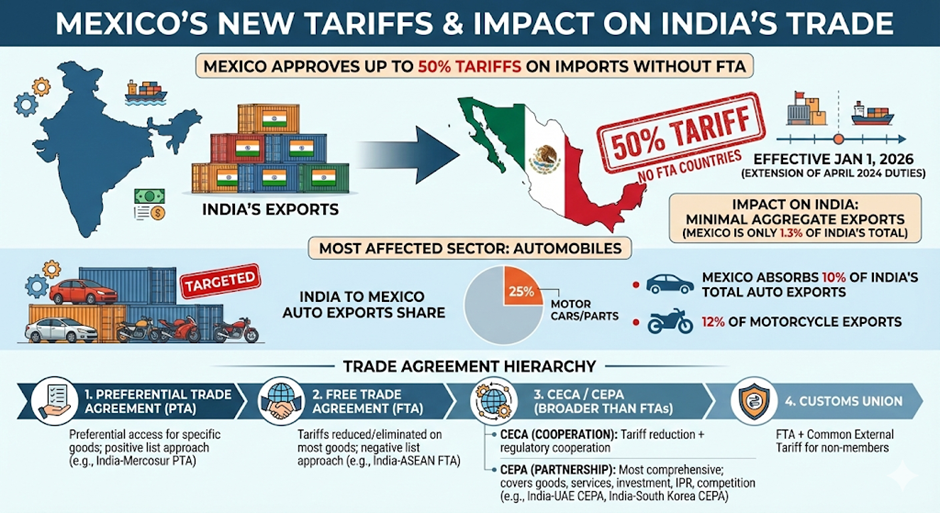
Mexico’s Senate recently approved tariffs of up to 50% on imports from countries with which it does not have a Free Trade Agreement (FTA), including India. These tariffs, expected to apply from January 1, 2026, are effectively an extension of duties already in place since April 2024.
Impact on India: Minimal on aggregate exports (Mexico is only 1.3% of India’s total exports), but high sectoral risk.
Most Affected Sector: Automobiles.
- 25% of India’s exports to Mexico are motor cars/parts.
- Mexico absorbs 10% of India’s total auto exports and 12% of motorcycle exports.
Trade Agreement Hierarchy
- Preferential Trade Agreement (PTA): Preferential access for specific goods; positive list approach (e.g., India-Mercosur PTA).
- Free Trade Agreement (FTA): Tariffs reduced/eliminated on most goods; negative list approach (e.g., India-ASEAN FTA).
- CECA / CEPA: Broader than FTAs.
- CECA (Cooperation): Focuses on tariff reduction + regulatory cooperation.
- CEPA (Partnership): Most comprehensive; covers goods, services, investment, IPR, and competition (e.g., India-UAE CEPA, India-South Korea CEPA).
- Customs Union: FTA + Common External Tariff for non-members.
India’s Major Trade Agreements
India has signed 14 trade agreements (FTAs/PTAs).
- South Korea: CEPA (Operational since 2010)
- Japan: CEPA (Operational since 2011)
- ASEAN: Trade in Goods Agreement (Operational since 2010)
- Malaysia: CECA (Operational since 2011)
- Singapore: CECA (Operational since 2005)
- UAE: CEPA (Operational since 2022 – First in MENA region)
- Australia: ECTA (Operational since 2022)
- Mauritius: CECPA (Operational since 2021)
- EFTA (4 nations): TEPA (Signed 2024 – Wait for ratification)