After Reading This Article You Can Solve This UPSC Mains Model Questions:
The university affiliation system, once a tool for expansion of higher education, has now become a constraint on quality and innovation.” Critically examine in the light of the National Education Policy (NEP) 2020. 15 Marks (GS Paper-2,Social Justice)
Introduction
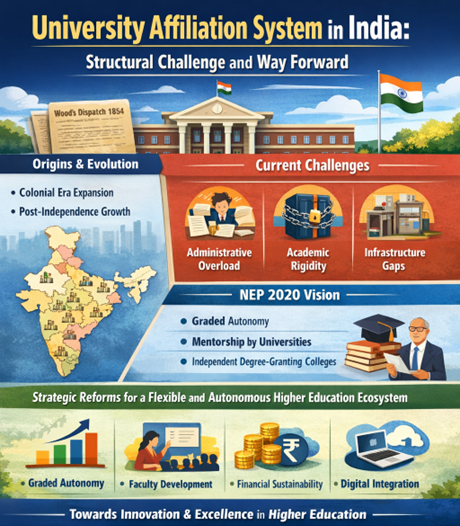
- An often-overlooked aspect of the National Education Policy (NEP) 2020 is its new regulatory framework for affiliating colleges, which seeks to promote empowerment and autonomy by phasing out the affiliation system over 15 years via graded autonomy, ultimately enabling affiliated colleges to become independent degree-granting institutions with improved quality, flexibility, and innovation.
- While the conventional university affiliation model once provided centralised control and administrative stability, it now hinders the growth, autonomy, and quality of colleges. The system is riddled with systemic inefficiencies, archaic academic rigidity, and administrative challenges that impede college progress.
Evolution and Rationale of the Affiliation System
The college–university affiliation system in India traces its origin to the colonial period, particularly following Wood’s Dispatch, 1854, which is often regarded as the “Magna Carta of English Education in India.” It laid the foundation for a structured and regulated higher education system in the country.
A. Colonial Foundations and Institutional Design
- Wood’s Dispatch recommended:
- Establishment of universities in presidency towns (Calcutta, Bombay, Madras)
- Adoption of the affiliating model inspired by the University of London (then a purely examining body)
- Universities were envisioned primarily as:
- Examining and affiliating bodies, rather than teaching institutions
- Objective:
- To create a centralized system of regulation and standardization
B. Post-Independence Expansion:
After 1947, the system was kept to help spread education to the masses. It allowed the government to grow higher education quickly across the country. By using one large university to give “brand-name” degrees and a fixed syllabus to hundreds of small, rural, or low-budget colleges, education became accessible to millions.
Core Objectives of the Affiliation Model
- Expansion of Access: Allowed rapid growth of colleges without establishing full-fledged universities
- Uniformity and Standardisation: Ensured a common curriculum, examination system, and academic benchmarks
- Administrative Efficiency (in colonial context): Enabled centralized control over a large and diverse territory
Present Structure of the Affiliation System
- Universities, especially State universities, are affiliated with hundreds of colleges
- Key responsibilities include:
- Conducting examinations and awarding degrees
- Curriculum design and revision
- Regulation of faculty and infrastructure standards
- Academic and administrative monitoring
How the University Affiliation System Works
Universities in India affiliate colleges in accordance with the University Grants Commission (UGC) guidelines. The primary purposes of affiliation are:
- To maintain academic standards across institutions
- To ensure uniform curriculum and standardised examinations
- To regulate infrastructure, faculty quality, and overall institutional functioning
Key Features of the Affiliation Process
- Provisional and Time-Bound: Affiliation is not a one-time approval. It is typically granted provisionally for an initial period of one year and must be renewed annually or at periodic intervals (usually 1–3 years), depending on the university and UGC norms.
- Strict Compliance Required: Affiliated colleges are mandatory to follow the affiliating university’s:
- Regulations and administrative instructions
- Prescribed syllabi and course structure
- Examination patterns, evaluation methods, and result processing
- Rules related to admissions, attendance, fee structure, and other academic/administrative matters
- Centralised Oversight by the University The affiliating university exercises extensive control and responsibility over its affiliated colleges, including:
- Designing and updating the curriculum
- Conducting university examinations and centralised evaluation of answer scripts
- Monitoring compliance with UGC, university, and statutory norms
- Overseeing academic quality, infrastructure, and faculty appointments
- Supervising academic and extracurricular activities
This oversight often extends to hundreds of colleges and lakhs of students under a single university — especially large state universities — creating a highly centralised and bureaucratic structure.
Structural Challenges Hindering Quality Education
The current system is characterized by “centralized control without standardized quality,” leading to several critical challenges:
1. Administrative Overburdening of Universities
- Bureaucratic Congestion: Large state universities often manage 800 to 1,000 colleges, forcing them to prioritize examination management, result processing, and compliance monitoring over academic leadership.
- Diversion from Research: Resource-strained institutions function as administrative secretariats. Consequently, core functions such as innovation, faculty development, and international collaboration are often neglected.
- According to AISHE 2021-22, there were 147 affiliating universities with more than 100 colleges each, and 20 universities had over 500 colleges.
- State Public Universities (SPUs) — numbering around 495 — oversee more than 46,000 affiliated institutions (including ~43,467 affiliated colleges), accounting for 81% of total higher education enrolment.
- Examples include universities in Uttar Pradesh (over 8,000 colleges across affiliating bodies), Maharashtra (~4,600+), and Rajasthan (~3,800+). Some individual state universities historically affiliate over 1,000 colleges (e.g., older reports cite Rajasthan University with ~1,052).
2. Academic Rigidity and Stifled Innovation
- Lack of Curricular Autonomy: Affiliated colleges are legally bound to the syllabi of the parent university. This prevents institutions from designing courses that align with local industry requirements or emerging global markets (e.g., AI, Fintech).
- Uniformity vs. Creativity: The system imposes a “one-size-fits-all” model that discourages specialized courses and modern pedagogical practices, effectively stifling the creative potential of faculty and students.
3. Inertia in Curricular Reforms
- Lagging Syllabus Updates: Revising a curriculum for hundreds of colleges involves exhaustive committee approvals. By the time a reform is implemented, the content is often obsolete, particularly in fast-paced fields like Engineering and Biotechnology.
- Agility Deficit: The affiliation model lacks the structural speed required to respond to the rapidly changing educational needs of the 21st-century workforce.
4. Infrastructure and Quality Disparity
- Uneven Delivery: Despite a uniform syllabus, the actual quality varies drastically due to gaps in laboratory facilities and teacher-student ratios.
- Skill Competency Gaps: Students graduating from different colleges under the same university possess vastly different skill levels, undermining the credibility of the standardized degree.
NEP 2020 Reform Vison
The NEP 2020 proposes a transformative shift:
- Existing universities will act as mentors to affiliated colleges.
- Colleges must achieve minimum benchmarks in academics, teaching, governance, finance, and administration.
- Through graded autonomy, colleges will progressively attain accreditation and become self-reliant autonomous degree-granting institutions.
- The affiliation system will be phased out over 15 years.
Global Best Practices
Many leading higher education systems worldwide have moved away from rigid affiliation models towards institutional autonomy backed by strong quality assurance:
- United States: Colleges and universities are largely independent and accredited by regional bodies (e.g., NEASC, HLC). There is no central affiliating university managing hundreds of institutions. Autonomy allows rapid innovation, industry alignment, and specialised programs.
- United Kingdom: All universities enjoy full degree-awarding powers and autonomy. Quality is maintained through external frameworks like the Teaching Excellence Framework (TEF) and Research Excellence Framework (REF), not bureaucratic oversight.
- Germany & Australia: Strong emphasis on institutional autonomy with federal or national accreditation systems. Universities focus on research and teaching excellence while responding quickly to market and societal needs.
Way Forward: Structural Reforms for Enhancing Quality, Equity, and Flexibility
To bridge the gap between policy intent and ground reality, a multi-pronged approach is required:
- Transition to Graded Autonomy: Implementation must be transparent, using the National Institutional Ranking Framework (NIRF) and NAAC accreditation scores as triggers for granting colleges more independence.
- Capacity Building for Faculty: For colleges to become self-reliant, there must be a focus on training faculty in curriculum design and internal assessment methodologies.
- Financial Robustness: The government and parent universities must support colleges in establishing sustainable financial models that do not depend solely on student fees or meager grants.
- Digital Integration: Leveraging the Academic Bank of Credits (ABC) will facilitate student mobility and allow autonomous colleges to focus on niche specializations without losing institutional credibility.
Conclusion
The university affiliation system, while once a tool for expanding education, has become a bottleneck in the era of massification and specialization. The future of Indian higher education depends on fostering an ecosystem of autonomy, flexibility, and innovation. Phasing out the affiliation system is not merely a regulatory change; it is an essential step toward empowering institutions to become globally competitive and ensuring that the Indian youth are equipped with contemporary, high-quality skills.