As the saying goes, “Success depends upon previous preparation, and without such preparation there is sure to be failure.” This perfectly reflects the approach required for the UPSC Civil Services Examination (CSE). Before starting preparation, aspirants must clearly understand the UPSC exam pattern.
Conducted at the national level by the Union Public Service Commission, the UPSC Civil Services Examination is considered one of the toughest competitive exams in India. Every year, lakhs of candidates apply despite intense competition and a low success rate. The reason lies in the prestige, responsibility, and opportunity to serve the nation through various civil services.
To prepare effectively for UPSC CSE , candidates must have complete clarity about:
- Exam stages (Prelims, Mains, Interview)
- Paper structure and duration
- Marking scheme and negative marking
- Subject-wise weightage
- Qualifying vs merit-based papers
Understanding the UPSC exam pattern is the first strategic step toward success. It strengthens preparation by helping aspirants align their study plan with the actual exam structure.
Why is Knowing the UPSC Exam Pattern Important?
- Builds clarity about the three-stage selection process
- Helps in identifying high-weightage areas
- Improves time management strategy
- Reduces confusion during preparation
- Enhances performance through structured planning
In this detailed guide, we will explain the UPSC Exam Pattern in a simple and structured manner, covering:
- UPSC Prelims Exam Pattern
- UPSC Mains Exam Pattern
- UPSC Interview (Personality Test
What is the UPSC Exam Pattern ?
Talking about the UPSC exam pattern, the UPSC CSE is conducted in an offline mode.
The selection procedure for UPSC CSE is an elaborate process comprising three stages, which are:
- UPSC Prelims
- Objective in nature: The Prelims consist of 2 papers – General Studies and CSAT. Both the papers are objective in nature.
- Total marks: Both papers are of 200 marks each, which makes the total 400 marks.
- Time duration: A total of 120 minutes (2 hours) is allotted to complete each paper.
- UPSC Mains
- Descriptive in nature: The Mains exam consists of 9 papers and all the papers contain descriptive based questions.
- Total marks: All the 09 papers constitute a total of 1750 marks in the exam.
- Time duration: The time duration allotted to complete each paper is 3 hours.
- UPSC Interview
- Nature of questions: The interview consists of questions related to the candidate’s personal details, educational background, current affairs, social and political events.
- Total marks: The Interview comprises of total 275 marks.
Now that you know about the exam pattern, You should also go through the detailed UPSC (IAS) CSE syllabus.
Exam Pattern for UPSC Prelims
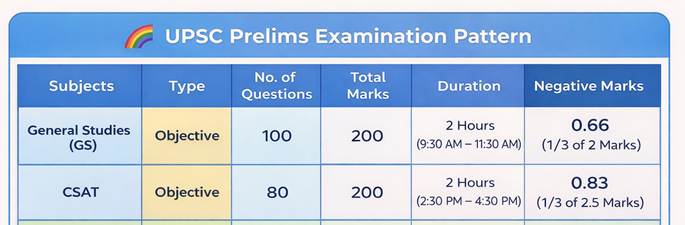
The Prelims’ stage of IAS exam pattern consists of 2 papers General Studies and CSAT.
General Studies (Paper 1):
- No. of questions: The GS Paper contains 100 questions.
- Total marks: This paper comprises of total 200 marks.
- Marking scheme: While each correct answer is for 2 marks, there is 1/3rd negative marking for each incorrect answer.
CSAT or Paper 2:
- No. of questions: The CSAT paper contains a total of 80 questions.
- Total marks: This paper comprises of total 200 marks.
- Marking scheme: While each correct answer is for 2.5 marks, there is 1/3rd negative marking allotted for every incorrect answer.
- Both the papers are conducted on the same day.
- The type of questions asked in both papers is objective in nature with multiple choices provided per question.
Let us look at the table provided below:
Prelims Exam Pattern Summary
Important Rule About Multiple Answers
- Each question has four answer options.
- If a candidate marks more than one option, the response is treated as incorrect.
- In such cases, a penalty of 0.66 marks is applied.
Now that we have discussed the exam pattern for Prelims, let us proceed to UPSC Mains exam pattern.
UPSC CSE Exam Pattern for UPSC Mains
The exam structure for UPSC Mains is very different from the Prelim’s exam. The UPSC Mains exam pattern is as follows:
- No. of Papers: The Mains exam comprises 9 descriptive papers .
It consists of 4 GS Papers, 1 Essay Paper, 2 Language Papers, 2 Optional Subjects.
- Total marks: The Mains exam for total 1750 marks. The 2 Language papers are of 300 marks in total, whereas the rest of the papers are of 250 marks each.
- Negative marking: Since the Mains exam is subjective in nature and candidates are required to write answers, there is no provision for negative marking.
UPSC CSE Mains Exam Pattern Summary
| Papers | Subjects | Nature of Paper | Marks | Duration |
| Paper A | Any Indian Language (Compulsory) | Qualifying (75 Marks required i.e. 25%) | 300 Marks | 3 Hours |
| Paper B | English | Qualifying (75 Marks required i.e. 25%) | 300 Marks | 3 Hours |
| Paper 1 | Essay | Final Merit (Marks counted in final merit list) | 250 Marks | 3 Hours |
| Paper 2 | General Studies 1 | Final Merit (Marks counted in final merit list) | 250 Marks | 3 Hours |
| Paper 3 | General Studies 2 | Final Merit (Marks counted in final merit list) | 250 Marks | 3 Hours |
| Paper 4 | General Studies 3 | Final Merit (Marks counted in final merit list) | 250 Marks | 3 Hours |
| Paper 5 | General Studies 4 | Final Merit (Marks counted in final merit list) | 250 Marks | 3 Hours |
| Paper 6 | Optional Paper 1 | Final Merit (Marks counted in final merit list) | 250 Marks | 3 Hours |
| Paper 7 | Optional Paper 2 | Final Merit (Marks counted in final merit list) | 250 Marks | 3 Hours |
Language & Optional Subjects Exam Pattern
- There are 2 qualifying language papers, i.e., English and any other Indian language. Both language papers are of 300 marks each. The minimum qualifying marks for both papers is 25%.
The language papers consist of the following:
- 100 marks worth of essay questions
- 60 marks worth of reading comprehension questions
- 60 marks worth precis – writing
- 40 worth of translation-based questions, and
- 40 worth of grammar-based questions.
- In the UPSC Mains exam pattern for optional subjects, there are 2 papers, i.e., Paper 1 and Paper 2 which consists of 250 marks each.
- For optional subject, candidates are required to choose any subject from the given list of 48 subjects.
UPSC Mains Paper Optional
| List of Optional Subjects | ||||
| Agriculture | Anthropology | Chemistry | Animal Husbandry and Veterinary Science | Botany |
| Geology | Law | Mathematcics | History | Management |
| Psycology | Sociology | Zoology | Public Administration | Statistics |
| Commerce and Accountancy | Electrical Engineering | Civil Engineering | Economics | Geography |
| Medical Science | Physics | Mechanical Engineering | Philosophy | Political Science and International Relations |
| Literature of any of the following languages: Bengali, Dogri, Hindi, Kashmiri, Maithili, Manipuri, Nepali, Punjabi, Santhali, Tamil, Urdu, Assamese, Bodo, Gujarati, Kannada, Konkani, Malayalam, Marathi, Odia, Sanskrit, Sindhi, Telugu, and English | ||||
- An important thing to note is that you can write both your optional papers, namely Paper 6 and 7 in English, even if you have written all the other papers in some other language.
- Now it is time to talk about the final stage of the UPSC exams or the Interview round.
IAS Exam Pattern for UPSC Interview Round
The UPSC Interview, also known as the Personality Test, is the third and final stage of the Civil Services Examination conducted by the Union Public Service Commission. Candidates who qualify the Mains examination are shortlisted for this stage.
When is the Interview Conducted?
The Interview round is generally held 3–4 months after the declaration of UPSC Mains results.
Marks and Weightage
- Interview (Personality Test): 275 marks
- Mains (Written Exam): 1750 marks
- Final Merit Total: 2025 marks (1750 + 275)
The final ranking is prepared based on the combined marks of Mains and Interview.
What is the Purpose of the UPSC Interview?
The Interview is not a test of academic knowledge alone. Instead, it evaluates whether a candidate possesses the personality traits required of a competent civil servant. A board of experienced and impartial members conducts the interaction to assess overall suitability for public service.
Types of Questions Asked in the UPSC Interview
The questions asked during the Personality Test may cover a wide range of areas, including:
- Personal Background – Questions related to your hobbies, interests, educational background, work experience, and home state.
- Current Affairs – National and international events of contemporary relevance.
- Socio-Economic Issues – Ongoing social, economic, and governance-related issues in the country or your region.
- Situational Questions – Hypothetical scenarios to evaluate decision-making skills and administrative temperament.
- Opinion-Based Questions – Designed to test analytical ability, clarity of thought, and moral integrity.
Qualities Assessed in the IAS Interview
The Interview board evaluates whether a candidate demonstrates the qualities expected from an ideal IAS officer. Some of the key attributes assessed include:
- Critical power of assimilation
- Balanced judgment
- Leadership ability and capacity to promote social harmony
- Mental alertness
- Clear, logical, and coherent expression
- Breadth and depth of interests
- Intellectual and moral integrity
Conclusion
The UPSC Interview round plays a decisive role in the final selection process. While it carries 275 marks, it can significantly impact a candidate’s overall rank. Proper awareness of the interview pattern, expected qualities, and types of questions can greatly enhance preparation and confidence.
FAQs: UPSC CSE Exam pattern
1. Is there negative marking in the UPSC IAS Exam 2026?
Yes, there is negative marking in the UPSC IAS Prelims Examination. For every incorrect answer, one-third (1/3rd) of the marks allotted to the question is deducted.
In General Studies Paper I: 2 marks per question → 0.66 marks deducted for each wrong answer.
In CSAT (Paper II): 2.5 marks per question → 0.83 marks deducted for each wrong answer.
However, there is no negative marking in the UPSC Mains Examination or Interview stage.
2. Why is it important to understand the IAS exam pattern?
Understanding the UPSC CSE exam pattern is crucial because it:
Provides clarity about the three-stage selection process
Helps in strategic preparation and time management
Explains the marking scheme and qualifying criteria
Identifies subject-wise weightage
Reduces confusion and enhances confidence
Knowing the structure of the exam is the first step toward effective preparation.
3. What is the IAS exam pattern of Prelims?
The IAS Prelims consists of two objective-type papers (MCQs):
General Studies Paper I – 200 marks (Merit-based)
CSAT (General Studies Paper II) – 200 marks (Qualifying; 33% required)
Key Features:
Mode: Offline (Pen & Paper)
Duration: 2 hours for each paper
Negative marking applicable
Only marks of GS Paper I are counted for merit
4. What is the selection process for the UPSC IAS Exam?
The selection process conducted by the Union Public Service Commission consists of three stages:
Preliminary Examination (Objective)
Main Examination (Descriptive)
Interview (Personality Test)
Candidates must qualify each stage to move to the next. The final merit list is prepared based on Mains + Interview marks.
5. What is the pattern for the UPSC Mains exam?
The UPSC Mains Examination consists of 9 papers, all descriptive in nature.
2 Qualifying Papers (Indian Language & English)
1 Essay Paper
4 General Studies Papers
2 Optional Subject Papers
Each paper is of 3 hours duration.
Total Marks (for merit): 1750 marks
There is no negative marking in Mains.
6. How many subjects are there for IAS Prelims?
The IAS Prelims has two papers/subjects:
General Studies (GS)
CSAT (Civil Services Aptitude Test)
Both are compulsory.
7. How many papers are there in IAS Mains?
There are 9 papers in total in IAS Mains:
- 2 Qualifying Papers
- 7 Papers counted for merit
Only the marks of the 7 merit papers (1750 marks) are considered for the final ranking.
8. What kind of questions are asked in the IAS interview?
The IAS Interview (Personality Test) assesses:
- Personality traits
- Decision-making ability
- Analytical skills
- Leadership qualities
- Ethical and moral integrity
- Awareness of national and international issues
Questions are generally based on the candidate’s Detailed Application Form (DAF), academic background, current affairs, and situational judgment.
9. Are only MCQs asked in the UPSC Exam?
No, only the Prelims stage consists of MCQs (Objective type questions).
The Mains Examination is descriptive, requiring long and short analytical answers.
The Interview stage is a face-to-face personality assessment.