The UPSC Civil Services Examination (CSE) is regarded as one of the most competitive and prestigious examinations in India. Every year, lakhs of aspirants appear for this exam with the aim of serving the nation as IAS, IPS, IFS, and other civil servants. However, success in UPSC does not depend only on hard work—it also depends on smart preparation, and that begins with a clear understanding of the UPSC exam pattern.
Knowing the exam pattern helps aspirants prepare in a focused manner, avoid common mistakes, and align their study plan with the actual demands of the examination. In this detailed guide, we explain the complete UPSC exam pattern for 2026, including structure, stages, marking scheme, and preparation relevance.
Overview of the UPSC Civil Services Examination
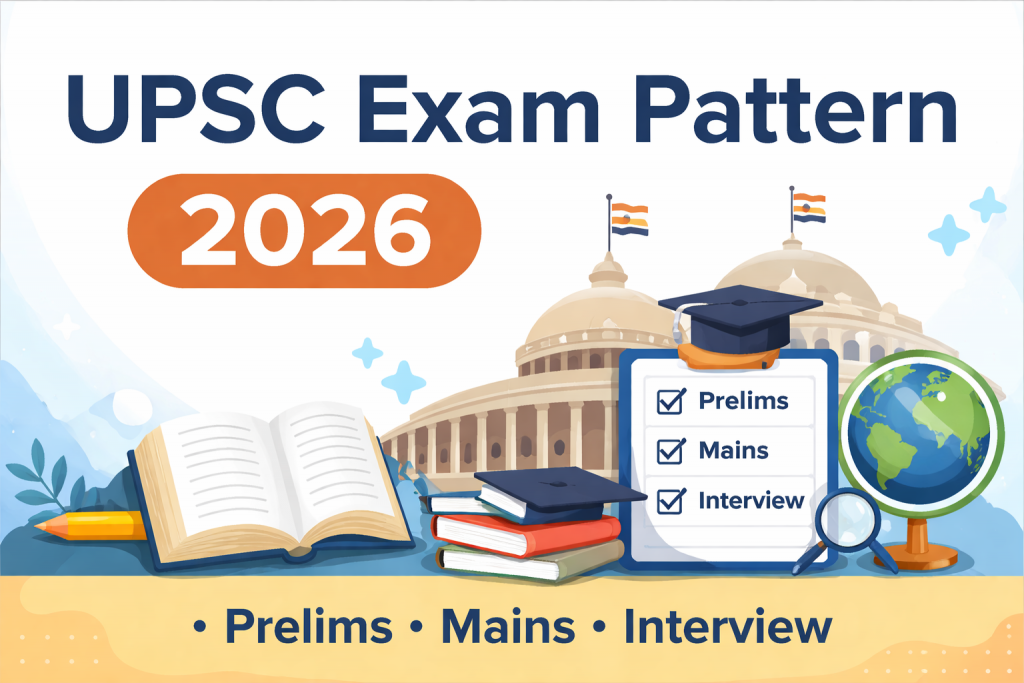
The UPSC Civil Services Examination is conducted annually by the Union Public Service Commission in three distinct stages:
- Preliminary Examination (Prelims)—Screening stage
- Main Examination (Mains)—Descriptive and merit-based
- Personality Test (Interview) – Final assessment
Candidates must qualify for each stage to move to the next. While the prelims are qualifying in nature, the marks of Mains and interview together determine the final merit list.
UPSC Preliminary Examination Pattern
The Preliminary Examination is the first hurdle in the UPSC journey. It is objective in nature and designed to test a candidate’s basic awareness and aptitude.
Structure of UPSC Prelims
The prelims consist of two compulsory papers conducted on the same day:
General Studies Paper I (GS)
- Number of Questions: 100
- Total Marks: 200
- Duration: 2 hours
- Type: Objective (MCQs)
- Negative Marking: Yes (⅓ marks deducted for each wrong answer)
This paper covers a wide range of subjects including:
- Current Affairs (National & International)
- History (Ancient, Medieval, Modern)
- Geography (India & World)
- Indian Polity and Governance
- Economy
- Environment & Ecology
- Science and Technology
General Studies Paper II (CSAT)
- Number of Questions: 80
- Total Marks: 200
- Duration: 2 hours
- Nature: Qualifying
- Minimum Qualifying Marks: 33%
CSAT tests:
- Comprehension
- Logical reasoning
- Analytical ability
- Basic numeracy (Class X level)
- Decision-making skills
⚠️ Important: Only marks of GS Paper I are considered for Prelims cut-off. CSAT is qualifying but compulsory.
UPSC Mains Examination Pattern
Candidates who clear the prelims are eligible to appear for the UPSC Mains examination. This stage is descriptive in nature and tests in-depth understanding, analytical ability, clarity of thought, and answer-writing skills.
Structure of UPSC Mains
The Mains examination consists of 9 papers, conducted over several days.
Qualifying Papers
- Paper A: Indian Language – 300 marks
- Paper B: English – 300 marks
These papers are qualifying in nature, and their marks are not included in the final merit.
Merit-Based Papers
| Paper | Subject | Marks |
|---|---|---|
| Paper I | Essay | 250 |
| Paper II | General Studies I | 250 |
| Paper III | General Studies II | 250 |
| Paper IV | General Studies III | 250 |
| Paper V | General Studies IV (Ethics) | 250 |
| Paper VI | Optional Subject – Paper 1 | 250 |
| Paper VII | Optional Subject – Paper 2 | 250 |
Total Marks for Mains (Counted): 1750
Understanding General Studies Papers in Mains
Each GS paper has a distinct focus:
- GS I: Indian Heritage, History, Geography, Society
- GS II: Polity, Constitution, Governance, International Relations
- GS III: Economy, Agriculture, Science & Technology, Environment, Security
- GS IV: Ethics, Integrity, Aptitude, Case Studies
These papers test not just knowledge but also the ability to analyze, evaluate, and present answers in a structured manner.
Optional Subject in UPSC Mains
The optional subject plays a crucial role in the Mains examination. Aspirants must choose one optional subject from the UPSC’s notified list. The optional consists of two papers, each carrying 250 marks.
Choosing the right optional subject depends on:
- Academic background
- Interest in the subject
- Availability of study material
- Overlap with GS syllabus
A well-prepared optional can significantly boost the overall Mains score.
UPSC Personality Test (Interview)
Candidates who clear the Mains examination are called for the Personality Test, commonly known as the UPSC Interview.
- Total Marks: 275
- Conducted by: UPSC Board
- Nature: Qualitative assessment
The interview evaluates:
- Personality and attitude
- Decision-making ability
- Leadership qualities
- Ethical values
- Awareness of current issues
Contrary to popular belief, the interview is not a test of factual knowledge but of personality and suitability for civil services.
Final Merit List Calculation
The final ranking of candidates is based on:
- UPSC Mains Marks: 1750
- UPSC Interview Marks: 275
Total: 2025 Marks
Prelim marks are not included in the final merit list.
Why Understanding the UPSC Exam Pattern Is Crucial
A clear understanding of the UPSC exam pattern helps aspirants:
- Prepare with a stage-wise strategy
- Allocate time efficiently between Prelims and Mains
- Focus on answer writing early
- Avoid over-studying irrelevant topics
- Track preparation progress realistically
Many aspirants preparing through UPSC coaching in India emphasize mastering the exam pattern before diving deep into the syllabus, as it provides direction and clarity throughout the preparation journey.
Trends and Expectations for UPSC 2026
While the basic structure of the UPSC exam remains consistent, recent trends show:
- Increased focus on analytical and application-based questions
- Integration of current affairs with static subjects
- Emphasis on ethics, governance, and decision-making
- Demand for concise, structured, and value-enriched answers
Aspirants should align their preparation strategy accordingly while keeping the exam pattern at the core.
Summary
The UPSC exam pattern is designed to assess a candidate’s knowledge, analytical skills, consistency, and personality in a comprehensive manner. Understanding the structure of Prelims, Mains, and Interview is the first and most important step toward effective UPSC preparation.
A disciplined study plan, regular practice, and continuous evaluation—guided by a clear understanding of the exam pattern—can significantly improve an aspirant’s chances of success. UPSC coaching in India plays an important role for aspirants preparing for the Civil Services Examination. With an extensive syllabus, changing exam trends, and high competition, many candidates prefer structured guidance to streamline their preparation.
Choosing the right UPSC coaching in India depends on factors such as faculty experience, study material quality, test series relevance, mentoring support, and overall academic approach. When combined with self-study and disciplined practice, the right guidance can significantly enhance an aspirant’s chances of success in the UPSC Civil Services Examination.
If you are looking for IAS coaching in Kolkata, RICE IAS stands out among UPSC coaching institutes in Kolkata due to its experienced faculty, comprehensive study material, and personalized mentoring approach. The faculty members are subject experts with in-depth knowledge of the UPSC syllabus and continuously update their teaching methods according to the latest exam trends.