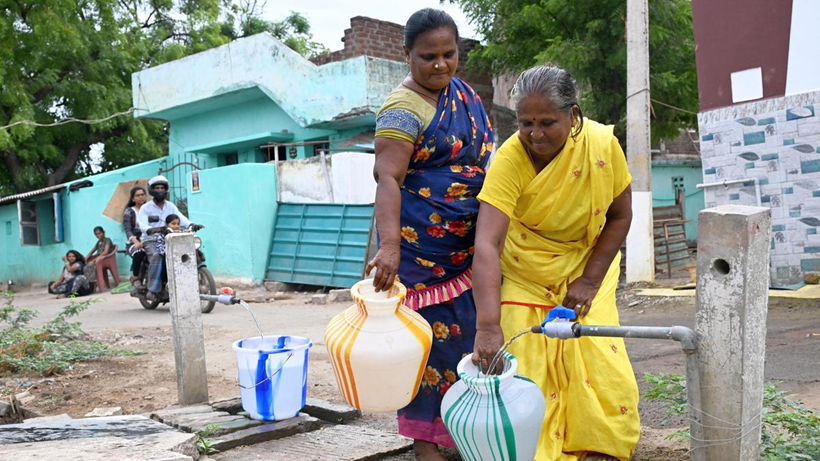
Why in the News?
A new study titled “The Value of Clean Water: Experimental Evidence from Rural India” (NBER, 2025) reveals that households value clean drinking water far more than earlier estimates suggested, calling for major reforms in water pricing, supply, and quality policies.
Background: India’s Drinking Water Challenges
- Water is essential, yet only ~70% of rural households have access to basic drinking water.
- Wide disparities persist in:
- Safe drinking water availability
- Water quality
- Reliability
- Households rely on unsafe or unreliable sources → affecting health, productivity, and well-being.
Traditional understanding underestimated how much households are willing to pay for clean, reliable water supply due to:
- Taste/odor aversion
- Irregular availability
- Hidden burdens of collection (mostly on women)
- Low-income constraints masking ‘true’ preferences
Study Overview: Conducted in Odisha
Why Odisha?
- Large rural population
- 32nd out of 37 states/UTs in water access
- ~83% households rely on government water connections
- 40% villages still lack safe drinking water access (2023 survey)
How the Study Measured Water Value
a) Two Methods Used
- Willingness to Pay (WTP) experiments
- Willingness to Accept (WTA) compensation for switching to dirty/low-quality water
b) Innovative Randomised Controlled Trial
- Conducted across 91 villages
- Private company supplied filtered water
- Randomisation allowed researchers to directly measure:
- Collection time
- Taste tolerance
- Water treatment behaviour
- Household preferences
c) Experimental design isolated factors such as:
- Income changes
- Seasonal scarcity
- Infrastructure quality
- Substitutes availability (protected vs unprotected sources)
Key Findings
1. Households value clean water far higher than previously believed
- WTP and WTA were significantly higher than estimates in earlier literature.
- Households are willing to pay more or accept high compensation to avoid unsafe water.
2. Strong preference for quality over affordability
Even poor households placed:
- High value on reliability
- High value on water source safety
- Strong aversion to switching to low-quality water
This contradicts old assumptions that poor households:
- Don’t prioritise water quality
- Value only cost or convenience
3. Hidden burdens became visible
The study captured costs earlier ignored:
- Time spent collecting water
- Physical fatigue
- Psychological stress
- Lower well-being from uncertain water access
These factors contributed significantly to valuations.
4. Households prefer clean treated water even when:
- Free alternatives exist
- Switching involves no financial penalty
- Quantity available is the same
→ The preference is fundamentally for health, safety and reduced stress.
Implications for Policymakers
1. Redesign water pricing & subsidies
- Water subsidies should prioritise:
- Quality of supply
- Reliable delivery
- Not merely affordability.
2. Strengthen rural drinking water schemes
(JJM, NRDWP, Swajal)
- Shift focus from coverage to:
- Water quality
- Real-time monitoring
- Grievance redressal
3. Prioritise investments in treatment infrastructure
- Households clearly value safe filtered water → State intervention must ensure:
- Water treatment plants
- Quality testing labs
- Contamination alerts
4. Recognise behavioural aspects
- Choices are driven by:
- Health preferences
- Reliability
- Risk perception
- Not only price.
5. Targeted support for vulnerable groups
- Women and children bear disproportionate water-collection burdens → Their well-being improves significantly with reliable piped supply.
Conclusion
The study fundamentally shifts how policymakers should view water access.
It shows that households deeply value safe, reliable water—economically, emotionally, and health-wise.
Future policies must recognise:
- Quality > Quantity
- Reliability > Affordability
- Well-being > Minimalist infrastructure
A reorientation towards people-centric, quality-focused water governance is the need of the hour.
Water Crisis: Meaning and India’s Situation
What is a Water Crisis?
A water crisis arises when the amount of clean, usable water available in an area becomes inadequate to meet the needs of its population. As per the World Bank, water scarcity occurs when annual per-capita water availability drops below 1,000 cubic metres.
Water Crisis Scenario in India
Overall Stress on Water Resources
- India holds only 4% of global freshwater, yet caters to 17% of the world’s population, placing enormous pressure on its limited resources.
- NITI Aayog’s Composite Water Management Index (CWMI) warns that India is undergoing its most severe water crisis ever, with around 600 million people facing high to extreme levels of water stress.
- Per-capita water availability dropped to 1,486 cubic metres (2021) — already in the “water-stressed” category — and may further fall to 1,341 cubic metres by 2025 and 1,140 cubic metres by 2050.
Lack of Access to Safe Drinking Water
As highlighted by CWMI:
- Nearly 200,000 deaths per year are linked to unsafe or inadequate water.
- Three-fourths of households do not have assured drinking water access.
- By 2030, about 40% of Indians may lack access to potable water.
Groundwater Depletion and Pollution
- India is the world’s largest user of groundwater, accounting for over 25% of global extraction.
- Nearly 70% of groundwater sources are contaminated, placing India at 120th out of 122 countries in the global water quality index.
Causes of the Water Crisis in India
1. Escalating Water Demand
- NITI Aayog projects that India’s water demand will double the available supply by 2030.
- Groundwater depletion between 2041–2080 is expected to be three times the current rate.
2. Agricultural Dependency on Groundwater
- Farming heavily relies on groundwater, especially due to water-intensive crops like paddy grown in Punjab and Haryana, despite being ecologically unsuitable.
3. Encroachment of Natural Water Bodies
- Urban expansion has led to destruction and encroachment of lakes, ponds, and wetlands.
- Example: Loss of traditional lakes in Bengaluru due to real-estate pressure.
4. Climate Change
- Irregular monsoons, rising temperatures, and declining river flows — all climate-induced — are aggravating water shortages across the country.
5. Pollution of Water Sources
- Groundwater and surface water contamination is rising due to industrial effluents, untreated sewage, and unregulated mining activities.
6. Outdated Legislation and Poor Management
- Laws such as the Easement Act of 1882 give landowners unrestricted access to groundwater, promoting over-extraction.
- Water management remains outdated and reactive rather than forward-looking.
7. Fragmented Governance
- Water governance is split between the Centre and States and even between departments within governments.
- Example:
- Central Water Commission (CWC) → surface water
- Central Ground Water Board (CGWB) → groundwater
- Example:
- Political interference exacerbates inter-state disputes.
8. Low Public Awareness
- Water is often treated as a free, inexhaustible resource, resulting in widespread misuse and neglect.
Impacts of the Water Crisis
1. Economic Consequences
- The World Bank estimates that India could see a 6% loss in GDP by 2050 due to water scarcity.
- Reduced water availability hampers agricultural productivity, endangering food security and livelihoods.
- Industries like textiles, power, and manufacturing may face production declines.
2. Ecological Effects
- Water scarcity threatens ecosystems, potentially leading to loss of plant and animal species.
- Contamination by heavy metals and chemical spills disrupts marine and freshwater biodiversity.
3. Social Implications
- Consumption of polluted water leads to health issues, especially in children, diminishing human capital.
- Rising healthcare expenses worsen the hardships of the vulnerable population.
- Women face increased burdens — long distances to fetch water, school dropouts, and even phenomena like “water wives” in drought-prone regions.
4. Strain on Federal Relations
- Scarce resources intensify long-standing inter-state disputes such as Cauvery, Krishna, and Godavari.
- Competition over water fuels regionalism and may weaken national cohesion.
5. International Tensions
- Cross-border rivers become points of contention.
- Example:
- China’s dams on the Brahmaputra affecting India’s water security.
- Discussions around revisiting the Indus Waters Treaty with Pakistan.
- Example:
India faces a severe and multidimensional water crisis driven by growing demand, depleting groundwater, climate change, weak governance, and widespread pollution. Its consequences are visible across the economy, ecology, society, federal structure, and international relations. Addressing this crisis requires urgent, coordinated, and long-term reforms in water governance, public behaviour, and sustainable management practices.
Source: Value of water: evaluating the pricelessness of clean, potable water – The Hindu
UPSC CSE PYQ
| Year | Question |
| 2024 | “Increasingly, the water crisis in India is not just a natural scarcity but a result of mis-governance.” Analyse. |
| 2024 | Describe the role of technology and community participation in addressing the challenges of groundwater depletion in India. |
| 2023 | “The loss of wetlands is a threat to water security.” Explain. |
| 2022 | “Groundwater depletion is emerging as a silent crisis in India.” Discuss with examples. |
| 2021 | How do river interlinking projects help in water security? Discuss the concerns associated with such projects. |
| 2021 | Discuss inter-state water disputes in India and measures to address them. |
| 2021 | “Water harvesting and water conservation are the key to sustainable food security.” Elaborate. |
| 2020 | The Himalayan rivers are perennial yet most Indian rivers face water scarcity. Explain. |
| 2019 | How do local bodies help in management of water resources? Explain. |
| 2019 | Inter-state river water disputes impede cooperative federalism. Discuss with reference to recent cases. |
| 2019 | “Water scarcity may become a source of internal security threat in India.” Examine. |