Recently, Venezuela has proclaimed a national emergency in response to reported military actions by the United States.
Venezuela’s government has alleged that the United States targeted both civilian and military installations across several states following reports of at least seven explosions and low-flying aircraft in the capital, Caracas.
About Venezuela
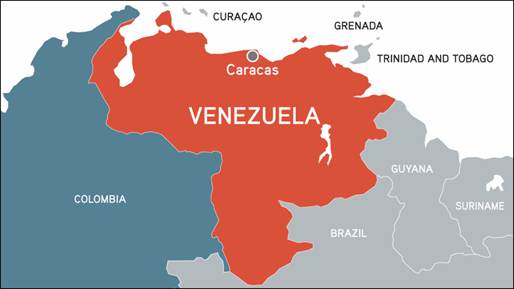
Venezuela is located in the north of South America.
Bordering Countries: Venezuela shares its borders with Guyana to the east, Brazil to the south, and Colombia to the southwest and west.
Area & Topography
Topographical regions:
Coastal Plain: Narrow, tropical, along the Caribbean.
Llanos (Plains): Extensive grasslands, flat, drained by Orinoco River.
Guiana Highlands: Includes tepuis (table-top mountains) and Angel Falls (world’s highest waterfall).
Andes Mountains: Extends into western Venezuela.
Lake Maracaibo Basin: Rich in petroleum deposits; One of the largest lakes in Latin America.
Major Rivers & Water Bodies
Orinoco River: One of South America’s largest rivers; forms part of the Orinoco Delta in the east.
Caroni River: Important for hydropower (Guri Dam).
Lake Maracaibo: Shallow, brackish; important for oil industry.
Ecosystems & Biodiversity
Venezuela is one of the 17 megadiverse countries in the world, & part of the Neotropical realm.
Habitats range from the Andes Mountains in the west to the Amazon Basin rainforest in the south.
Its cloud forests and lowland rainforests are particularly biodiversity-rich.
Protected areas: Canaima National Park (UNESCO World Heritage Site), Henri Pittier National Park, Mochima National Park, Médanos de Coro National Park ( also known as mini Sahara of Caribbean).
Economy
Almost 82 per cent of Venezuelans live in poverty, with 53 per cent in extreme poverty, unable to buy even basic foodstuffs.
Tourism in Venezuela has grown due to diverse landscapes, rich biodiversity, culture, and climate. Margarita Island is a top destination with beaches, cultural sites, and modern infrastructure.
Petroleum & natural gas: One of the world’s largest oil reserves (Lake Maracaibo & Orinoco Belt).
Minerals: Gold, iron, bauxite, diamonds.
Since oil was discovered in the early 20th century, Venezuela has been a major global oil exporter and a founding member of OPEC.
About OPEC Founded: 1960 in Baghdad, Iraq.Founding Members: Iran, Iraq, Kuwait, Saudi Arabia,Venezuela.Headquarters: Vienna, Austria.Membership (12 countries): Algeria, Congo, Equatorial Guinea, Gabon, Iran, Iraq, Kuwait, Libya, Nigeria, Saudi Arabia, UAE, Venezuela.
Consider the following statements:
Statement 1: In Venezuela there is no Desert ecosystem.
Statement 2: Venezuela has a tropical, megathermal climate due to its proximity to the Equator.

Which one of the following is correct in respect of the above statements?
(a) Both Statement-I and Statement-II are correct and Statement-II explains Statement-I
(b) Both Statement-I and Statement-II are correct, but Statement-II does not explain Statement-I
(c) Statement-I is correct, but Statement-II is incorrect
(d) Statement-I is incorrect, but Statement-II is correct

Answer: D
Statement-I is incorrect: Venezuela has desert landscapes, notably Médanos de Coro National Park in Falcón and arid parts of La Guajira, marked by sand dunes, xeric scrub, and cacti.
Statement-II is correct: Venezuela lies within the tropics, showing little seasonal temperature variation, while elevation strongly influences local temperature, rainfall, and vegetation due to its equatorial location.