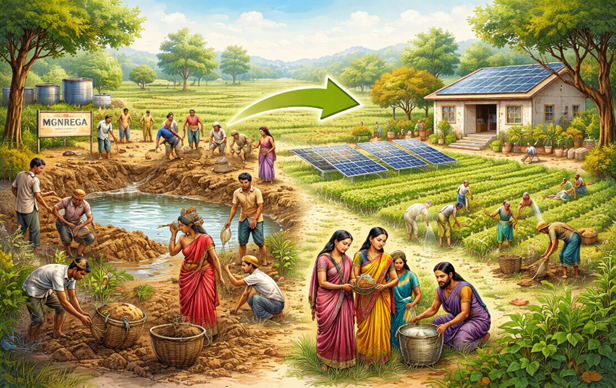
After reading this article you can solve this UPSC Model question-
The transition from MGNREGA to the VB-G RAM G Bill, 2025, signifies a fundamental shift from a demand-driven 'rights' framework to a supply-linked 'mission' framework. Evaluate the potential of this reform in creating durable rural assets while addressing the fiscal and federal challenges it poses.250 words.
                                                                                                                 (GS-2 Governance)
BACKGROUND:
1. The Constitutional Philosophy
MGNREGA is the operationalization of the Directive Principles of State Policy (DPSP).
- Article 41: Mandates that the State shall, within its economic capacity, secure the “Right to Work” and public assistance in cases of unemployment.
- Article 21: The Supreme Court has often linked the “Right to Work” with the “Right to Life with Dignity,” as employment provides the means for a dignified existence.
- Article 243G: Empowers Panchayats to plan for economic development, which is the bedrock of MGNREGA’s decentralized implementation.
2. Historical Evolution (Pre-2005)
MGNREGA did not emerge in a vacuum; it was the culmination of multiple failed or partial schemes:
- 1970s (Maharashtra Model): The first “Employment Guarantee Scheme” (EGS) was launched in Maharashtra following a severe drought. Its success became the blueprint for a national law.
- 1980-90s: Schemes like the Jawahar Rozgar Yojana (JRY) and the Employment Assurance Scheme (EAS) were launched but suffered from “top-down” planning and middleman leakages.
- 2001: The Sampoorna Grameen Rozgar Yojana (SGRY) merged earlier schemes but remained “allocation-based”—meaning if the budget ran out, the work stopped.
3. The 2005 “Rights-Based” Paradigm Shift
In September 2005, the Parliament passed the National Rural Employment Guarantee Act (NREGA), which was renamed MGNREGA in 2009. Unlike its predecessors, it was an Act, not just a scheme.
4. Implementation Milestones (2006–2025)
- Phase I (Feb 2006): Launched in the 200 most backward districts.
- Phase II & III (2007-08): Expanded to all rural districts in India.
- 2011: Direct Benefit Transfer (DBT) was introduced to pay wages directly into bank accounts, curbing corruption.
- COVID-19 Pandemic (2020): Acted as a “lifeboat” for millions of migrant workers returning to villages, with the budget hitting a record ₹1.11 lakh crore.
- 2023-24: Introduction of the National Mobile Monitoring System (NMMS) for real-time digital attendance to prevent “ghost” workers.
- Dec 2025: Introduction of the VB-G RAM G Bill to transition the scheme into a “Mission-Mode” infrastructure framework.
Issues with MGNREGA:
While MGNREGA has been a “lifeboat” for the rural poor, especially during the pandemic, it faces a set of chronic and structural issues that have hampered its effectiveness. These challenges are often cited as the primary reason for the 2025 revamp via the VB-G RAM G Bill.
1. The Fiscal & Budgetary Crisis
- Budget Cuts: Despite being a demand-driven scheme, the budget allocation has seen a steady decline. In FY 2024-25, the allocation was significantly lower than the actual expenditure in previous years, leading to “negative balances” in several states.
- Material-Wage Ratio Mismatch: The Act mandates a 60:40 ratio (60% wage, 40% material). In many states, materials for durable assets are not procured on time because the Centre prioritizes wages, resulting in poor-quality, non-durable assets.
2. Wage-Related Issues
- Chronic Payment Delays: Though the Act mandates payment within 15 days, delays of months are common. This “Stage-2 delay” (at the Central government level) discourages workers from seeking work.
- Wages Below Market Rates: In many states, MGNREGA wages (approx. ₹230–₹370) are significantly lower than the Minimum Wage for agricultural labor or market rates. This has led to the “feminization” of MGNREGA, where men seek higher-paying private work while women take up MGNREGA.
- Inflation Indexing: Wages are linked to the CPI-AL (Agricultural Labour), which many experts argue does not accurately reflect the rising cost of rural living, unlike the CPI-Rural.
3. The “Digital Burden” and Exclusion
- ABPS (Aadhaar Based Payment System): Since January 2024, ABPS has been mandatory. While meant to curb “ghost workers,” it has excluded thousands whose Aadhaar details do not perfectly match their bank records or job cards (name spelling, etc.).
- NMMS App Glitches: The mandatory National Mobile Monitoring System (NMMS) app requires supervisors to upload geo-tagged photos of workers twice a day.
- Network Issues: In remote or tribal areas with poor connectivity, photos fail to upload, leading to rejected attendance and zero pay for a full day’s work.
- Hardware Lack: Many supervisors (Gram Rojgar Sahayaks) do not have high-quality smartphones capable of running the heavy app.
4. Administrative and Quality Issues
- Creation of “Ghost Assets”: Corruption at the Panchayat level sometimes leads to the recording of assets (like a pond or road) that exist only on paper.
- Poor Planning: Works are often planned in a “siloed” manner without convergence with other schemes like the Pradhan Mantri Awas Yojana (PMAY) or Swachh Bharat, leading to fragmented infrastructure.
- Weak Social Audits: Although mandatory, many states have not yet established independent Social Audit Units. In states where they exist, audit findings are rarely acted upon by local officials.
How Vb-G Ram G Bill Can Solve The Issue Of MGNAREGA:
The Viksit Bharat — Guarantee for Rozgar and Ajeevika Mission (Gramin) (VB-G RAM G) Bill, 2025 is designed as a “legal reset” to fix the structural and operational inefficiencies that plagued MGNREGA for two decades.
Key Provision of the Bill
1. Expanded Statutory Guarantee (125 Days)
- The Provision: The Bill statutorily guarantees 125 days of unskilled manual work per financial year to every rural household, an increase from the 100 days mandated under MGNREGA.
- Significance: It acknowledges the rising aspirations of rural households and seeks to provide an additional 25% income floor. While MGNREGA allowed “not less than 100 days,” the system often treated it as a cap; the new Bill makes 125 days the legal standard.
2. The “Agricultural Pause” (60-Day Moratorium)
- The Provision: State governments can now notify a “pause” in public works for a total of 60 days in a financial year, coinciding with peak sowing and harvesting seasons.
- Rationale: This directly addresses long-standing complaints from the farming community regarding “labor crowding-out.” By halting government-guaranteed work during peak farm periods, it ensures the availability of agricultural labor and prevents artificial wage inflation for farmers.
- Flexibility: Notifications can be specific to agro-climatic zones, districts, or even blocks, ensuring the pause matches local cropping cycles.
3. Shift to “Normative Allocation” (Budgetary Reform)
- The Provision: The Bill replaces the open-ended, demand-driven “Labour Budget” with “State-wise Normative Allocations.” The Central Government will determine fixed annual funding for each state based on objective parameters.
- Impact: Under MGNREGA, the Centre was legally bound to provide funds as demand arose. Now, the Centre sets a limit; any expenditure exceeding this normative allocation must be borne entirely by the State Government.
4. Shared Funding Model (Centrally Sponsored Scheme)
- The Provision: The funding structure has changed from the Centre bearing 100% of unskilled wages to a 60:40 (Centre:State) split for most states.
- 90:10 for North-Eastern and Himalayan States.
- 100% Central funding for Union Territories without legislatures.
- Rationale: To instill “cooperative federalism” and ensure states have “skin in the game,” encouraging better monitoring and curbing of leakages.
5. Viksit Bharat National Rural Infrastructure Stack
- The Provision: All rural works will now be integrated into a unified digital framework called the Infrastructure Stack, aligned with the PM Gati Shakti National Master Plan.
- Four Priority Verticals: To prevent the creation of “non-durable” assets (like temporary pits), the Bill limits works to:
- Water Security: Rejuvenation of ponds (Amrit Sarovars), check dams, and irrigation canals.
- Core Rural Infrastructure: Roads, connectivity, and foundational village assets.
- Livelihood Assets: Warehouses, cold storages, and market sheds.
- Climate Resilience: Flood drainage and disaster-mitigation works.
Impacts:
1. Economic Impact
- Boost to Household Income: Increasing the guarantee from 100 to 125 days provides a 25% potential hike in the annual wage floor for rural families. This is crucial for smoothing consumption during lean periods.
- Rural Demand Stimulus: Enhanced income leads to higher liquidity in the rural market, potentially boosting the FMCG, tractor, and two-wheeler sectors.
- Fiscal Decentralization (and Stress): By moving to a 60:40 cost-sharing model, states now have a direct financial stake.
- Inflation Control: The 60-day pause prevents artificial wage spikes during peak seasons, helping to stabilize food production costs and curb “food inflation” driven by high farm labor costs.
2. Impact on Agriculture
- Labor Rebalancing: The seasonal moratorium solves the “Labor Crowding-out” issue. It ensures that when farmers need hands for sowing or harvesting, workers are not diverted to digging trenches for the government.
- Water Security: With “Water” as a primary vertical, the creation of Amrit Sarovars and check-dams directly improves groundwater levels, enabling multi-cropping and increasing farm yields.
- Reduced Post-Harvest Losses: Focus on “Livelihood Infrastructure” (cold storages and drying yards) helps farmers store produce longer, preventing “distress sales.”
3. Impact on Infrastructure (The “Durable Asset” Shift)
- Asset Quality: Unlike MGNREGA’s often temporary “kucha” works, the integration with PM Gati Shakti ensures that assets like rural roads and community centers are permanent and strategically located.
- Climate Resilience: The mandate for disaster-mitigation works (like flood-drainage and soil conservation) helps rural communities withstand the increasing frequency of extreme weather events.
4. Social and Rights-Based Impact
- Empowerment of Vulnerable Groups: The Bill introduces Special Schedules of Rates for women, the elderly, and persons with disabilities, recognizing that their output might differ and ensuring they aren’t excluded due to rigorous physical targets.
- Digital Inclusion vs. Exclusion: Biometric and AI-driven systems reduce corruption (leakages).
5. Modern Digital Governance & Transparency
- Biometric & AI Integration: The Bill mandates biometric authentication for attendance and uses AI-enabled analytics for fraud detection and risk mitigation.
- Weekly Payment Cycle: Unlike the 15-day cycle of MGNREGA, the Bill aims for weekly wage payments, improving liquidity for the rural poor.
- Public Disclosure: Mandatory weekly public disclosure of data at the Panchayat level to ensure real-time accountability.
Challenges of the VB-G RAM G Bill:
1. Fiscal and Federal Challenges
The most contentious issue is the shift from a Central Sector type funding (where the Centre paid 100% of unskilled wages) to a Centrally Sponsored Scheme (CSS) model.
- Financial Burden on States: The 60:40 cost-sharing ratio (for general category states) places a heavy fiscal load on states already struggling with revenue deficits. Economically backward states like Bihar, Jharkhand, and Odisha, which have the highest demand for rural work, may find it impossible to provide their 40% share, leading to a “funding crunch” at the ground level.
- The “Normative Allocation” Trap: Unlike MGNREGA’s demand-driven funding, the new Bill uses a capped “Normative Allocation.” If a state experiences a local disaster (like a drought or flood) and demand spikes, the Centre is not legally bound to provide more funds. The state must bear 100% of any expenditure above the pre-set cap.
- Inter-State Disparity: States that are fiscally stronger might implement the scheme better, while poorer states might “soft-pedal” the guarantee to save costs, worsening regional inequality.
2. Legal and Rights-Based Concerns
Critics argue that the Bill dilutes the fundamental “Right to Work” established by the 2005 Act.
- Supply-Driven vs. Demand-Driven: Under MGNREGA, work was a legal entitlement—if you asked for it, the government had to provide it. The new Bill prioritizes “Viksit Gram Panchayat Plans.” If a worker’s need does not fit into the “pre-approved” infrastructure stack, work may be denied.
- Centralized “Switch-Off” Power: Section 5(1) of the Bill reportedly allows the Central Government to notify specific “rural areas” where the Act applies. This raises fears that the Centre could selectively “switch off” the scheme in certain districts or opposition-ruled states, turning a universal right into a discretionary benefit.
3. Implementation and Operational Hurdles
The “tech-first” approach of the Bill brings its own set of practical difficulties.
- The “Double Burden” of the Agricultural Pause: While the 60-day pause helps farmers, it creates a shorter window (only 300 days) for workers to complete their guaranteed 125 days of work. This could lead to massive overcrowding at worksites during the non-pause months.
- Digital Exclusion & Connectivity: The mandate for Biometric Authentication and GPS-based tracking assumes seamless rural internet. In many “shadow areas” (hilly or remote regions), workers risk losing wages simply because the server was down or their fingerprints didn’t scan—a phenomenon already seen with the NMMS app.
- Loss of Local Autonomy: By narrowing permissible works to four specific verticals (water, infrastructure, livelihoods, and climate), the Gram Sabhas lose the flexibility to address unique local needs that don’t fall into these “national priorities.”
Way Forward:
1. Fiscal Smoothing and Transitional Support
The shift to a 60:40 funding ratio is the biggest hurdle for federal cooperation.
- Gramin Transition Grants: The Centre should provide special “bridging grants” for the first three years to help fiscally stressed states like Bihar, Odisha, and West Bengal adjust to the new 40% wage liability.
- Finance Commission Alignment: The 16th Finance Commission should consider “Rural Employment Indicators” as a criterion for horizontal tax devolution, rewarding states that effectively implement the 125-day guarantee.
- Contingency Fund for Distressed States: A “National Rural Distress Fund” should be created, where the Centre reverts to 100% funding during times of officially notified national disasters or droughts, bypassing the “Normative Allocation” caps.
2. Strengthening Grassroots Democracy (Decentralized Planning)
The “Infrastructure Stack” should not stifle local innovation.
- Hybrid Planning Model: Gram Sabhas should retain absolute authority over 30% of the village fund for “Local Priority Works” that may not fall under the four national verticals.
- Viksit Panchayat Digital Literacy: To prevent a “bureaucratic takeover” of planning, a massive training drive is needed for Gram Panchayat members to use the PM Gati Shakti and spatial planning tools effectively.
3. Human-Centric Technology Implementation
Technology must be an “enabler,” not an “excluder.”
- Offline-First Mode: Biometric and GPS systems must allow for “offline-caching” to ensure that workers in hilly or “shadow zones” (like Chhattisgarh or Ladakh) can mark attendance even without live internet, with data syncing once they reach a network.
- The “Zero-Tolerance” Grievance Redressal: A dedicated Weekly Ombudsperson at the Block level should have the power to override tech-based rejections (like fingerprint mismatches) based on physical verification.
4. Dynamic and Flexible Agricultural Pauses
A “one-size-fits-all” 60-day pause could be disastrous for varied cropping patterns.
- Micro-Zonal Notifications: Instead of state-wide notifications, the authority to trigger the 60-day agricultural pause should lie with the Gram Sabha or Block Development Officer, ensuring it aligns exactly with the local sowing/harvesting weeks.
- Voluntary Labor Pool: Create a “Farm-Support Labor Portal” where workers during the pause can be matched with local farmers seeking labor, ensuring a smooth transition between public works and private farm jobs.
Conclusion:
The VB-G RAM G Bill represents a shift from a “social safety net” to an “economic growth engine.” While the increase to 125 days is a welcome expansion of benefits, the success of this reform will depend on balancing central digital control with the federal autonomy of states and the grassroots needs of workers.