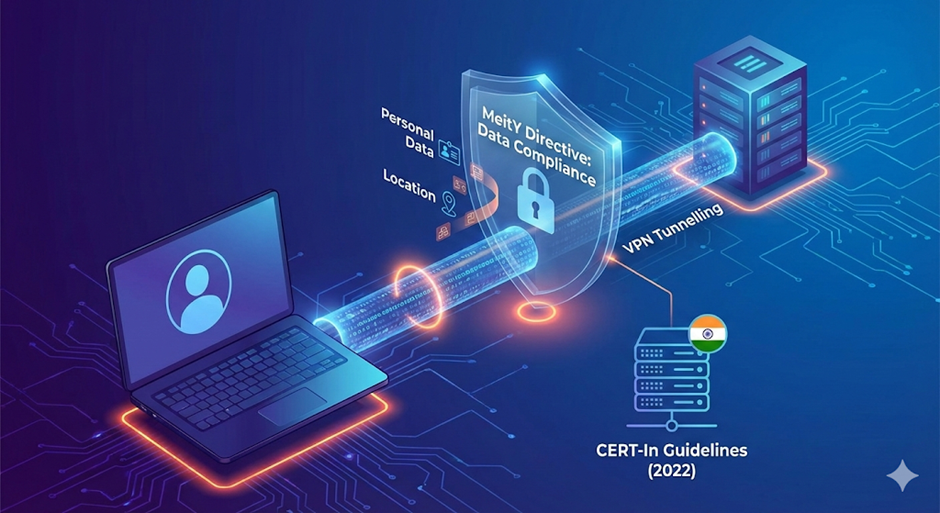
The Ministry of Electronics and Information Technology (MeitY) has issued a strict advisory to Virtual Private Network (VPN) providers, directing them to block websites that are leaking the personal data of Indian citizens.
The Current Directive
- Issuing Body: The Ministry of Electronics and Information Technology (MeitY).
- The Order: Directed Virtual Private Network (VPN) providers to block access to websites that are leaking sensitive personal data (names, locations, mobile numbers) of Indian citizens.
- Objective: To curb the misuse of leaked data that allows the tracking of individuals via phone numbers or addresses.
What is a VPN?
- A Virtual Private Network (VPN) is a technology that establishes a secure, encrypted connection (a “tunnel”) between a user’s device and a remote server owned by the VPN provider.
- It masks the user’s actual Internet Protocol (IP) address, replacing it with the IP address of the VPN server.
2. How does it work?
- Encryption: It scrambles data into unreadable code, ensuring that Internet Service Providers (ISPs) or third parties cannot monitor the user’s browsing activity.
- Location Spoofing: By routing traffic through a server in a different country, it allows users to bypass geo-restrictions and censorship.
3. Why is it used?
- Privacy: To prevent tracking by ISPs, advertisers, and surveillance agencies.
- Security: To protect data when using public Wi-Fi networks.
- Access: To access content blocked in specific geographic regions.
Key Terms
- Virtual Server: A server that appears to be in one location (e.g., India) to the user, but is physically located in another country (e.g., Singapore).
- Split Tunneling: A feature in some VPNs allowing users to route some traffic through the VPN while letting other traffic access the internet directly.
- Deep Packet Inspection (DPI): A method used by ISPs/Governments to detect and block VPN traffic.
Q. With respect to the technical components of Virtual Private Networks (VPNs) mentioned in the article, consider the following statements:
- Split Tunneling allows a user to simultaneously route some internet traffic through an encrypted VPN connection while other traffic accesses the internet directly.
- A Virtual Server must be physically located within the same geographic jurisdiction that its IP address represents to the user.
- Deep Packet Inspection (DPI) is a tool primarily used by VPN providers to enhance the encryption standards of their tunnels.
How many of the statements given above are correct?
(a) Only one
(b) Only two
(c) All three
(d) None
Answer: (a)
Statement 1 is correct. Split Tunneling is a feature that allows users to choose which traffic goes through the VPN and which uses the direct internet connection.
Statement 2 is incorrect. According to the article, a Virtual Server can appear to be in one location (e.g., India) while being physically located in another country (e.g., Singapore).
Statement 3 is incorrect. Deep Packet Inspection (DPI) is a method used by ISPs or governments to detect and block VPN traffic, rather than a tool used by VPN providers to improve encryption.