After reading this article you can solve this UPSC Mains Model question
Discuss the significance of transitioning from a linear to a circular economy model in addressing urban waste management in India. (GS-3, Environment)
Context:
- Scale of the problem: India generates roughly 62 million tonnes of municipal solid waste annually, but only about 25-30% is scientifically treated.
- Urban vs. Rural footprint: Urban residents consume nearly double the resources per person compared to rural citizens, leading to a disproportionate per capita waste output.
Shift to a Circular Economy:
- Circular Economy defined: A systemic approach to economic development designed to benefit businesses, society, and the environment by decoupling economic activity from the consumption of finite resources.
- The Strategic Pillars:
- Redesign: Products should be made to last longer and be easily dismantled.
- Recycle: Practical near-term strategy given current consumerist lifestyles where “reuse” is declining.
- Waste-to-Wealth: Treating organic waste to produce biogas (Bio-CNG) and compost.
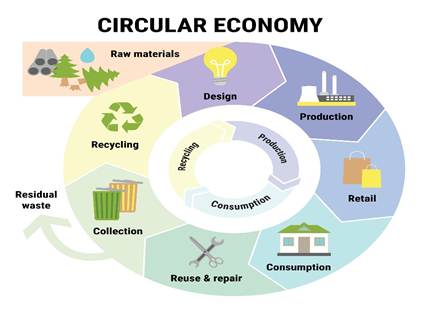
Sector-Specific Waste Challenges:
1. Plastic Waste: The “Reporting & Traceability” Gap
While India has a high recycling rate for plastic compared to global averages, it faces systemic hurdles in data and enforcement.
- EPR Reporting Gap: There is a significant discrepancy between “reported” waste and “estimated” generation. Actual plastic output is estimated at 0.54kg/person/day, while official records often capture far less.
- The “Fake Certificate” Crisis: The system faced a setback when several firms were found trading fraudulent Extended Producer Responsibility (EPR) certificates. In response, the CPCB launched a Blockchain-based tracking portal in late 2025.
- Eco-Modulated Fees: Starting this year, EPR fees are being “eco-modulated”—meaning producers using non-recyclable multi-layered plastics (MLP) pay higher penalties than those using mono-materials.
2. Construction & Demolition (C&D) Waste: The New EPR Frontier
- The 2025 Rules: New Environment (Construction and Demolition) Waste Management Rules replace the 2016 framework.
- Mandatory Recycled Content: Large-scale projects (over 20,000 sq m) must now ensure that at least 5% of their materials (bricks, aggregates) are sourced from recycled C&D waste, increasing to 25% by 2030.
- C&D Hubs: To solve the land crisis, cities are moving toward a “Hub and Spoke” model—centralized processing plants that serve several surrounding municipal wards.
3. Electronic Waste (E-waste): Longevity vs. Obsolescence
India is the world’s third-largest E-waste generator, with volumes surging by over 70% in the last five years.
- Planned Obsolescence: Devices are increasingly designed with non-removable batteries and soldered parts, making repair nearly impossible.
- Right to Repair Movement: The government has introduced a “Repairability Index” (similar to the EU model). Products are now rated on a scale of 1–10 based on the availability of spare parts and repair manuals.
- Critical Mineral Recovery: “Urban Mining,” where recyclers are incentivized to recover Lithium, Cobalt, and Rare Earth metals to support India’s EV battery goals.
4. Biomedical & Hazardous Waste
- Micro-Incineration: Small towns are being encouraged to use mobile, high-temperature micro-incinerators to treat biomedical waste locally, avoiding the risks of long-distance transport.
- Industrial Symbiosis: Hazardous waste from one industry (like fly ash from power plants) is being “synergized” as raw material for others (cement manufacturing), a core tenet of the 2025 Draft Solid Waste Rules.
Systemic Barriers and Governance Gaps:
1. Financial Barriers: The “Municipal Deficit”
Urban Local Bodies (ULBs) in India are often financially crippled, making them the “weakest link” in the waste chain.
- The Funding Gap: Municipalities often receive only 75–80% of the budget required for waste concessionaires. This leads to “service breakdowns” where garbage remains uncollected for days due to unpaid contractors.
- User Fee Apathy: There is significant “public apathy” toward paying waste collection fees. Most ULBs rely on state/central grants rather than a self-sustaining “Polluter Pays” revenue model.
- Performance-Linked Disbursals: Under SBM-U 2.0, central funds are now performance-linked. While intended to improve efficiency, it often penalizes smaller, under-resourced municipalities that cannot meet the initial milestones to unlock more cash.
2. Institutional Gaps: Fragmented Accountability
- The “Paper-Only” Plan: Most cities have Solid Waste Management (SWM) plans, but they lack spatial data (GIS mapping). Without knowing where the waste is generated in real-time, route optimization remains a theory.
- Weak Enforcement: The 2016 SWM Rules are comprehensive but poorly enforced. The article highlights that over 70% of banned single-use plastic items still circulate because local inspectors lack the “political will” or manpower to shut down manufacturing hubs.
- Inter-Agency Friction: Waste management often overlaps between Municipal Corporations, Pollution Control Boards (SPCBs), and Urban Development Departments, leading to “blame-shifting” when targets (like clearing legacy dumpsites) are missed.
3. The Informal Sector Paradox
Approximately 1.5 to 2 million informal waste pickers handle 60% of India’s recycling, yet they remain “systemically invisible.”
- Displacement by Privatization: As cities move toward high-tech “Waste-to-Energy” (WtE) plants through private players, informal pickers are often banned from dumpsites, losing their livelihoods.
- Social Stigma & Health: Despite their role as “Green Technicians,” they lack legal identity cards, social security, and health insurance, making them vulnerable to hazardous working conditions and exploitation.
- Missing EPR Coverage: The Extended Producer Responsibility (EPR) framework is largely designed for formal recyclers, leaving the informal army out of the financial incentive loop.
The “Satara Model” and Urban-Rural Partnerships:
1. The Satara Model: Specialized Segregation
The core of the Satara (Karad) model is its focus on “Niche Waste Streams” that are often ignored in general garbage collection:
- 100% Sanitary & Biomedical Segregation: Karad became the first modest-sized Indian city to achieve total segregation and processing of sanitary and biomedical waste.2
- The “Red Bin” System: Dedicated red bins are installed in public toilets and on garbage collection vehicles. This prevents hazardous waste (like masks, syringes, and sanitary products) from contaminating the dry/wet waste streams.
- High-Temperature Incineration: Instead of dumping, this waste is sent to a Common Biomedical Waste Treatment Facility (CBWTF) where it is oxidized at 1200degreeC, reducing it to harmless ash and ensuring no pathogens enter the environment.
2. Urban-Rural Partnerships: A Symbiotic Loop
A major “Governance Gap” in India is that small Urban Local Bodies (ULBs) often lack the land for treatment plants, while rural Panchayats lack the funds. The Satara model bridges this through Inter-governmental Partnerships:
A. The “Hub and Spoke” Infrastructure
- The Hub (Urban): The city (like Karad or Satara) hosts the high-tech processing unit (e.g., a Bio-CNG plant or a plastic pyrolysis unit).
- The Spoke (Rural): Nearby Gram Panchayats collect their dry waste and transport it to the urban “Hub.”
- Benefits:Villages get a scientific end-destination for their plastic and hazardous waste, preventing open burning in fields.
- Cities get a higher volume of waste, which makes their processing plants financially viable (economies of scale).
B. Shared Financial Burden
- The article mentions that in these partnerships, the tipping fee (processing cost) is often subsidized or waived for rural areas in exchange for the urban center retaining the revenue from the “Waste-to-Wealth” products (like compost or recycled pellets).
- Informal Sector Inclusion: These partnerships often employ Women’s Self-Help Groups (SHGs) from both urban and rural areas, providing them with “Green Jobs” as waste auditors and plant operators.
Way Forward: A “Jan Andolan” (People’s Movement):
1. Beyond Technology: The “Behavioral First” Approach
The article notes that India has some of the world’s most advanced Waste-to-Energy (WtE) and Bio-CNG plants, yet many operate under capacity or fail entirely.
- The Problem: Mixed (unsegregated) waste contains “inerts” like sand and stones. When fed into incinerators, these reduce the caloric value, leading to plant breakdowns.
- The Solution: The Jan Andolan focuses on Source Segregation (Dry, Wet, and Sanitary/Hazardous) as a non-negotiable civic duty. Without the “people’s participation” at the kitchen level, the industrial level cannot function.
2. Institutionalizing the Movement
A. The “Nudge” Economics
- Property Tax Rebates: Cities like Indore and Surat have experimented with offering 2–5% rebates on property taxes for households that compost their own wet waste or maintain 100% segregation.
- Public Shaming vs. Recognition: Using “Green Star” ratings for residential societies to foster healthy competition between neighborhoods.
B. Integrating the “Harbingers” of the Movement
- Formalizing Waste Pickers: The Jan Andolan must include the integration of the informal sector. By issuing ID cards and providing health insurance, the government transforms “rag-pickers” into “Swachhata Mitras” (Friends of Cleanliness).
- Role of SHGs: Leveraging Women’s Self-Help Groups for door-to-door awareness and collection, as seen in the success of the Kudumbashree model in Kerala.
3. Transparency and the “Audit” Culture
- Real-time Dashboards: Making waste collection data public so citizens can see if their ward’s waste is actually being treated or just dumped.
- Social Audits: Empowering Ward Committees to audit the performance of private waste contractors, ensuring that the “taxpayer’s money” is being used for scientific treatment, not just transportation.
Conclusion:
“The success of Swachh Bharat Mission 2.0 by the end of 2026 hinges not on the number of trucks purchased, but on the number of minds changed. A ‘Jan Andolan’ for waste management represents the transition from ‘Government-led cleaning’ to ‘Citizen-led sustainability,’ fulfilling the constitutional duty under Article 51A(g) to protect and improve the natural environment.”