Why in the News?
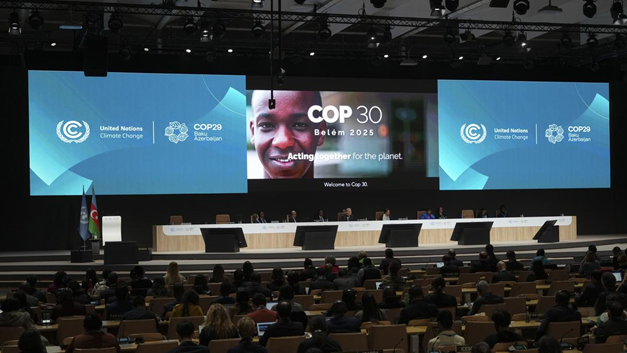
South Asian countries and civil society groups have presented a unified set of priorities and expectations ahead of COP30. Being one of the most climate-vulnerable regions in the world, South Asia is urging global negotiators to move beyond promises and deliver concrete action on adaptation finance, predictable funding, technology transfer, and regional cooperation. The article highlights the key demands emerging from consultations across Bhutan, Nepal, Maldives, Sri Lanka, and Bangladesh.
Background / Context
- South Asia, home to nearly two billion people, faces multiple climate threats — monsoon floods, landslides, heatwaves, glacial lake floods, and coastal erosion.
- Despite global commitments under the Paris Agreement and Nationally Determined Contributions (NDCs), implementation gaps persist, particularly in climate finance and adaptation support.
- The consultations revealed a collective regional stance focused on operational clarity, accountability, and a stronger regional framework for addressing shared climate challenges.
- Small island nations and developing economies in the region are increasingly taking the lead, driven by necessity rather than capacity, to safeguard their people and ecosystems.
Key Priorities and Demands
- Predictable and Scaled Adaptation Finance
- South Asia calls for urgent scaling up of adaptation finance, emphasizing that global pledges like the Baku to Belém Roadmap target of $1.3 trillion must have clear delivery pathways.
- Without operational clarity, targets such as the $300 billion adaptation goal by 2035 remain symbolic.
- The region seeks a tripling of adaptation finance, prioritizing concessional and grant-based mechanisms for the Least Developed Countries (LDCs).
- Strengthening Regional Cooperation and Shared Solutions
- Regional collaboration is essential for sharing knowledge, aligning priorities, and promoting technology-driven solutions.
- Initiatives like India’s Coalition for Disaster Resilient Infrastructure (CDRI) and Nepal’s Sagarmatha Sambad show the potential of collective action.
- Cross-border issues such as Himalayan glacier melt, coastal erosion, and river basin management require joint regional strategies.
- Mainstreaming Adaptation and Local Ownership
- Local institutions must have the technical, institutional, and financial capacity to implement adaptation plans.
- Adaptation should be integrated into national and sub-national development planning rather than treated as a separate agenda.
- Blending scientific research with community-based traditional knowledge can ensure more durable and inclusive outcomes.
- Mobilising Private and Non-State Finance
- The article proposes creating a South Asian Resilience Finance Facility with dedicated regional allocations from multilateral funds such as the Green Climate Fund, Loss and Damage Fund, and Adaptation Fund.
- Encouraging private sector and sub-national actors to invest in adaptation can fill the gap left by limited public budgets, provided there is accountability and alignment with domestic needs.
- Enhancing Technology Access and Digital Infrastructure
- Simplifying access to climate finance and technology through low-transaction, non-debt-inducing instruments is a key demand.
- The region seeks greater cooperation in digital tools — remote sensing, AI, blockchain, and public digital infrastructure — to improve data-driven climate action.
- Current international technology transfer systems often exclude smaller economies; South Asia demands equitable and affordable access.
- Inclusion, Accountability, and Multi-Actor Participation
- Active engagement of civil society, youth, academia, and private businesses is essential for innovation and transparency.
- Regional platforms should document and disseminate best practices through regular independent assessments.
- Accountability mechanisms within multilateral climate governance must ensure that commitments translate into measurable outcomes.
- Region-Specific Vulnerabilities
- Himalayan region: Prone to glacial lake outburst floods and rising water stress.
- Indo-Gangetic plains & peninsular India: Increasing number of days exceeding 35°C — projected to double from 100 to 200 annually by 2100.
- Small island states (Maldives): Exposed to sea-level rise and saltwater intrusion.
- Bangladesh: Frequent cyclones, flooding, and land loss.
- Sri Lanka: Expanding drylands and worsening water scarcity.
Challenges in Implementation
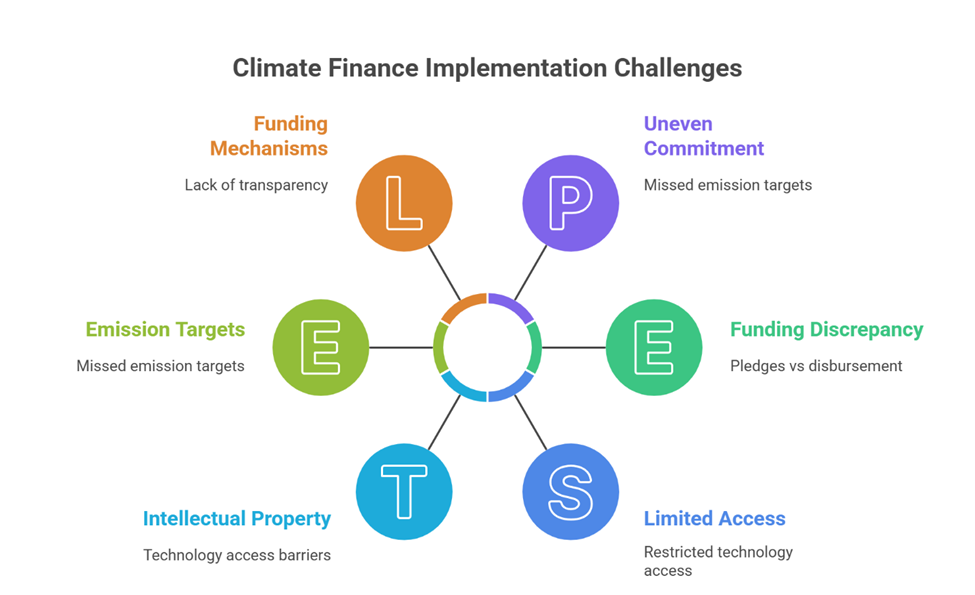
- Persistent gap between pledges and actual disbursement of climate finance.
- Lack of clarity, transparency, and accountability in existing global funding mechanisms.
- Uneven commitment from developed countries, many of which are not on track to meet 2030 emission or finance targets.
- Restricted technology access due to intellectual property barriers and high costs.
- Limited administrative capacity, governance bottlenecks, and high transaction costs in accessing multilateral funds.
- Over-reliance on loans rather than grants adds to the debt burden of vulnerable countries.
Way Forward
- Operational Clarity and Delivery Mechanisms
- Establish clear timelines, accountability frameworks, and measurable indicators for adaptation finance and technology transfer.
- Ensure finance is accessible, transparent, and prioritizes vulnerable communities.
- Regional Climate Cooperation
- Create a South Asian platform under existing regional groupings (BIMSTEC, SAARC, or BRICS) to coordinate cross-border action, data sharing, and joint research.
- Integration of Adaptation into Development
- Embed climate resilience in national and local development plans to align adaptation with growth and poverty reduction.
- Leveraging Private Sector and Innovation
- Mobilize private investment through blended finance models and innovation funds that support small enterprises and local technologies.
- Technology Partnerships
- Facilitate South-South cooperation and partnerships for affordable and context-specific technological solutions.
- Strengthening Accountability
- Develop a regional compendium of progress and best practices to evaluate outcomes annually, enhancing credibility and trust in multilateral processes.
Conclusion
South Asia’s unified voice at COP30 reflects a pragmatic and collaborative approach, grounded in the realities of its climate vulnerabilities. The region is not merely asking for new promises but demanding delivery — predictable finance, transparent governance, inclusive technology access, and genuine multilateral accountability. For a region bearing the brunt of global climate disruption, these steps are essential to ensure that climate justice moves from rhetoric to tangible action.
UPSC CSE PYQ
| Year | Question Text |
| 2023 | The Intergovernmental Panel on Climate Change (IPCC) has predicted a global sea-level rise of about one metre by AD 2100. What would be its impact in India and the other countries in the Indian Ocean region? |
| 2023 | Discuss the consequences of climate change on the food security in tropical countries. |
| 2022 | Discuss global warming and mention its effects on the global climate. Explain the control measures to bring down the level of greenhouse gases which cause global warming in the light of the Kyoto Protocol, 1997. |
| 2020 | How will the melting of Himalayan glaciers have a far-reaching impact on the water resources of India? |