Context
Recently, a groundbreaking study published in the journal Science Advances has challenged long-standing beliefs about why birds move up and down mountains. While it was previously assumed that birds migrate primarily to “track” specific temperatures they are adapted to, researchers from the University of East Anglia (UK) and other global institutions have found that energy efficiency—the optimization of food intake against energy expenditure—is the true driver of seasonal mountain migration.
1. What is Elevational Migration?
Elevational (or altitudinal) migration refers to the seasonal movement of animals, particularly birds, up and down mountain slopes.
- Summer: Birds typically move to higher elevations to exploit seasonal flushes of food (insects/fruits) and find breeding grounds.
- Winter: They descend to lower, more productive elevations to escape harsh conditions and resource scarcity at the summits.
2. The New Paradigm: Energy Efficiency vs. Temperature
- Traditional View: Birds are “climate trackers” who stay within a narrow temperature range (thermal niche) to which they are evolutionarily adapted.
- The New Finding: The study analyzed 34 mountain regions and nearly 11,000 avian populations. It revealed that many birds move against the temperature gradient (moving into cooler areas during winter) if that is where resources are most abundant.
- Core Driver: The movement is a strategic choice to optimize their energy budget. Birds prioritize areas with high food availability and low competition from other species, even if the temperature is not “ideal.”
3. The SEDS Model (Seasonally Explicit Distributions Simulator)
Researchers utilized the SEDS model to simulate how birds should be distributed if they were perfectly optimizing their energy.
- The model starts with an “empty mountain” and adds bird populations one by one based on where they can find the most food with the least effort.
- The simulation matched real-world bird distribution patterns in 28 out of 34 mountain ranges studied, confirming that energy optimization is a global biological pattern.
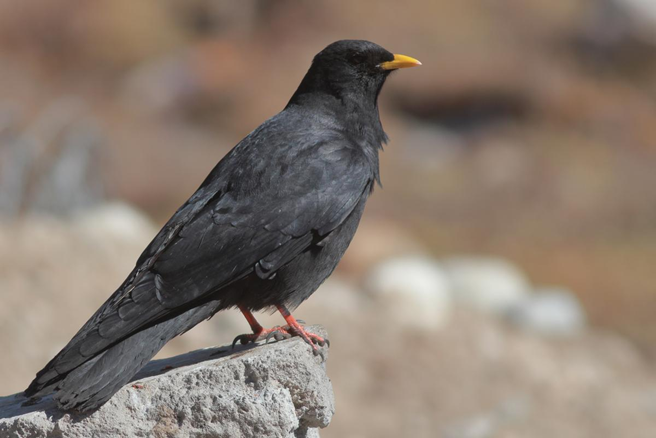
4. Case Study: The Yellow-billed Chough (Alpine Chough)
- Scientific Name: Pyrrhocorax graculus.
- Habitat: High-altitude specialist found in the Himalayas (including North Sikkim), Alps, and Central Asia.
- Specialty: It is known to nest at higher altitudes than almost any other bird (up to 6,500m).
- Dietary Shift: In summer, they feed on invertebrates at high elevations; in winter, they shift to fruits or human-provided food at lower elevations/tourist sites to maintain their energy balance.
- IUCN Status: Least Concern.
Conservation and Climate Change Implications
- Habitat Management: Understanding that birds follow “resources” rather than just “cold air” helps conservationists protect specific foraging corridors.
- Agricultural Impact: Changes in land use (like farming at mid-elevations) can disrupt the energy budgets of migrating birds by altering food availability.
- Climate Predictions: The study predicts an average upslope shift of ~129 meters by the year 2100 due to climate change, not just because of heat, but because primary productivity (plants and insects) will shift higher.
Q. With reference to the 'Elevational Migration' of birds, consider the following statements:

1. It involves the seasonal movement of birds between different latitudes, such as the migration of the Arctic Tern.

2. The "Energy Efficiency" hypothesis suggests that birds move primarily to optimize their food intake and energy expenditure rather than simply tracking temperatures.

3. The Yellow-billed Chough, a common high-altitude resident of the Himalayas, is listed as 'Critically Endangered' on the IUCN Red List.

Which of the statements given above is/are correct?
(a) 1 and 2 only
(b) 2 only
(c) 1 and 3 only
(d) 2 and 3 only

Solution:
Correct Answer: (b)

• STATEMENT 1 IS INCORRECT: Seasonal movement between latitudes is called Latitudinal Migration. Elevational migration specifically refers to movement up and down mountain slopes.

• STATEMENT 2 IS CORRECT: As per the latest research, birds migrate to optimize their energy budgets (balancing food availability and competition) rather than just staying in a specific temperature zone.

• STATEMENT 3 IS INCORRECT: The Yellow-billed Chough (Pyrrhocorax graculus) is listed as 'Least Concern' on the IUCN Red List, as it is widespread and abundant across several mountain ranges.