On January 3, observers across the globe witnessed the full “Wolf Moon,” a celestial phenomenon during which the Moon appeared significantly larger and brighter than usual.
What is Full Moon?
A Full Moon occurs when the Earth lies between the Sun and the Moon, allowing the Moon’s near side to be completely illuminated.
It represents one of the primary phases of the lunar cycle, occurring roughly every 29.5 days (synodic month).
During a Full Moon, the Moon rises around sunset and sets around sunrise, remaining visible throughout the night.
Full Moons play an important role in tidal variations, contributing to spring tides due to the alignment of the Sun, Earth, and Moon.
Many Full Moons have traditional names (e.g., Wolf Moon, Harvest Moon), reflecting seasonal and cultural associations.
Why the ‘Wolf Moon’?
The Wolf Moon is the traditional name for the full Moon occurring in January.
The name originates from Native American, Anglo-Saxon, and European folklore, where winter months were associated with howling wolves roaming near human settlements due to scarcity of food.
It is part of a system of seasonal full Moon names (e.g., Harvest Moon, Snow Moon) used to track time before modern calendars.
Why is it called a ‘Wolf Supermoon’?
A Wolf Supermoon occurs when the January full Moon coincides with a supermoon.
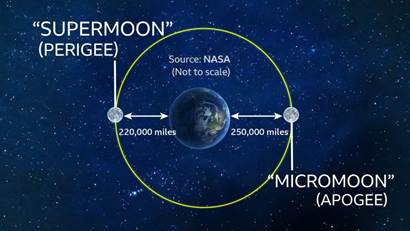
The Moon revolves around the Earth in an elliptical orbit, rather than a perfectly circular one, resulting in variations in its distance from Earth.
The point at which the Moon is closest to Earth is termed perigee, while its farthest point is known as apogee.
When a full Moon coincides with perigee, the event is scientifically referred to as a supermoon.
At perigee, the Moon is approximately 220,000 miles from Earth, compared to about 250,000 miles at apogee, making it appear larger and brighter in the night sky.
On average, three to four supermoons occur each year, rendering them relatively common, though the occurrence of four consecutive supermoons is uncommon.
Cultural Significance
Full moons have inspired art and folklore, with beliefs (though lacking scientific backing) about their influence on human behavior, sleep, and plant growth.
Consider the following statements regarding the Wolf Moon:
1. It is the first full Moon of the year.
2. Its name originates from folklore associating wolves with winter.
3. A Wolf Moon always coincides with a supermoon.

Which of the statements are correct?
(a) 1 and 2 only
(b) 1 and 3 only
(c) 2 and 3 only
(d) 1, 2, and 3

Answer: A

Explanation: The Wolf Moon is the first full Moon of January, named from winter folklore. It does not always coincide with a supermoon.