After Reading This Article You Can Solve This UPSC Model Question:
“Women farmers play a crucial role in India’s agri-food systems, yet they remain largely invisible in policy and land ownership.” Examine the challenges faced by women farmers in India and suggest measures to empower them. (15 Marks, GS-3 Agriculture)
Context
As The United Nations has declared 2026 as the International Year of the Woman Farmer. , the focus is on transforming these laborers into empowered entrepreneurs.
The Reality of Women in Agriculture
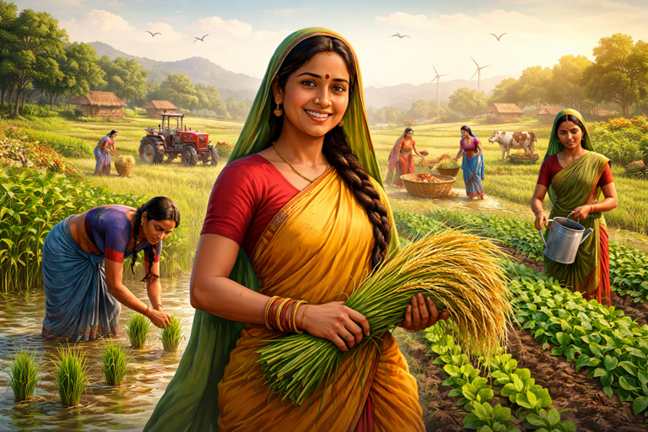
- Workforce Participation: Over 80% of economically active women in rural India are employed in agriculture.
- Labor Contribution: Women perform approximately 70% of all agricultural activities (sowing, weeding, harvesting, and post-harvest management).
- Ownership Gap: Despite their labor, only about 13.9% of operational landholdings are held by women (Agriculture Census).
- Productivity Potential: According to the FAO, if women had the same access to productive resources as men, they could increase yields on their farms by 20–30%.
- FLFPR Trend: The Economic Survey 2025-26 indicates a rise in Female Labour Force Participation Rate (FLFPR) to 42%, largely driven by the rural agricultural sector.
The Importance of Women Farmers in India
1. Nutritional Security & SDG 2 (Zero Hunger)
Women prioritize “Nutrition-Sensitive Agriculture.” Unlike commercial cash-cropping, women-led farms often focus on diverse food crops that directly impact the health of rural households.
Example: The “Nutri-Garden” (Poshan Vatika) initiative under the POSHAN Abhiyaan, where women grow green leafy vegetables and fruits to combat stunting and anemia in their families.
2. Conservation of Biodiversity & Indigenous Knowledge
Women act as the primary “Seed Keepers” of India. They possess specialized knowledge for selecting, treating, and storing traditional seeds that are often more resilient than high-yield varieties.
Example: Rahibai Popere (the “Seed Mother” of India), who was awarded the Padma Shri for conserving hundreds of native secondary landraces and promoting traditional seed banks.
3. Leadership in “Natural Farming” (BPKP)
Women are the natural pioneers of Bhartiya Prakritik Krishi Paddhati. Their traditional role in livestock management makes them experts in using organic inputs like Jeevamrut and Ghanajeevamrut.
Example: In Andhra Pradesh, the Community-Managed Natural Farming (APCNF) model has succeeded largely due to the participation of over 6 million women who transitioned away from expensive chemical fertilizers.
4. Pillars of the Rural Post-Harvest Economy
Women bridge the gap between the farm and the market by leading “Value Addition” activities, which prevents post-harvest losses and increases farm income.
Example: Women-led FPOs (Farmer Producer Organizations) in states like Madhya Pradesh and Maharashtra that process raw millets into “Ready-to-Eat” snacks, significantly increasing the profit margin compared to selling raw grain.
5. Resilience Against “Male Out-Migration”
As rural men migrate to urban centers for work, women have stepped up as the de facto managers of the entire farm ecosystem, ensuring national food production remains stable.
Example: In the Himalayan and Bihar regions, where male migration is highest, women have taken over “ploughing to peak-harvest” duties, preventing the “fallow land” crisis.
6. Technology Pioneers & Digital Inclusion
Women are breaking the “technological glass ceiling” in agriculture, proving that gender is not a barrier to adopting high-tech precision farming tools.
Example: The Namo Drone Didi Scheme, where thousands of women in Self-Help Groups (SHGs) are being trained to operate drones for precision spraying of pesticides and fertilizers, transforming them into “Agri-Technicians.”
Critical Challenges for Women Farmers
- Land Ownership & Legal Invisibility: Patrilineal inheritance ensures men hold the majority of titles; women own <14% of operational land. This lack of “Farmer” status creates a “recognition gap,” relegating them to “agricultural laborers” despite performing the bulk of the work.
- Credit & Insurance Exclusion: Banks mandate land as collateral, creating a “Collateral Barrier.” This denies women access to institutional credit and central safety nets like PM Fasal Bima Yojana, pushing them toward exploitative informal moneylenders.
- Technological & Drudgery Bias: Most farm machinery is designed for the male physique (“Gender-neutrality gap”). Lack of ergonomic, woman-friendly tools leads to high physical drudgery and chronic health issues, limiting productivity and mechanization.
- Structural Wage Disparity: A persistent Gender Pay Gap exists in the unorganized sector. According to PLFS 2025-26, women earn only 70-80% of male wages for identical labor, despite often working longer hours.
- Digital Divide & Info-Asymmetry: Limited access to smartphones and the internet creates a “Knowledge Gap.” Women are often excluded from e-NAM price discovery and “Lab-to-Land” extension services, which remain predominantly male-centric.
- “Time Poverty” (The Dual Burden): Rural women face a “Double Day”—balancing intensive farm labor with nearly 360 minutes/day of unpaid care work. This “Time Poverty” restricts their ability to attend training, engage in leadership, or access distant markets.
Key Government Initiatives for Women Farmers
- Namo Drone Didi: Empowering Women SHGs through 80% drone subsidies (up to ₹8 lakh) to transition from manual labor to high-tech Agri-Entrepreneurs.
- Lakhpati Didi Mission: Aiming to elevate 6 crore rural women to an annual income of ₹1 Lakh by 2029 through diversified SHG-led livelihoods.
- Krishi Sakhi Program (KSCP): Training women as certified para-extension workers (56-day module) to earn ₹60,000–80,000 annually by bridging the “Lab-to-Land” gap.
- Mahila Kisan Sashaktikaran Pariyojana (MKSP): A DAY-NRLM sub-component empowering 3.5 crore women in climate-resilient natural farming via community resource centers.
- Womaniya on GeM: Facilitating direct market linkage for 2 lakh women-led MSEs to secure government procurement orders worth over ₹80,000 crore.
- Gender Budgeting & Earmarking: Mandating 30% fund allocation in agriculture schemes (RKVY/MIDH) and providing 3% interest subvention via the Agriculture Infrastructure Fund.
Way Forward
1. Recognise Women as Farmers: Revive the spirit of the 2011 Women Farmers’ Entitlement Bill (proposed by MS Swaminathan) to create a legal framework that recognizes a “farmer” based on cultivation, not just land ownership.
2. Strengthen Land Rights: States should incentivize the registration of agricultural land in women’s names through Stamp Duty waivers (e.g., as seen in UP and Haryana) and promote Joint Titling.
3. Improve Access to Credit and Resources: Scaling “Livelihood Finance” through Joint Liability Groups (JLGs) to provide collateral-free institutional credit.
4. Promote Women-Centric Farmer Institutions: Strengthening Women-only FPOs (Farmer Producer Organizations) to eliminate middlemen and improve bargaining power in platforms like e-NAM.
5. Improve Technology and Extension Services: R&D by institutes like ICAR (Central Institute for Women in Agriculture) must prioritize the “feminization of tools”—creating lightweight, adjustable machinery (power tillers, weeders) suited for the female physique to reduce drudgery.
6. Nutrition-Sensitive Agriculture: Leveraging women’s expertise in Shree Anna (Millets) to lead India’s nutritional security and climate adaptation strategy.
Conclusion
Empowering women farmers via land rights and Agri-Tech is vital for Viksit Bharat @2047. As 2026 honors their leadership, integrating them into the digital value chain ensures a climate-resilient, food-secure future.